Our Python result covers committer tools, not a Kafka broker
The checkout at commit d12941e held 7,540 files and roughly 1,621,716 lines of source, but the automated path our lab identified was the Python project under committer-tools/. Apache Kafka itself is a distributed event-streaming platform written mainly in Java and Scala. That scope distinction decides how to read every result below: we learned something useful about the repository's maintainer utilities, not about broker startup, message delivery, or cluster behavior.
Kafka's root README describes data pipelines, streaming analytics, data integration, and other event-driven applications. The committer directory solves a narrower set of contributor chores. Its scripts find likely reviewers from Git history, refresh repository collaborators, locate tests that started without finishing, verify binary-license contents, update a cached branch, and guide authorized maintainers through pull-request merges. Those jobs matter inside the project, but an application developer can use Kafka without touching most of them.
The 87.1 MB checkout is a platform, not a Python package
Our clone occupied 87.1 MB before dependencies, and the source scan counted about 1.6 million lines. That is the whole Kafka repository around a small Python corner. The root instructions use Gradle for JARs, unit and integration tests, documentation, coverage, release archives, and code-quality checks. A buyer should expect a large multi-module JVM project, even though the sandbox found a quick Python install route.
The README's local broker sequence generates a cluster ID, formats storage with config/server.properties, and starts the server. It also points readers to a published Docker image for a quicker trial. Neither route was part of our measured run. We did not open port 9092, produce a record, add brokers, test failover, or measure latency. Any conclusion about those tasks would need another run built around Kafka rather than committer-tools/.
What happened when we ran it
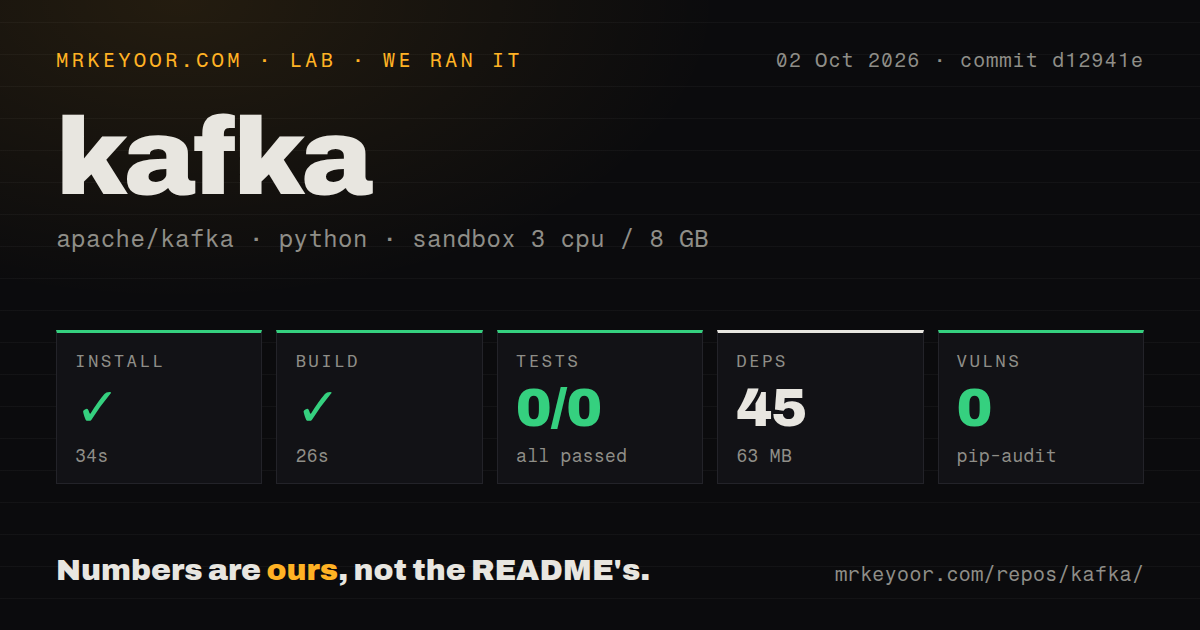
Our sandbox installed commit d12941e in 34 seconds, pulling 45 Python packages and using 63 MB on disk. The build finished successfully in 26 seconds. Our measurement setup was an unprivileged Debian container with 3 CPUs, 8 GB of RAM, Python 3.12, and no secrets. Pip-audit found 0 known vulnerabilities in the installed Python environment.
The test step failed after 10 seconds with exit code 5. Pytest reported 0 passed and 0 failed because it collected no tests, and the last line said, no tests ran in 0.00s. The repository scan did find a tests directory elsewhere in the 7,540-file checkout, but the Python command did not execute that wider Java and Scala suite. The log gives no basis for claiming a dependency problem or a code defect.
Those two successful steps are still useful. They show that the pinned Python dependencies installed and that the selected build action completed at d12941e. They do not create a passing test result, and they do not cover Kafka's Gradle tasks. For an adoption decision, keep the 34-second install in the maintainer-tool column and require a separate broker proof using your retention, partitioning, security, and failure-recovery requirements.
Six maintainer scripts require project context and write access
The committer-tools directory held 6 files that run as scripts, plus its README and requirements file. The dependency list itself is short, pinning PyGithub 2.4.0 and ruamel.yaml 0.18.6. The surrounding environment is less generic: the README calls for the GitHub CLI, and the collaborator refresher reads GITHUB_TOKEN before updating Kafka's local .asf.yaml file.
The reviewer helper can edit a pull request body through gh, while the merge helper fetches branches, creates commits, pushes to a configured remote, and can update ASF JIRA when credentials are present. These are deliberately privileged actions with interactive confirmations. They make sense for Kafka maintainers who know the project's branch and review rules. They are a poor fit for casual automation or a service account whose repository permissions have not been tightly scoped.
Java 17 and 25 matter more than the 34-second install
The 34-second Python install did not exercise the Java toolchain. Kafka's README says the project is built and tested with Java 17 and 25, with different release targets across clients, streams, and the rest of the modules. Scala 2.13 is the supported Scala line. The Python environment we measured cannot compile the broker, run the documented Gradle unit and integration tasks, or tell you whether your production JDK and build cache are set up correctly.
Operations add another layer beyond compilation. A meaningful evaluation should start brokers, create topics, exercise producers and consumers, and observe the exact failure cases your system must survive. Kafka may be a good answer when durable shared event streams justify that work. If you only need a small queue between two services, Apache Pulsar, Redpanda, and NATS are all worth comparing before accepting Kafka's larger operational surface.
Twenty CI workflows and October activity show current maintenance
Our scan counted 20 files used for CI workflows, and GitHub recorded a repository push on October 7, 2026. The committer-tools history also had an August 23 change to the collaborator refresher, after reviewer-script fixes in June and March. GitHub listed 625 open issues and pull requests together, which is a workload signal for a project of this size, not a count of confirmed bugs.
GitHub's latest-release API returned no release object, so a missing GitHub release should not be read as abandonment. The repository activity and recent tool changes give the stronger health signal. Pick Kafka when its protocol, ecosystem, and event model are requirements. Our run says its Python helper environment is straightforward to install, while the 0-test pytest result leaves the broker evaluation exactly where it belongs: on a separate Java build and a workload you control.