
GS Quant mixes local finance code with institutional services
GS Quant covers derivative instruments, pricing, risk, market data, backtesting, time series, and statistical models in one Python package. The source tree separates those concerns into modules such as instruments, markets, risk, data, models, and backtests. That makes it useful as a common vocabulary inside a quant team: an instrument can move through pricing and risk workflows without every desk inventing its own object model.
The access boundary shapes the buying decision more than the feature list. Goldman Sachs says its APIs require a client ID and secret issued to institutional clients. Some numerical and statistical pieces can be useful locally, but Marquee sessions, Goldman Sachs datasets, and authenticated services depend on that relationship. A public Apache-2.0 repository does not make its connected data services public. Before adopting it, list the specific classes your code needs and confirm which ones cross that boundary.
The one-line install hid a private default index in our checkout
The top-level README says to run pip install gs-quant and requires Python 3.9 or newer. Current package metadata instead says Python 3.10 or newer. It declares familiar scientific dependencies including NumPy, pandas, SciPy, statsmodels, and lmfit, plus HTTP, tracing, serialization, and utility packages. Notebook, test, development, internal, and MCP features live in optional dependency groups.
The repository's uv settings deserve attention when working from source. They name https://pypi.aws.site.gs.com/repository/pypi-group/simple as the default index for both uv and pip output. That host is also where our install tried to obtain public tools such as setuptools and pip-audit. A developer following only the short public README would not learn about that source-checkout behavior before the resolver used it.
What happened when we ran it
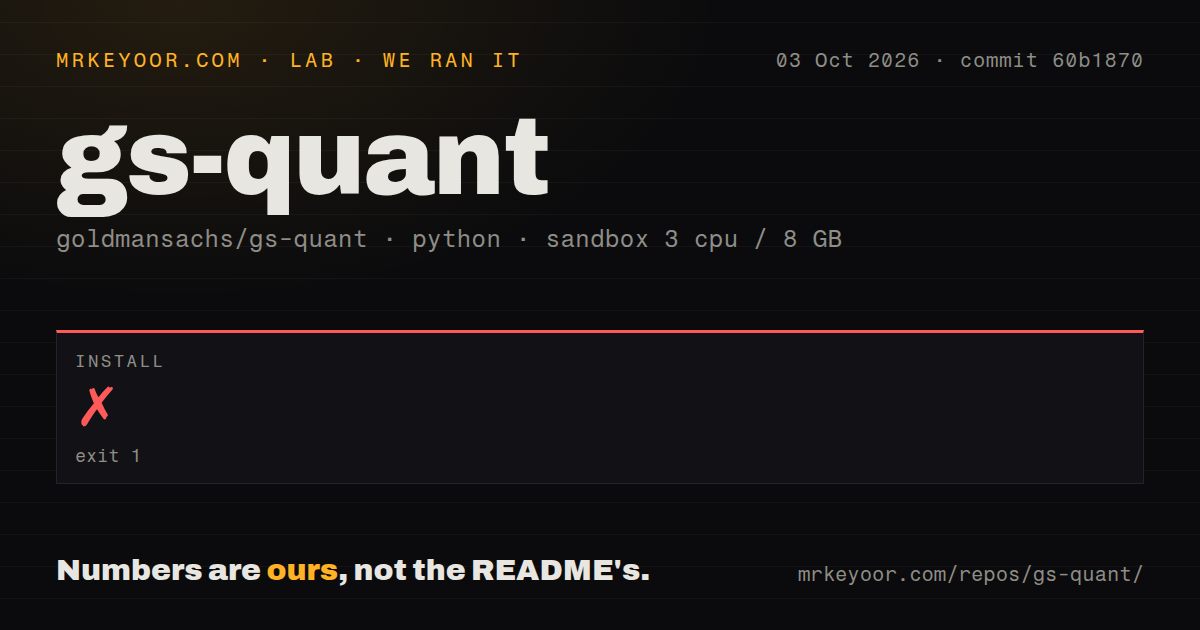
Our sandbox cloned commit fa9dd42 and attempted installation in a fresh unprivileged Debian container with 3 CPUs, 8 GB of RAM, Python 3.12, and no secrets. The checkout contained 1,783 files, about 152,072 lines of source, and occupied 29.3 MB. Installation exited with code 1 after 78 seconds, so the environment never reached a state where later build or test results could be reported.
The last log lines showed requests to the Goldman Sachs package index for setuptools and pip-audit. After 3 retries, the client reported a DNS error and said the address could not be found. The log proves that the configured endpoint did not resolve in our sandbox. It does not prove whether that host is intended for a corporate network, was temporarily unavailable, or was placed in the configuration by mistake, so we are not assigning one of those causes.
Our scan found 1 CI workflow file, no Dockerfile, and no top-level tests directory. The package does contain its own gs_quant/test tree, but our measurement did not install the environment or run that suite. The practical finding is still sharp: a source contributor on a plain public network may need to inspect and override the configured index before dependency resolution can even finish.
Marquee credentials decide how much of the package is useful
The README is direct about API eligibility. A client ID and secret come through Goldman Sachs sales coverage or Marquee Sales, and the package then creates authenticated sessions for service calls. This is a reasonable fit for an existing institutional client because it turns a proprietary service relationship into normal Python objects and data methods. It is a frustrating evaluation target for an unaffiliated developer because many interesting examples cannot be judged with repository access alone.
That split calls for small proof-of-concept code before a wider commitment. Import and run the local calculations you care about, then exercise each required dataset and risk endpoint with the credentials your deployment will use. The 29.3 MB checkout is modest, but dependency installation, entitlements, data availability, and service behavior are separate questions. A passing import would answer only the first one.
The MCP server is experimental and shares real credentials
GS Quant now includes an optional Model Context Protocol server and client built on FastMCP. The server discovers tools, filters them by tags or keys, and exposes them over streamable HTTP. A local mode creates one GS session at startup and reuses it for every request. Passthrough mode builds a session per caller from cookies, a JWT, or an OAuth token.
The project's MCP README labels the API, CLI, and configuration experimental. That warning fits the security model: local mode gives all callers the server's one authenticated identity, while passthrough mode forwards user authorization material. The default endpoint uses port 4301, and a YAML file can specify paths and TLS certificates. Treat it as code to test behind an access-controlled boundary, not as a server to expose after adding the optional package extra.
Recent releases show activity, not universal access
Release 2.1.6 and the repository's last push both landed on August 26, 2026. GitHub listed 12,770 stars and 68 open issues and pull requests when fetched. Updated work in August included fixes around missing dates, event-trigger query windows, backtest cost aggregation, and notebook paths. Those are concrete signs of continuing maintenance; the combined open count should not be read as 68 confirmed defects.
GS Quant is easiest to recommend inside the environment it was built for. An authorized Marquee client gets a substantial Python surface over instruments, risk, data, and analytics, plus an experimental agent interface. Our 78-second failed install makes the public source experience harder to endorse without qualification. If access to Goldman Sachs services is uncertain, start with QuantLib for derivative work or Qlib for investment research, then revisit GS Quant only when its authenticated services solve a specific requirement.