It scans images, directories, and SBOMs from one CLI
Grype takes three common security inputs: a container image, a local filesystem, or an existing software bill of materials. Its package coverage spans major Linux distributions and language ecosystems including Java, JavaScript, Python, Go, Rust, Ruby, PHP, and .NET. It also understands Docker, OCI, and Singularity image formats. That makes it useful when a team wants one vulnerability check at several points between source checkout and deployment.
The output is more than a CVE list. Grype can include EPSS probability, CISA's Known Exploited Vulnerabilities status, a risk score, and OpenVEX statements that explain why a finding does or does not apply. Those fields can make a queue easier to sort, but they remain inputs to a decision. They do not prove that every package was identified correctly or that every advisory match is applicable.
A 91-second install still led to integration failures
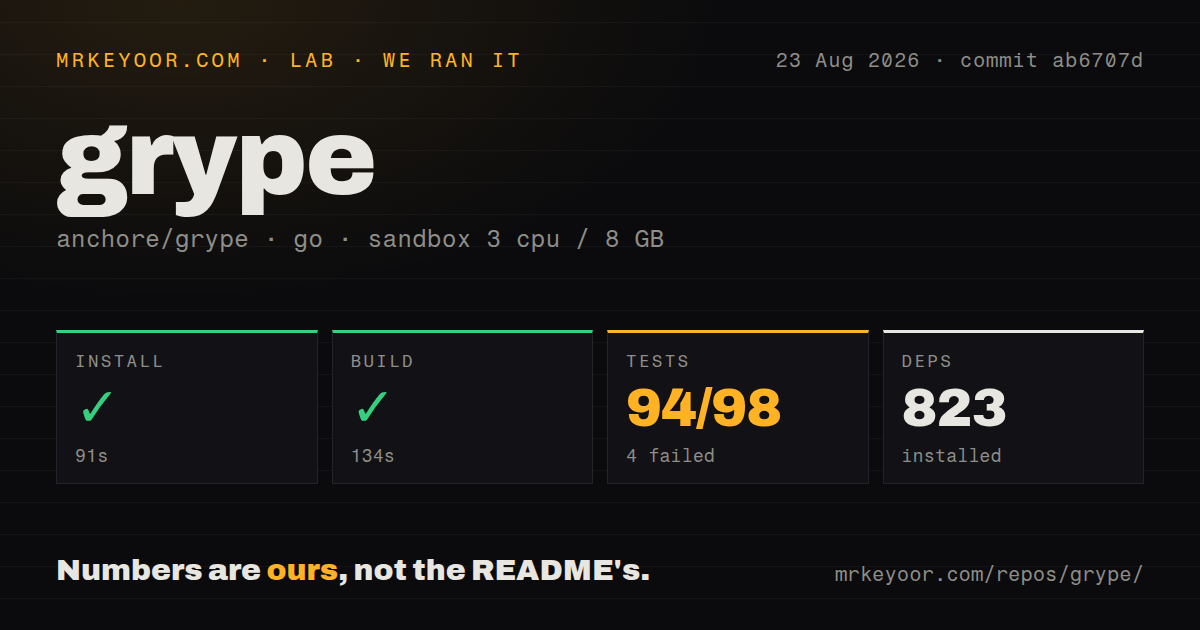
We cloned commit ab6707d into an unprivileged Debian container with 3 CPUs and 8 GB of RAM. The checkout contained 23,241 files, about 148,817 source lines, and occupied 17.4 MB. Installing its Go dependencies succeeded in 91 seconds and pulled 823 packages. The build also succeeded, taking 134 seconds.
The repository has 5 CI workflow files, a Dockerfile, and a tests directory. Those are good maintenance signals, yet our full test command did not finish cleanly. That distinction matters for contributors: obtaining a binary was straightforward, while reproducing the repository's expected behavior was not. A company consuming only a release binary sees less setup work, but anyone changing matchers or output should budget for the integration suite.
What happened when we ran it
Our sandbox test run failed after 205 seconds. Go reported 94 passing packages and 4 failures out of 98. The final failure was github.com/anchore/grype/test/integration; the log tail showed a comparison where matcher names including JavaScript, OpenVEX, Pacman, Python, RPM, Ruby gem, and Rust appeared as removed expected entries. The supplied tail does not identify why the list differed, so attributing it to a missing service or a code defect would be guesswork.
The useful result is narrower and still important: commit ab6707d installed and compiled on the stated Go image, but its complete tests did not pass in our clean environment. Before changing matcher configuration or upgrading a production scanner, repeat the suite in the same image your CI uses and preserve the failing diff. Four failing packages can hide several assertions, so the package count should not be read as four individual broken cases.
Scanner findings need confirmation before they block a release
Open issue 3674 gives a concrete false-positive risk. The reporter says constraints for Grafana CVE-2026-42127 cover versions outside the affected minor series, causing a fixed Grafana artifact to be reported as vulnerable. Issue 3670 documents the opposite failure mode: a vendored OpenSSL binary owned by an unrelated RPM was detected during cataloging but suppressed by overlap handling, leaving a critical CVE unreported in the described image.
These are reports, not a measurement of Grype's overall accuracy. They do show why security teams should keep an exception process and a reproduction path. For a high-impact finding, inspect the package URL, detected version, advisory source, and fix range. For a surprising clean result, compare the SBOM with the actual files and consider a second scanner. A vulnerability tool is most useful when its evidence is reviewable, not when its exit code becomes unquestioned policy.
Repeated --by-cve output may not be byte-stable
Issue 3630 targets users who diff scanner results. Its reproduction feeds identical input and database data through --by-cve 20 times and reports that advisory metadata can vary when multiple records collapse into one CVE. The finding set stays stable, while fields such as namespace, data source, fix metadata, and URLs can come from different surviving records. That is a problem for cached reports and drift detection even if the visible CVE count does not change.
If reproducible JSON is a requirement, test that option with representative SBOMs before adopting it. Store the Grype version and database status beside every report, and compare normalized fields that your policy genuinely uses. The issue includes a detailed code-path analysis, but it remains open in the data we fetched. That makes the limitation citable and specific, without treating the proposed fix as shipped behavior.
Installation is easy; target access and database handling are the work
The README's fastest path pipes an installer into a privileged shell and places the binary in /usr/local/bin. It also links supported installation routes for Homebrew, Docker, Chocolatey, and MacPorts. Teams with stricter supply-chain rules should download and verify a pinned release through their normal artifact process instead of executing a remote installation script directly.
A useful scan also needs access to its target and current vulnerability data. Local directories and SBOM files are simple. Private registries introduce credentials and network policy, while container-daemon access can widen the CI job's privileges. Grype can consume a Syft SBOM directly, which is often the cleaner split: inventory the artifact once, retain that evidence, then scan the saved document under a pinned policy.
Active maintenance does not settle match quality
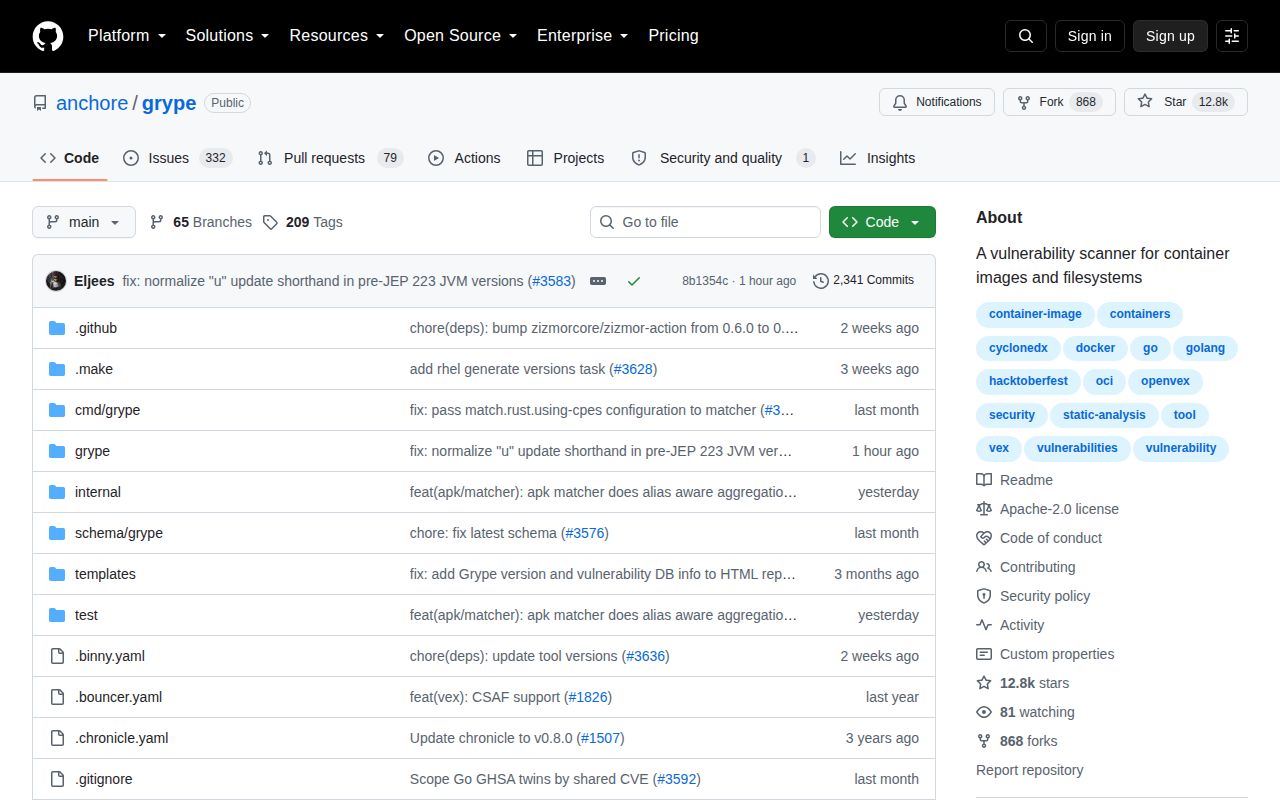
GitHub showed 12,788 stars, 411 combined issues and pull requests, and a last push on August 26, 2026. Release v0.117.0 was published on August 10, 2026. Its notes added vulnerable ranges to CycloneDX output, fixed a Rust CPE configuration behavior, updated 11 dependencies, and recorded 2 remediated dependency advisories. The Apache-2.0 license permits commercial use and modification.
That activity supports using Grype as maintained infrastructure rather than an abandoned experiment. It also creates regular database, matcher, and output changes that can affect policy. Pin the scanner version, record database metadata, exercise known-positive and known-negative samples, and review release notes before upgrades. Our 823-package install and failed integration run make the same point from the contributor side: the binary is easy to obtain, but dependable security decisions require a controlled process around it.