mrkeyoor.com_
Wed 02 Sept 16:57 UTC
LLM Toolsevaluationupdated 02 Sept 2026

geo-seo-claude review

GEO-SEO Claude Code is a Claude Code skill that audits websites for visibility in AI answers while also checking familiar SEO basics. It turns page fetching, crawler rules, schema checks, content scoring, and report generation into slash commands for people who already work inside Claude Code.

trackingstars / 7d
Verdict

Our geo-seo-claude run installed 50 packages in 47 seconds and passed all 14 tests, making it cheap for a Claude Code user to try. Use it as a structured first pass for English-language sites, then verify the fetched page, headers, schema, and business claims before sending a report. The open correctness issues make unsupervised client delivery a poor bet.

We ran it

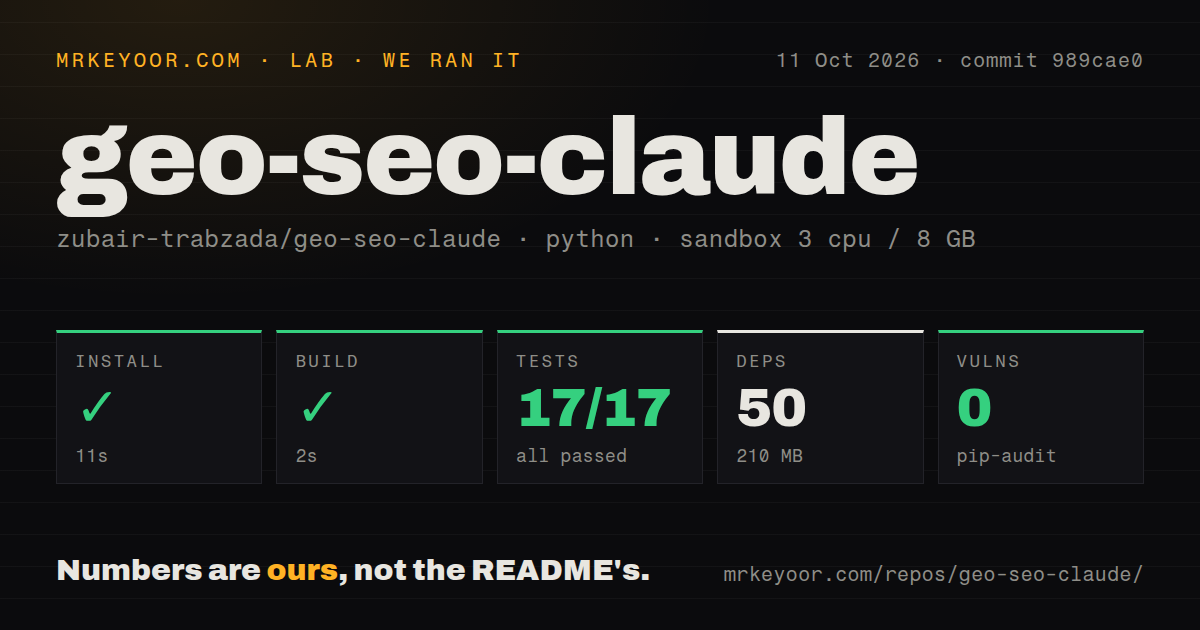
Lab card: what happened when we ran geo-seo-claudeScreenshot of geo-seo-claude (www.skool.com/aiworkshop)
Install✓ · 47s50 packages · 207 MB
Build✓ · 5s
Tests✓ · 5s14 passed · 0 failed of 14 (pytest)
Known vulns0(pip-audit)
Repo71 files~3,220 lines of source · 0.6 MB · 1 CI workflows · tests dir

Answers from our run

Does geo-seo-claude build from source?

Dependencies installed in 47 seconds (50 packages), and the build succeeded in 5 seconds. We cloned commit 5d068e9 into a clean Debian container with 3 CPUs and no project-specific setup.

Do geo-seo-claude's tests pass?

Yes: 14 of 14 passed when we ran the project's own test command (pytest). Some failures need services or credentials a bare container does not have.

Does geo-seo-claude have known vulnerabilities in its dependencies?

pip-audit found none in the dependency tree at the time of our run.

Who should not use geo-seo-claude?

Teams that need deterministic client reports without manual review: open issue 81 documents inputs the agents cannot collect and cases that can produce a wrong result without an error.

What are the alternatives to geo-seo-claude?

GEO Optimizer Skill, Lighthouse, Screaming Frog SEO Spider. Our geo-seo-claude run installed 50 packages in 47 seconds and passed all 14 tests, making it cheap for a Claude Code user to try.

Setup4/547-second install, but Python and install-scope traps remain
Docs3/5Broad command coverage, with a wrong Python minimum
Community4/510,152 stars and a current issue and PR queue
Maturity3/5Tests pass, but correctness reports remain open

Who it’s for

SEO consultants who already use Claude Code and want a repeatable audit structure.
Marketing teams that need crawler, schema, content, and AI-citation checks in one report.
Agencies willing to verify each finding before putting it in front of a client.
Python developers who want editable scoring and reporting scripts instead of a hosted black box.

Who it’s NOT for

Teams that need deterministic client reports without manual review: open issue 81 documents inputs the agents cannot collect and cases that can produce a wrong result without an error.
People auditing non-English sites: issue 80 shows that much of the citability score depends on English-only patterns.
Auditors of JavaScript-heavy sites who cannot check the rendered page separately: issue 57 reports that the default fetcher can miss hydrated content and schema.
Shared teams or CI jobs that require a project-local install: the current installer targets the user's global ~/.claude directory, and project-local installation remains an open request.
macOS users relying on the documented Python 3.8 floor: issue 69 shows current dependency pins require Python 3.10 or newer and can leave a partial install behind.

Setup reality

Our sandbox installed 50 packages in 47 seconds and used 207 MB on disk. The build succeeded in 5 seconds, then all 14 pytest cases passed in another 5 seconds. Pip-audit found 0 known vulnerabilities in the installed packages.

The documented path needs Python, Git, and Claude Code. The installer creates a virtual environment under ~/.claude/skills/geo; Playwright is optional for screenshots, while live audits need network access to every site and platform being checked.

The README says Python 3.8+, but current dependency pins need 3.10+ according to open issue 69. Installation is global rather than project-local, and runtime data for prospects, proposals, and monthly reports remains in ~/.geo-prospects after the provided uninstaller runs.

Thirteen sub-skills make Claude Code the audit console

GEO-SEO Claude Code installs a main skill plus 13 specialized sub-skills for citability, crawler access, llms.txt, brand mentions, platform checks, schema, technical SEO, content, reports, prospects, proposals, and comparisons. Five agent files split a full audit across separate areas before Claude combines the results. That is a useful arrangement for an agency already living in Claude Code because the instructions, scripts, JSON-LD templates, and output formats stay editable. It is much less attractive if your team does its SEO work in a browser dashboard.

The checked-out project was small: our sandbox counted 71 files, about 3,220 lines of source, and 0.6 MB before dependencies. Most of the product is method and orchestration rather than a crawler built from scratch. Python utilities fetch pages, score passages, scan brand mentions, generate llms.txt, and render PDF reports. Claude supplies the judgment and synthesis. That division makes the toolkit easy to inspect, but it also means prompt wording and model behavior can affect what reaches the final report.

What happened when we ran it

Our run installed 50 Python packages in 47 seconds and occupied 207 MB on disk. The build completed successfully in 5 seconds. Those numbers are modest for an AI-adjacent developer tool because the repository does not bundle a model or a web application. The documented installer creates an isolated environment under ~/.claude/skills/geo/.venv, so it avoids changing system Python packages. There is no Dockerfile, which matters if your normal review process expects a disposable image supplied by the project.

Pytest passed all 14 tests in 5 seconds, with 0 failures. Pip-audit also reported 0 known vulnerabilities in the installed dependency set. The checkout had one CI workflow and a tests directory. These results cover commit 5d068e9 in our fresh Debian container with 3 CPUs and 8 GB of RAM. They show that the packaged code builds and its available tests pass; they do not establish that any generated audit is factually correct for a live site.

English-only scoring can underrate translated pages

The scorer assigns 30% of its total to answer-quality patterns that open issue 80 shows are English-specific. Definition, early-answer, and citation checks look for English phrases, so a non-English page can lose much of that section even when its translated structure matches an English page. The same issue says FAQ answers inside dl and dd elements never reach the block scorer. Anyone auditing Spanish, French, or another language should treat the absolute score as unsuitable until those patterns and elements are handled.

Passing 14 tests does not cover every website shape the tool claims to assess. Issue 57 reports that the default requests-based fetcher missed hydrated content and JSON-LD on a JavaScript-heavy site. Issue 81 describes instructions that ask Claude's page tool for response headers it does not return, plus Microdata and RDFa checks that lack raw HTML input. These are painful failures because an audit may produce a confident negative finding instead of stopping with an error. A consultant must compare the report with rendered HTML and raw responses.

The one-command installer writes to a global Claude directory

The installer puts 13 related sub-skills and 5 agents under the user's ~/.claude tree. The README's shortest route pipes install.sh into Bash, then users invoke commands such as /geo audit or /geo quick inside Claude Code. Python, Git, and the Claude Code CLI are required. Open issue 36 asks for project and custom destinations because the fixed global location complicates pinned team setups, side-by-side versions, and CI jobs. That matters more in an agency than it does on one person's laptop.

Our 207 MB environment installed cleanly with Python 3.12, but the stated Python 3.8 requirement is misleading. Issue 69 traces current Pillow, lxml, and Playwright pins to a Python 3.10 floor and shows the installer accepting macOS system Python 3.9 before failing during dependency resolution. The report also says copied skill files can remain after that failure. Use Python 3.10 or newer, inspect the target directories before installation, and remember that uninstalling the skill does not delete ~/.geo-prospects runtime data.

A September 2026 push is active, while correctness work is open

GitHub recorded the last push on September 2, 2026, and listed 10,152 stars with 25 combined issues and pull requests. The repository has an MIT license and no latest GitHub release, so adopters need to pin a commit rather than assuming a release tag defines a tested package. Recent issue activity includes detailed reports about scorer language, missing fetch inputs, installer version checks, and unreliable audit findings. That activity is useful evidence of scrutiny, but the combined open count is not a defect count.

The 47-second install and complete 14-test pass make GEO-SEO Claude Code easy to evaluate without much sunk time. Its command set can give an experienced reviewer a consistent checklist and a serviceable report draft. It should not be the final authority on whether a client has an llms.txt file, schema, headers, or citation-ready content. Pin the commit, audit English sites first, and require a human to reproduce every negative or commercially important claim before the report leaves your team.

Alternatives

ProjectWhat it isPick it when
GEO Optimizer SkillA GEO and answer-engine toolkit with CLI, Python, MCP, and web interfaces.pick this instead when you want an interface outside Claude Code or explicit MCP support.
LighthouseGoogle's automated auditor for performance, accessibility, SEO, and web best practices.pick this instead when browser-measured technical quality matters more than AI-answer scoring.
Screaming Frog SEO SpiderA desktop crawler for large-site technical SEO inspection and exports.pick this instead when crawl coverage and technical inventory matter more than a Claude Code workflow.

What people are saying

  1. [github-trending] zubair-trabzada/geo-seo-claude

Sources

  1. GEO-SEO Claude Code README
  2. Issue 81: five correctness issues in the GEO agents
  3. Issue 80: English-only citability patterns
  4. Issue 69: installer accepts an unsupported Python version
  5. Issue 57: hydrated content missed by the default fetcher
  6. Issue 36: request for project-local installation

More llm tools reviews

notebooklm-py · a2ui · web-llm · hello-agents · OpenResearch · rig · the whole board →