It supplies kernels, layers, and complete model definitions
Flash Linear Attention is a toolbox for sequence-model researchers. Under one Python namespace it includes low-level Triton operations, PyTorch layers, and model configurations registered with Hugging Face Transformers. The catalog spans linear attention, sparse attention, state-space models, and hybrids. Named implementations include RetNet, GLA, DeltaNet, RWKV6 and 7, Mamba2 and 3, Gated DeltaNet, KDA, NSA, MoBA, and newer 2026 research code.
That range is the reason to adopt it. A lab can compare several designs without maintaining unrelated repositories and incompatible layer interfaces. It is also the reason to proceed carefully. Replacing multihead attention with a recurrent or sparse mechanism changes the model, cache behavior, numerical path, and checkpoint assumptions. This library is an engineering base for those experiments, rather than a switch that makes an unchanged Transformer faster.
Five backend extras replace a bare installation
Version 0.5 changed installation on purpose. Torch and Triton are absent from the base dependency set, and users select 1 of 5 extras: CUDA, ROCm, XPU, NPU, or CPU. The maintainers made that split to prevent a resolver from silently installing CUDA wheels on a different accelerator. A bare package installation can succeed yet still fail to import because no Torch backend was selected.
CUDA gets the shortest command, pip install flash-linear-attention[cuda]. ROCm, Intel XPU, and CPU users first install Torch from the matching PyTorch wheel index, then install the corresponding FLA extra. Ascend is more constrained: the guide pins CANN 9.1.0, Torch 2.9.0, Torch NPU 2.9.0.post6, and Triton Ascend 3.2.2. That matrix is clear documentation, but it makes backend choice part of application packaging.
What happened when we ran it
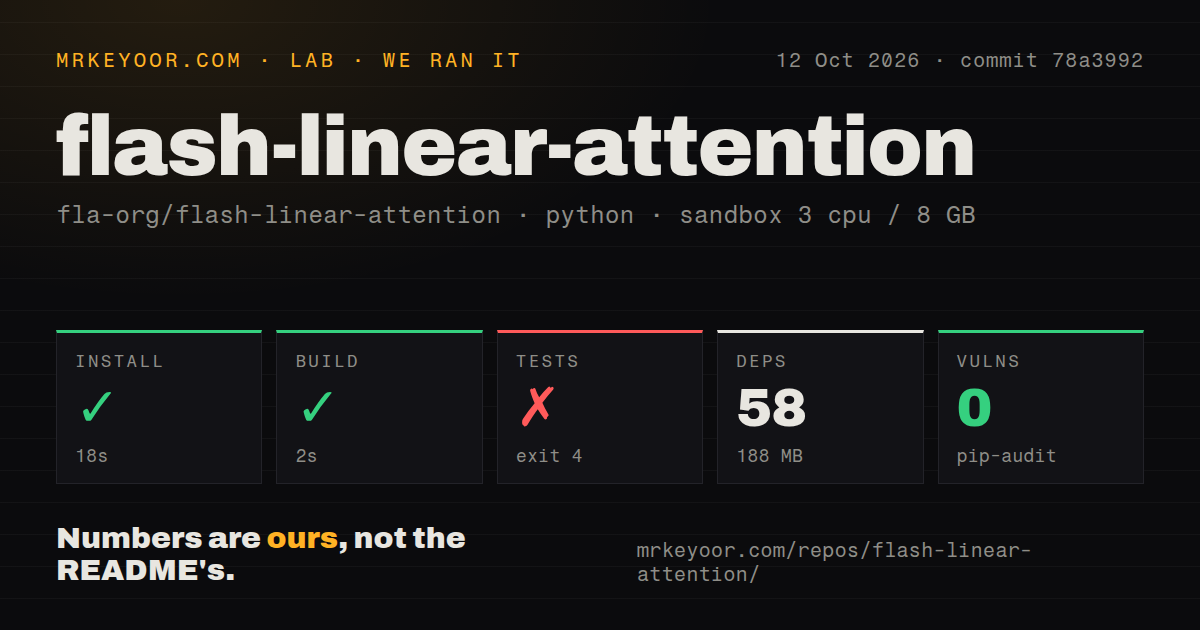
Our sandbox installed commit bccaf2d in 38 seconds. It added 57 packages, used 186 MB on disk, and built successfully in 6 seconds. The checkout itself contained 737 files and about 187,779 source lines in 7.8 MB. Pip-audit reported 0 known vulnerabilities in the Python environment produced by that base installation.
The test command exited with code 4 after 6 seconds. Pytest was loading tests/conftest.py when import torch raised ModuleNotFoundError: No module named 'torch'. No tests were collected, so there is no pass count to report. The log establishes that the environment lacked Torch. The installation guide explains that the base package omits it until a backend extra is selected, which matches the observed boundary without proving how the suite behaves on any supported accelerator.
Our run used a fresh unprivileged Python 3.12 Debian container with 3 CPUs, 8 GB of RAM, and no secrets. It did not have an NVIDIA, AMD, Intel, or Ascend accelerator available for a backend-specific run. The useful result is therefore about packaging: the project builds with its 57 base packages, while its tests require an explicit hardware dependency choice that a generic Python install does not make.
Seventeen workflows cover hardware-specific paths
Our repository scan found 17 CI workflow files and a tests directory. The contributor guide says GPU checks run on NVIDIA H100, A100, and 4090 hardware, plus Intel B580 when available. The latest release also mentions Ascend A2 checks. This is meaningful for a kernel library because a shape or address calculation that works on one compiler and accelerator can fail on another.
Test policy is unusually concrete. Every optimized operator is expected to have a naive PyTorch reference, compare forward outputs and gradients, and include non-power-of-2 sequence lengths. The test fixture fills empty allocations with NaNs for operator and module tests, which can expose kernels that forget to initialize an output lane. Performance changes are expected to pass their correctness gate before maintainers accept timing results. Those rules inspire more confidence than a benchmark chart by itself.
CPU installation is an import path, not the main target
The project metadata supports Python 3.10 or newer and provides a CPU extra. Its install table labels Triton as import-only on that route, while the contributor prerequisites ask for a Triton-capable NVIDIA, AMD, or Intel GPU. A CPU user may be able to load reference code and inspect model definitions, but should not infer the intended kernel experience from the existence of the extra.
Training has also moved beyond this repository's older scripts. The README points new training work to the separate flame project and keeps legacy material here. Generation, fused modules, and Transformers model classes remain documented in FLA. Before choosing it for a training program, verify which layer, model, backend, cache mode, and training harness form the supported combination. A library with dozens of fast-moving architectures cannot make every cross-product equally settled.
v0.5.2 is active while kernel fixes arrive daily
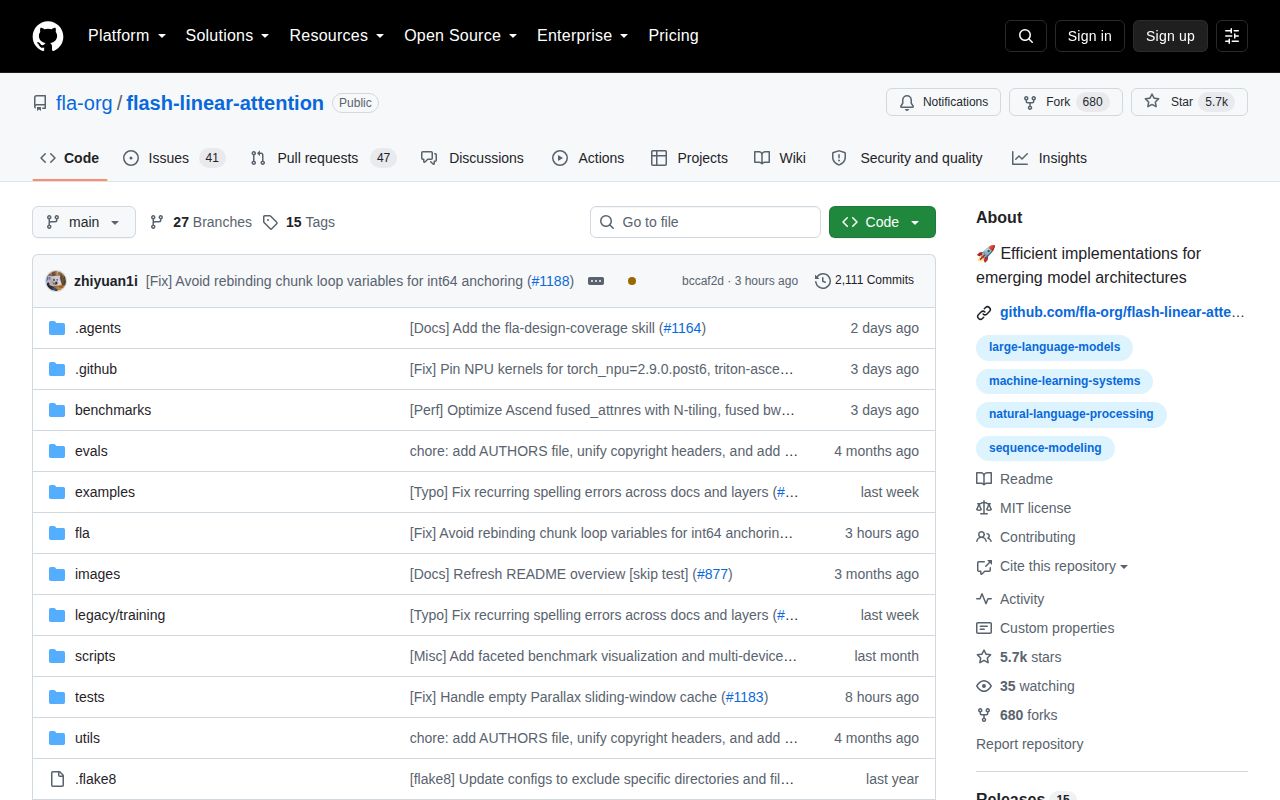
GitHub recorded a push on August 28, 2026, the day we fetched the project. It had 5,650 stars and 88 combined open issues and pull requests, split into 41 issues and 47 pull requests. Release v0.5.2 was published on July 27. Its change list includes overflow fixes, cache and generation corrections, new backend work, added tests, and many kernel optimizations.
Current activity is intense rather than merely recent. On August 28, open work included a MesaNet NaN report plus fixes for cached decoding, state sizes, rotary offsets, and invalid cache or mask combinations. That does not make the package unsuitable; these are the kinds of boundary bugs a wide kernel catalog attracts. It does mean production users should pin v0.5.2 or a tested commit, run the relevant operator tests on their own hardware, and avoid upgrading solely because a newer kernel appears in the main branch.