OpenCypher rides on Redis commands and sparse matrices
FalkorDB models data as property-bearing nodes and relationships, then queries that graph with OpenCypher plus project-specific extensions. Underneath, GraphBLAS sparse matrices represent adjacency and linear-algebra operations execute graph work. The server is a Redis module, so clients can send GRAPH.QUERY through redis-cli or raw Redis commands. Official client libraries cover Python, Java, Node.js, Rust, Go, and C#.
The quick start exposes Redis on port 6379 and a browser interface on port 3000 from one published container. That is an approachable way to test a graph, and the README's motorcycle example creates riders, teams, and relationships with a few Cypher statements. Production evaluation still needs your own queries and data shape. The repository links separate performance results, but our lab did not run a database benchmark, so we make no latency or throughput claim here.
The 116-second source build stopped before Rust compilation finished
FalkorDB's manual guide puts cargo build first, then explains the required native layers below it. GraphBLAS and LAGraph come from one project script. RediSearch lives in a recursive Git submodule and has its own build script. Linux contributors need clang-22 and libomp-22-dev, while macOS uses Homebrew LLVM and libomp. The recommended route is a VS Code development container whose first build is described as taking about 10 to 15 minutes.
That dependency chain is part of the product, not optional contributor polish. The Rust graph build links static LAGraph, GraphBLAS, and RediSearch archives, plus OpenMP, C++, OpenSSL, and crypto libraries. graph/build.rs explicitly searches for a generated RediSearch binary directory and aborts when it is missing. A source checkout therefore needs recursive submodules and the documented preprocessing scripts before Cargo can link the module.
What happened when we ran it
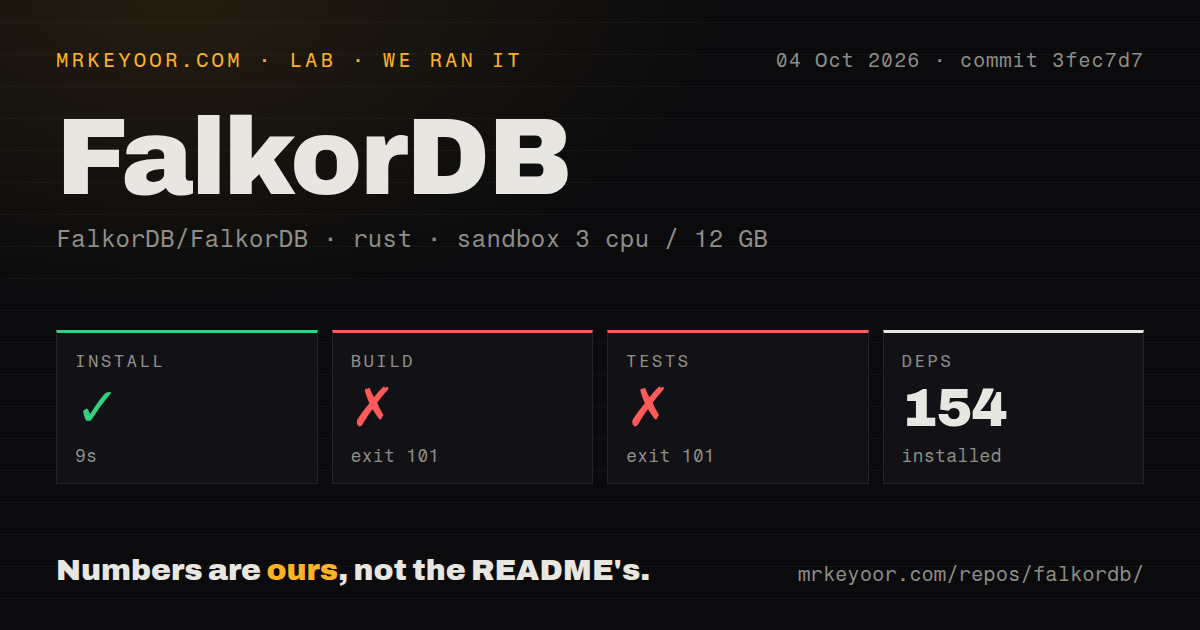
Our sandbox installed 150 packages in 16 seconds. The build ran for 116 seconds, then exited with code 101. Its final error came from graph/build.rs:114 and said deps/RediSearch/bin missing - run ./redisearch.sh first. The log also listed the native libraries Cargo intended to link, including LAGraph, GraphBLAS, OpenMP, C++, SSL, and crypto. We do not infer any other cause from that output.
The test command failed with the same exit code 101 after 7 seconds and the same missing RediSearch directory. No test cases ran to a reported summary. The checkout contained 4,612 files, about 1,114,343 source lines, and 70.6 MB before installed dependencies. It had 20 CI workflow files and a tests directory. Those are healthy engineering signals, but they do not turn our failed build and test attempts into passes.
Six official clients reduce application-side friction
FalkorDB's Redis command surface is practical for existing service stacks. A team can start with raw commands, then use one of the 6 official language clients when it wants typed graph results and connection management. The property-graph model and OpenCypher also make query intent readable to people who already know graph databases. Graph storage, traversal, and vector indexing live in the same database instead of being joined across unrelated services.
The combined design also widens the failure surface. Open issue 1710 reports HNSW vector queries returning empty or incorrect results during sequential ingestion and includes a reproduction based on a growing graph. Maintainers marked it needs-info, so it is an unresolved report rather than a confirmed universal defect. If retrieval depends on vectors while writes continue, replay that workload against the exact FalkorDB image you intend to ship and compare results with a known set.
SSPL-1.0 rules out some otherwise good fits
The repository license is Server Side Public License 1.0. Teams that standardize on permissive licenses cannot treat it as an Apache-2.0 substitute, and anyone providing the database as part of a network service should have counsel review section 13. Running the unmodified program for an internal application is a different decision from offering database functionality to third parties. The license deserves review early, before migration code and operational tooling make a change expensive.
FalkorDB also carries the duties of a stateful Redis-compatible service. Persistent data belongs under /var/lib/falkordb/data in the quick-start example. A real deployment needs controlled network exposure, authentication, backups, restore drills, upgrade tests, and resource limits. The browser interface on port 3000 is useful during a trial, but it should not be treated as evidence that those operational decisions have been made.
Version 4.20.4 shipped while 642 issues and PRs remained open
GitHub recorded 5,700 stars and a last push on August 30, 2026. Release v4.20.4 arrived on August 20 with a replica crash fix, a persisted-graph loading change, and serializer APIs. GitHub's combined open count was 642; a separate search split that into 489 issues and 153 pull requests. The dates and active pull-request queue show current maintenance, while the volume also signals a large migration and compatibility workload.
The Rust repository has several distinct test routes: graph unit tests, end-to-end and function tests, concurrency and MVCC suites, flow tests, and a Technology Compatibility Kit selection. That breadth is reassuring once the native prerequisites are in place. Our 7-second test failure means we did not independently confirm any of them at commit dd99ae9. Trial the Docker image, then reproduce the source build in the project's container before committing staff time to a fork.