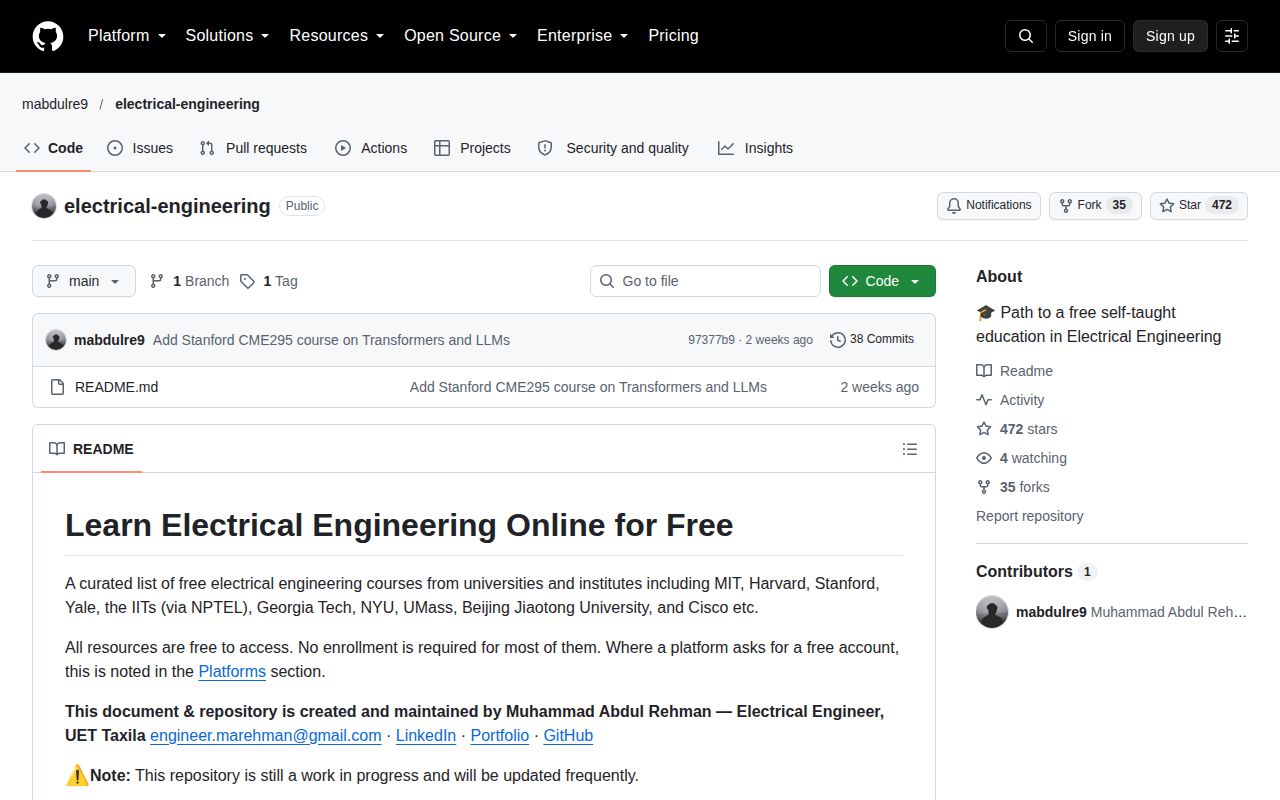
The useful part is the prerequisite map across 25 subjects
Electrical Engineering puts its entire curriculum in 1 file at commit 97377b9, and the prerequisite notes tell you what should come first. Circuit analysis starts with algebra and trigonometry. Signals and systems expects calculus, differential equations, and later work with transforms. Control systems points to differential equations before state-space methods. Those small notes turn the README into a usable map rather than a pile of bookmarks.
The scope is broad enough to resemble an electrical engineering department: 25 sections cover the mathematics, physics, electronics, machines, communications, control, power, instrumentation, programming, and machine learning. Within a section, the author sometimes compares resources. The linear algebra note separates Bazett's geometric intuition from Strang's emphasis on application and rigor, for example. That judgment is more helpful than listing both names without a reason.
It links to courses, but it does not supply a degree
The 1-file repository sends you to MIT OpenCourseWare, NPTEL, Harvard, Stanford, Yale, YouTube educators, and other providers. Its platform table distinguishes free access from free accounts and optional paid certificates. Links stay visible instead of being hidden behind labels, which makes the destination easier to inspect before clicking. The contribution rules reject paywalled course content, shortened URLs, affiliate tracking, and pirated copies.
commit 97377b9 has 1 file and leaves the hard work with the learner. There are no calendars, assignments, grades, lab kits, capstone projects, or progress records. Even the recommended textbooks are titles, not hosted books. A person can assemble a serious study plan from these entries, but the README does not establish that completing selected links equals a university degree or professional qualification.
What happened when we ran it
We did not run the repository in our sandbox. The lab found no supported software ecosystem and no Dockerfile at commit 97377b9, so an install, build, or test attempt would have been invented work. The tree contains 1 file, README.md. There is no application hiding behind the list and no local server to start.
Our measurement setup was a fresh Debian container with 3 CPUs and 8 GB of RAM, but it had nothing executable to measure. We did not record installation time, test coverage, dependency health, or link availability because there are no dependencies or test target in the measured block. Evaluate this page by its organization, source choices, maintenance, and external-link accuracy.
Eleven platform notes make the access cost clearer
The 1-file README covers 11 destinations and tells you when an account or certificate fee enters the picture. MIT OpenCourseWare, UMass lectures, DSP First, and several other sources are described as free without an account. MITx, XuetangX, Cisco Networking Academy, and LabEx may require a free login. NPTEL content is free to watch, while its certificates can cost money.
Those notes matter because 'free course' can mean several different things. The stated selection rule is that teaching material must remain accessible without payment, even if assessment or certification costs extra. The README also says certificates are optional and gives projects more weight for employment. It does not provide those projects, so you will need a separate plan for practical work.
The missing LICENSE file weakens an otherwise careful curation policy
At commit 97377b9, the repository has 1 file and no LICENSE, although the README says its curation, organization, and original text use the MIT License. GitHub consequently reports no detected license. Linked courses keep their publishers' terms, and the README correctly tells readers to check each course before reuse.
The v1 README also excludes scraped paid material and asks contributors to preserve original course names. That matters if a school or company wants to copy the structure, since linking to a public lecture differs from republishing its slides or video. Adding the missing license file would make the repository's own reuse terms match its stated policy.
September activity is real, but the history is only days long
The repository was created on September 20, 2026, published a v1 release that day, and received its last push on September 24. commit 97377b9 added a Stanford transformers course after several days of link and section updates. GitHub showed 472 stars, 35 forks, and 0 open issues or pull requests on October 8. There is no issue history from which to judge response time.
The repository's first 4 days show active assembly, not long-term maintenance. External course links decay, platforms change access rules, and recommended sequences benefit from learner feedback. Use the list now because its prerequisite notes save time. Keep your own record of the courses you choose, and verify a provider's current access terms before building a semester around it.