42 of the 70 listed projects have full source
Cybersecurity-Projects is closer to a workshop shelf than a single product. Its root index lists 70 builds across foundations, beginner, intermediate, and advanced tiers, plus certification roadmaps and resource pages. The README says 42 projects have full source. That distinction matters: some entries are usable code, while others remain synopses or planned lessons. A reader should choose one project and follow its local documentation instead of treating the whole repository as one install.
That breadth has a physical cost. Our checkout contained 4,760 files, roughly 382,140 source lines, and 54.2 MB before installation. Navigation is helped by difficulty tables and learn/ folders, though code search still crosses many unrelated languages and applications. The collection works best as a place to study or borrow from. It is a poor fit for anyone expecting one versioned security suite with a common runtime and release cycle.
fastapi-420 exposes 3 algorithms through 3 FastAPI hooks
The measured project lives at PROJECTS/advanced/api-rate-limiter. It packages sliding window, token bucket, and fixed window algorithms behind middleware, decorators, or FastAPI dependency injection. Redis supplies shared counters, with an in-memory backend available when Redis is absent. The API also exposes client fingerprint levels and scoped rules, so different endpoint groups can receive different limits without separate limiter instances.
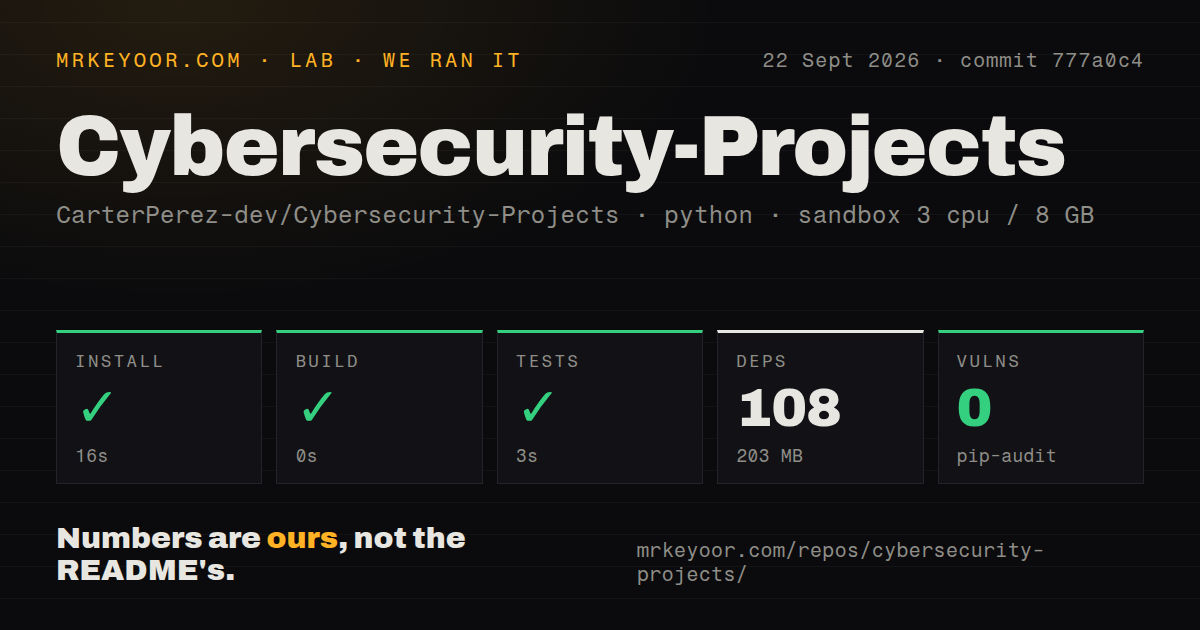
This is a focused Python package inside a much larger Go-labeled repository. Our install added 108 packages and occupied 203 MB, a meaningful footprint for a component whose job is request admission. The local README requires Python 3.14 and recommends uv; Redis support and just are presented as optional additions. No hosted account or secret is needed for the in-memory path, which keeps the first experiment simple.
What happened when we ran it
Our sandbox installed commit 777a0c4 in 16 seconds from the nested rate-limiter directory. The build completed in 0 seconds, and the test step succeeded in 3 seconds. Pip-audit reported 0 known vulnerabilities in the installed Python environment. Those results came from an unprivileged Debian container with 3 CPUs and 8 GB of RAM, without secrets. They establish that the supplied package can clear its mechanical checks in that environment.
The repository scan found 10 CI workflow files and a tests directory, but no Dockerfile. The full checkout measured 4,760 files and 54.2 MB, while the installed subproject used 203 MB. We did not benchmark request throughput, Redis behavior, fingerprint accuracy, or protection under attack. The project's learning notes include performance exercises and target figures, but those are assignments and examples, not results from our sandbox.
fastapi-420 fails open when storage errors occur
The fastapi-420 architecture document says the limiter handles errors with fail-open behavior. It also describes automatic in-memory fallback when Redis is unavailable. That can keep an API online during a storage outage, but it changes the protection model: a team that requires a shared counter to authorize traffic may prefer to reject requests instead. The challenge notes also identify missing production validation for Redis and a circuit-breaker bypass that checks authentication without checking permission.
A passing 3-second test step does not settle those policy questions. It says the checked-in suite completed in our container, not that every outage mode matches your service contract. Before adoption, test a Redis disconnect, several application workers, forwarded client addresses, and recovery after the shared store returns. The project is most useful when its defaults become prompts for those tests instead of being accepted as production policy.
Python and license metadata contradict themselves
pyproject.toml requires Python 3.14, while its package classifiers also advertise Python 3.12 and 3.13. Install tools enforce the requirement field, so developers on either older interpreter should expect friction regardless of the classifiers. The license story is more serious: GitHub identifies the repository as AGPL-3.0, the subproject ships the AGPL text, and its README repeats AGPL 3.0, yet the same pyproject.toml declares MIT.
Our 108-package environment installed cleanly despite those metadata conflicts, but installation success cannot choose a license for you. A company embedding the package in a network service should ask the maintainer to reconcile the files before legal review or deployment. The mismatch also weakens the package's release story, because GitHub returned no latest release even though the package metadata identifies version 1.0.1 and beta status.
September activity is current, while releases remain informal
GitHub recorded the last push on September 18, 2026, five days before this review. The repository showed 7,281 stars and 7 combined issues and pull requests. Only one of those open items was an issue, a repository roadmap updated on September 11; the rest were pull requests. That mix, plus 10 workflow files, points to current maintenance even without a GitHub release page.
The measured package deserves a look from learners and FastAPI teams willing to inspect policy. A 16-second install, 0-second build, successful 3-second test step, and clean pip-audit result lower the cost of that evaluation. They do not erase the fail-open design, Python 3.14 floor, unfinished parts of the 70-project collection, or the license conflict. Study it freely, prototype carefully, and delay production adoption until those choices are resolved in writing.