mrkeyoor.com_
Wed 07 Oct 06:44 UTC
AI Toolsevaluationupdated 07 Oct 2026

Covalent-MAS review

Covalent-MAS is a small Python interface layer for wiring molecule generators, optimizers, docking tools, and trajectory records into a covalent-drug design workflow. The repository currently supplies data contracts, JSONL storage, a sequential AutoDock Vina adapter, and a CLI for already prepared ligands, not the generation and optimization models described in its results section.

Verdict

Our Covalent-MAS run passed 2 tests in 3 seconds, but those tests cover contract wiring and JSONL storage rather than drug generation, docking execution, or the published benchmark claims. Use it only as a concise starting vocabulary for an in-house covalent-design pipeline or as a thin Vina batch wrapper. Do not choose it expecting the advertised multi-agent research system to run from this repository.

We ran it

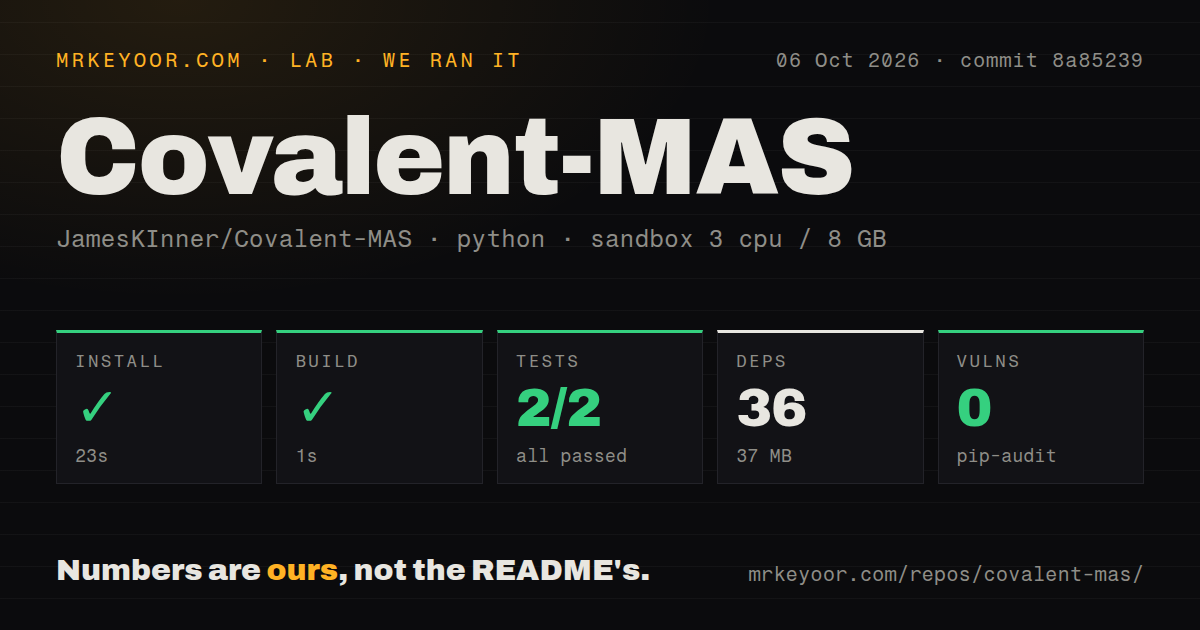
Lab card: what happened when we ran Covalent-MASScreenshot of Covalent-MAS (github.com/JamesKInner/Covalent-MAS)
Install✓ · 23s36 packages · 37 MB
Build✓ · 1s
Tests✓ · 3s2 passed · 0 failed of 2 (pytest)
Known vulns0(pip-audit)
Repo16 files~578 lines of source · 1.6 MB · 0 CI workflows · tests dir

Answers from our run

Does Covalent-MAS build from source?

Dependencies installed in 23 seconds (36 packages), and the build succeeded in 1 seconds. We cloned commit 8a85239 into a clean Debian container with 3 CPUs and no project-specific setup.

Do Covalent-MAS's tests pass?

Yes: 2 of 2 passed when we ran the project's own test command (pytest). Some failures need services or credentials a bare container does not have.

Does Covalent-MAS have known vulnerabilities in its dependencies?

pip-audit found none in the dependency tree at the time of our run.

Who should not use Covalent-MAS?

Buyers seeking a ready covalent-molecule generator or optimizer: the repository defines protocols for both but includes no implementation of either.

What are the alternatives to Covalent-MAS?

AutoDock Vina, RDKit, REINVENT4. Our Covalent-MAS run passed 2 tests in 3 seconds, but those tests cover contract wiring and JSONL storage rather than drug generation, docking execution, or the published benchmark claims.

Setup3/5Package setup is easy; a useful workflow needs outside implementations
Docs3/5Clear interfaces, but headline results lack reproducibility assets
Community2/5339 stars, 1 fork, no issues, and no push since September 20
Maturity1/5Only 2 tests, no CI, no release, and core model layers are absent

Who it’s for

Computational chemistry teams that want simple Python protocols for their own private generators and optimizers.
Researchers who already prepare receptor and ligand PDBQT files and need a thin Vina batch wrapper.
Prototype workflows that benefit from append-only JSONL event records and explicit parent-child molecule lineage.
Developers prepared to implement most chemistry, filtering, learning, and retrieval components themselves.

Who it’s NOT for

Buyers seeking a ready covalent-molecule generator or optimizer: the repository defines protocols for both but includes no implementation of either.
Researchers trying to reproduce the headline 98.81% validity, 53.17% graft success, or claimed 10% optimizer advantage: the repository contains no benchmark data, evaluation scripts, trained model, or linked paper for those results.
Teams that need covalent docking evidence: the README says the included standard Vina path screens pre-reaction pose and pocket occupancy and does not establish bond formation.
Production screens requiring parallel scheduling or retry control: dock_candidates invokes Vina sequentially for every candidate.
Regulated workflows that require a release trail and visible automation: GitHub has no tagged release and our scan found 0 CI workflow files.

Setup reality

Our fresh Python 3.12 sandbox installed commit 8a85239 in 23 seconds, adding 36 packages and using 37 MB. The build passed in 1 second. Pytest finished in 3 seconds with 2 passed and 0 failed; pip-audit found 0 known vulnerabilities.

The package itself declares no runtime dependencies. The useful CLI still needs AutoDock Vina on PATH, plus a prepared receptor and one prepared PDBQT ligand per candidate. Generation, filtering, optimization, memory building, and knowledge retrieval require implementations that are not included.

The 1.6 MB checkout had 16 files and about 578 lines of source. It included a tests directory but no Dockerfile and 0 CI workflows. One test covers optimizer contract wiring; the other covers JSONL append and query behavior. The Vina process and CLI are not tested by those 2 cases.

The repository is an interface kit, not the advertised research stack

Covalent-MAS names the stages a serious covalent-drug workflow might need: candidate generation, chemistry filters, docking, multi-objective optimization, trajectory learning, and retrieval. The code implements only a small part of that list. Its core is a collection of Python dataclasses and protocols. These describe candidates, docking requests, objectives, memory records, skills, and events, but they do not generate a molecule or optimize one.

The package has 0 runtime dependencies and about 578 source lines in our checkout. Concrete behavior consists of CSV candidate loading, a loop over a supplied docking tool, a loop over a supplied optimizer, JSON result writing, append-only JSONL events, and one AutoDock Vina subprocess adapter. The README's example optimizer calls an undefined run_model, which is a placeholder for code the user must bring. No candidate generator, chemistry filter, experience builder, or knowledge retriever is included.

The Vina CLI expects prepared inputs

The usable command reads candidate IDs and SMILES from CSV, pairs each ID with a prepared ligand PDBQT file, and invokes Vina against a prepared receptor. Users provide the search-box center, box size, exhaustiveness, and output paths. The adapter extracts the first affinity from Vina's text, records a pose path when one exists, and stores the final results as JSON.

Preparation remains outside the project by design. You must choose protonation, atom typing, the covalent-ligand representation, and how receptor and ligand files are produced. The README also draws a necessary scientific boundary: standard Vina docking evaluates a pre-reaction pose and pocket occupancy. It does not prove covalent bond formation. The 23-second package install on our box did not install Vina because the Python project declares no dependencies.

What happened when we ran it

Our sandbox installed commit 8a85239 in 23 seconds, adding 36 packages and consuming 37 MB. The build succeeded in 1 second. Pytest completed in 3 seconds with 2 passed and 0 failed, and pip-audit found 0 known vulnerabilities. The checkout held 16 files, about 578 lines of source, and 1.6 MB of data.

The run used an unprivileged Debian container with 3 CPUs, 8 GB of RAM, Python 3.12, and no secrets. We found a tests directory, 0 CI workflow files, and no Dockerfile. One test checks that memory and skill records reach a mock optimizer. The other appends 2 trajectory events to JSONL and queries them. Neither test launches Vina, exercises the CLI, validates a molecule, or measures any result in the README.

The headline metrics cannot be reproduced from this checkout

The README reports a 98.81% valid-molecule rate, 53.17% 3D graft success, and 401 graftable molecules per 1,000 requests. It also claims 10% higher aggregate optimization performance than GPT-5.6-Sol under a project benchmark. Those are precise results, but the 16-file repository contains no benchmark corpus, evaluation harness, model weights, generated candidates, raw results, or linked paper that would let another team check them.

That missing evidence is more important than the short test suite. The shipped code could store reported metrics in a trajectory record, but it cannot produce the generation results described above. The README says candidate structures still need computational review and experimental validation, which is correct. A buyer should go further and treat the headline numbers as unsupported by the public repository until the authors publish enough artifacts to reproduce the protocol.

JSONL provenance is useful but minimal

The event model records a run ID, target, iteration, stage, candidates, inputs, outputs, metrics, and decision. Parent IDs can travel into optimized children, while memory and skill records carry source event IDs. That is a sensible starting shape for tracing why a candidate advanced. JSONL also stays easy to inspect and import elsewhere.

Storage is a single append call and a linear file scan. The query function filters target or stage and stops at a limit. It has no locking, schema migration, deduplication, index, transaction, or validation of referenced evidence. At 2 passing tests, it is a prototype persistence layer rather than a laboratory record system. Teams can keep the dataclasses and replace the store, but that replacement is part of the work this project hands back to them.

September activity has no public release trail

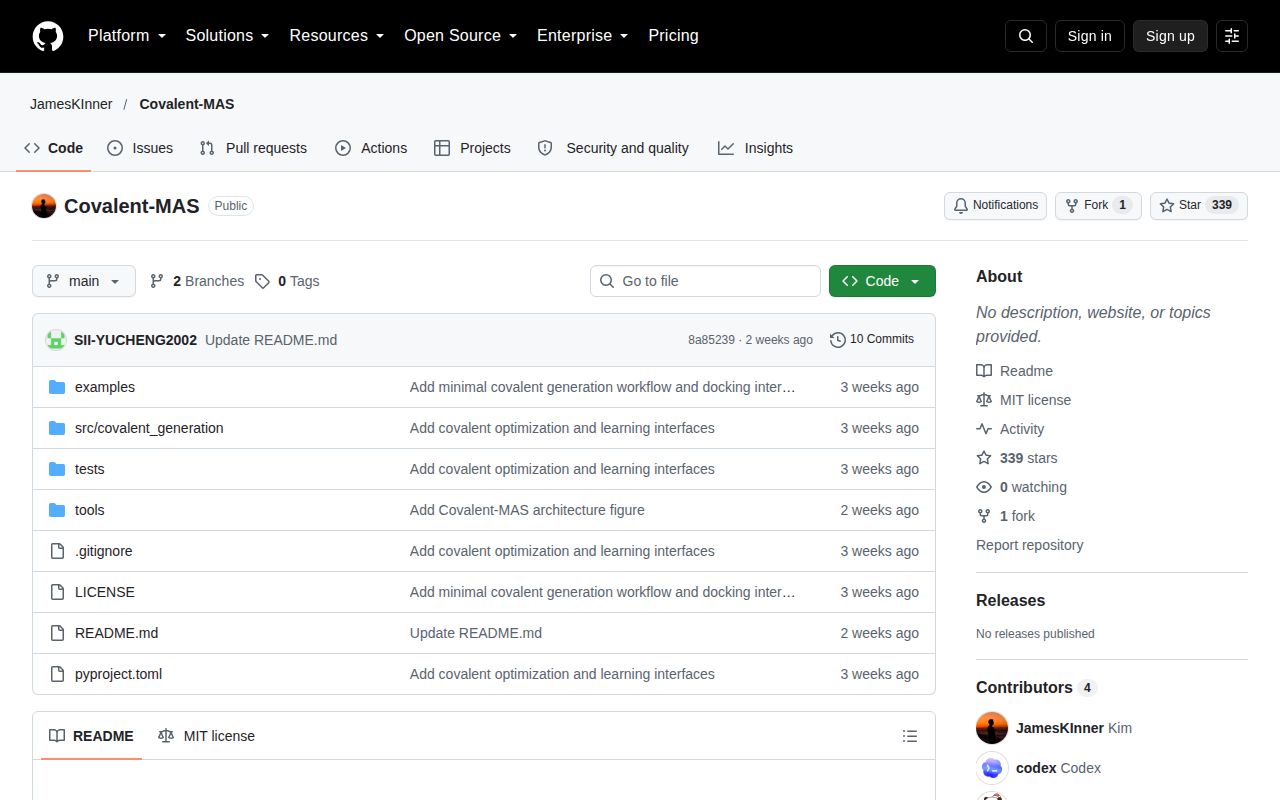
GitHub showed 339 stars, 1 fork, and 0 open issues or pull requests on October 7, 2026. The repository was created September 19 and last pushed September 20. Its README calls the software v1.0 and installation uses a v1.0 branch, while GitHub exposes no latest tagged release. With 0 CI workflows, there is no visible automation proving that the 2 tests run on each change.

Covalent-MAS may save an afternoon for a research group that wants names and dataclasses for its private systems. That is a modest use, not a finished multi-agent drug-design platform. The code we inspected can batch prepared ligands through Vina and preserve simple lineage. Everything that would justify the scientific claims lives outside these 578 lines.

Alternatives

ProjectWhat it isPick it when
AutoDock VinaThe docking engine that Covalent-MAS calls through its only concrete scientific adapter.pick this instead when docking prepared structures is the whole job and you do not need custom workflow contracts.
RDKitA mature chemistry toolkit for molecule handling, descriptors, filters, and transformations.pick this instead when you need actual cheminformatics operations rather than interfaces around future components.
REINVENT4A working molecular design system for generation and optimization tasks.pick this instead when de novo design or molecule optimization must run without writing the model layer yourself.
DeepChemA broader machine-learning toolkit for chemistry, biology, materials, and molecular datasets.pick this instead when training, featurization, datasets, and evaluation matter more than a minimal orchestration shell.

What people are saying

  1. [velocity-scout] JamesKInner/Covalent-MAS

Sources

  1. Covalent-MAS repository
  2. Covalent-MAS README
  3. Covalent-MAS interfaces
  4. Covalent-MAS Vina adapter
  5. Covalent-MAS tests

More ai tools reviews

embodied-jev · underclass · minecraft-agent · laya-coreml · CometixCode · openJev-verdict-2.0 · the whole board →