Cobra models a CLI as a tree of commands
Cobra's central type is Command. A command has a name, help text, argument rules, flags, an action, and optional child commands. That structure maps naturally to interfaces such as app server start or app config set. Persistent flags can flow down the tree, while local flags stay attached to one command. Aliases and suggestions help users recover when names change or a command is mistyped.
The library also generates the parts teams often neglect: usage text, help flags, shell completion, man pages, and Markdown documentation. Bash, Zsh, Fish, and PowerShell are supported. Projects can customize the output when the defaults do not fit. The result is a single command definition serving runtime parsing and release documentation instead of maintaining each representation separately.
The library and generator are separate choices
Adding Cobra to a Go module requires go get github.com/spf13/cobra. Developers can create the root command and children by hand, which is often clearer in an existing application. The separate cobra-cli program generates a new application or command file. That tool is convenient for a blank project, but it is not required at runtime and lives in its own repository.
This separation keeps scaffolding out of deployed binaries. It can confuse first-time users who install Cobra and then expect a cobra executable, so the README points to both installation paths. Teams should decide whether generated file layout fits their conventions before committing it. A small hand-written command tree can be easier to navigate than boilerplate spread across many files.
What happened when we ran it
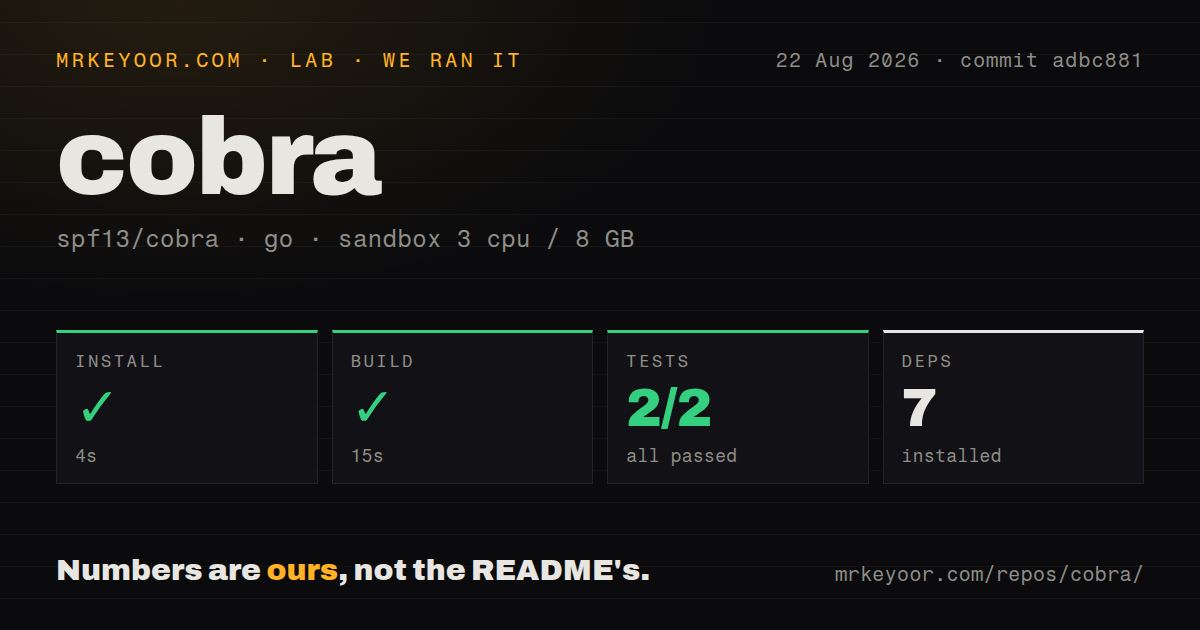
Our sandbox tested commit adbc881 with Go 1.24 on Debian. Dependency installation finished in 4 seconds and added 7 packages. The build succeeded in 15 seconds. Tests completed in 9 seconds: Go reported 2 passed and 0 failed out of 2.
The checkout contained 66 files, about 16,801 lines of source, and occupied 0.7 MB. Two CI workflow files were present, with no Dockerfile and no tests directory. Go tests can live beside package code, so the missing directory is not a warning by itself. The small source and dependency footprint matches Cobra's role as an embedded library rather than a service.
Our run gives a clean baseline for the measured revision. It does not verify every generated completion script in an interactive shell. Completion behavior depends on the target shell, escaping, current arguments, and how an application defines valid values. Projects shipping completion should add their own fixtures around the actual command tree.
Completion is valuable and still the busiest edge
Current issue activity concentrates on the places where shells disagree. August 2026 work addressed PowerShell exceptions for empty or single-line output, Bash handling of required flags supplied in two-word form, escaping in partial completions, and suggesting flags after parse errors. These are narrow bugs, but completion is user-facing and hard to test by eye across four shells.
Cobra provides the generator and hooks; application authors still own semantic suggestions. A command that queries a network or reads a large database during completion can make every tab press slow. Keep completion functions bounded, handle missing credentials quietly, and test empty, one-item, and special-character results. Recent PowerShell fixes show why those small cases belong in a release checklist.
The same caution applies to command-tree mutation. A recent pull request recomputed cached path lengths when a subtree was reparented, while another avoided claiming -h when an application already used that shorthand. Most CLIs build their tree once at startup and will never hit the first case. Libraries that assemble plugins dynamically should exercise it.
Viper is optional, and that boundary is useful
Cobra parses commands and flags. Viper can bind configuration files and environment variables, but the README labels the integration optional. Keeping those concerns separate avoids forcing a configuration system on every CLI. A program with a few flags can read its own environment and remain simpler; a service-style CLI can add Viper when precedence across defaults, files, variables, and flags is worth the extra rules.
Flag parsing itself comes from spf13/pflag, which extends Go's familiar flag interface with POSIX-style short and long options. This gives users expected forms such as -p and --port. Persistent flags are powerful, though deep inheritance can make help output and precedence harder to reason about. Prefer local flags unless a setting genuinely applies to every child.
Maintenance remains active after the latest release
Version 1.10.2 was released on 2025-12-04. The repository's last push was 2026-07-11, while issues and pull requests continued through August. GitHub listed 434 open issues and pull requests combined. That count includes feature work, questions, documentation, and proposed fixes; it is not 434 confirmed defects.
The Apache 2.0 license suits commercial and open-source tools. Documentation is split sensibly between the short README, the Cobra website, the user guide, and Go's API reference. Existing users also benefit from command aliases, which can keep old names working during a migration.
Cobra is the right default once a Go program has a real command hierarchy or promises completion on several shells. Kong and go-arg offer a more compact struct-first style, while urfave/cli has a different declarative API. For one command with five flags, the standard library remains a respectable answer. Complexity should follow the interface users actually need.