Nine built-in CLIs share one control surface
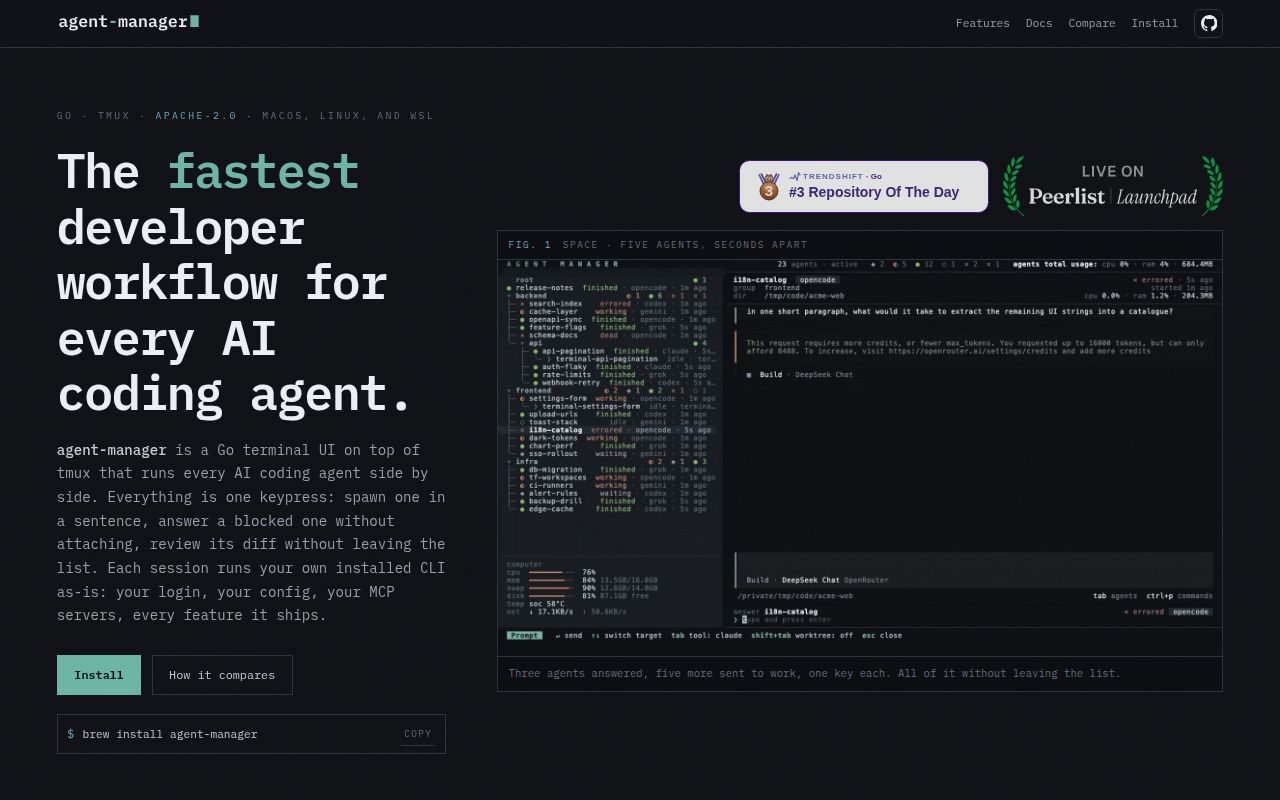
Claude Code, OpenCode, Codex, Grok Build, Gemini CLI, Pi, Command Code, Hermes Agent, and Muse Code each keep their usual login, subscription, settings, and MCP servers. Agent Manager watches the sessions, marks them working or waiting, and lets you reply without attaching to a pane. That is the useful distinction: it organizes tools you already chose instead of asking you to move work into a new agent system.
The list starts paying for itself when several agents are active. Sessions sit in a project tree, groups can be folded or reordered, and a filter shows only the work that needs attention. Pressing space sends a prompt to the selected session or creates an agent under a selected group. Version 0.39.0 also added single-click focus and draggable rows. With one or two agents, this can feel like extra furniture. With six sessions split across repositories, it replaces a lot of tab hunting.
tmux 3.1 is required for persistent sessions
Each pane lives on a private server named agentmgr. Closing Agent Manager leaves those sessions alive, and tmux -L agentmgr ls can reach them from a normal shell. Killing your usual tmux server does not touch the manager's panes. That separation is a sensible answer to a common worry: adopting the dashboard does not mix its agents into a carefully arranged personal tmux workspace.
The dependency still shapes who will enjoy the tool. Agent Manager needs tmux 3.1 or newer, while git powers diff review and worktree sessions. macOS and Linux are direct targets. Windows users run the Linux build inside WSL2, with their agent CLIs installed in that distro. Nested tmux also needs attention because detach prefixes can collide. The docs explain how to forward the inner prefix, and issue 461 shows that custom prefix behavior can still catch experienced tmux users.
What happened when we ran it
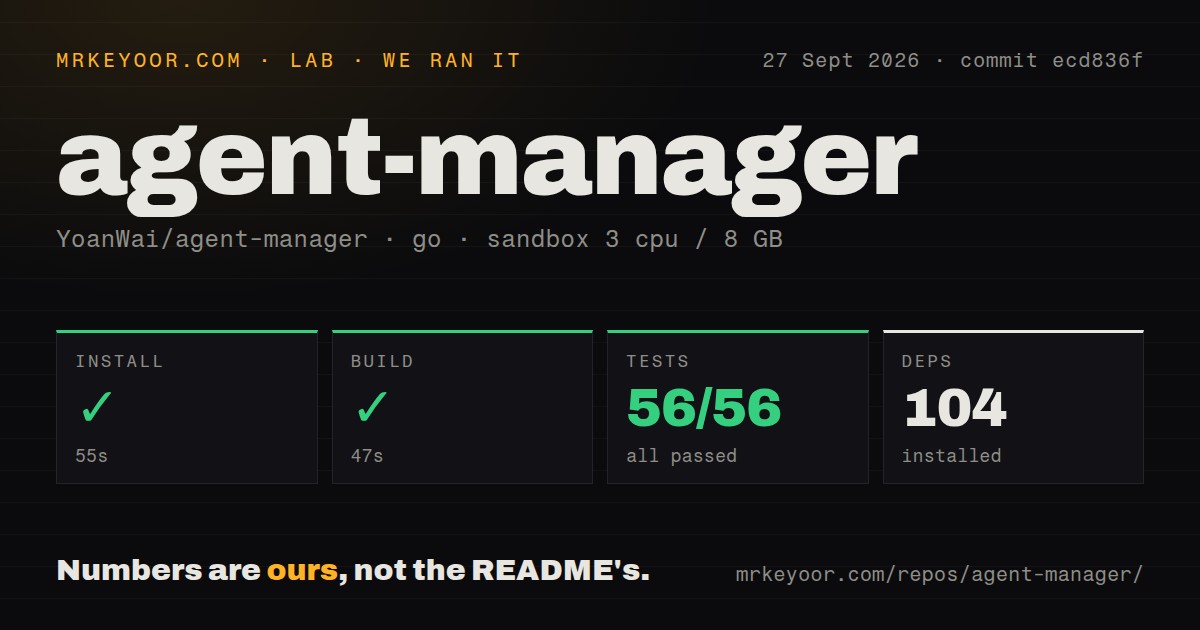
Our sandbox installed commit ecd836f in 55 seconds and added 104 packages. The build succeeded in 47 seconds. Tests took 346 seconds, with 56 passed and 0 failed out of 56. This was a fresh unprivileged Debian container with 3 CPUs and 8 GB of RAM, so the result is a clean check of the repository rather than a developer machine helped by old caches or existing configuration.
The checkout occupied 22 MB and held 305 files with roughly 101,782 lines of source. We found 4 CI workflow files, no Dockerfile, and no tests directory. The missing directory does not mean the project lacks tests: Go keeps tests next to packages, and the supplied test command found 56 of them. Contributor documentation says the suite drives a real tmux server on a separate socket. In our run, that end-to-end dependency worked and the whole suite passed.
Ctrl+R returns line comments as one review round
Changed files appear in full context instead of a narrow patch. You can comment on individual lines, collect several points, and send them to the session as one numbered review round. Sent comments remain visible and can be marked handled through the included MCP tool or a shell command. Review marks are tied to the exact diff and scope, so changing the code does not quietly preserve an approval that belongs to an older state.
Worktree support fits that review loop. A new session can start in its own branch under a sibling worktree, keeping parallel agents from editing the same checkout. The manager can also open a shell beneath an agent for builds or Git commands. These controls do not guarantee safe changes, and they do not replace a final human review. They do make the handoff visible: one agent has a branch, its diff has comments, and the next response returns to that same conversation.
Unsupported CLIs require a feature request
Launch, revive, fork, MCP registration, and screen-reading rules for the nine supported CLIs ship in the binary. Updating Agent Manager can therefore fix a changed Codex or Claude interface for everyone. It also means you cannot describe an unknown CLI in configuration and expect the same treatment. The README sends unsupported tools to a feature request, and issue 535 records Kiro CLI waiting for that work.
Even a built-in tool can expose a gap. Open issue 482 reports that OpenCode permission and question dialogs may fail to mark a session as waiting, which also prevents the attention filter and notification from firing. Two other open issues, 568 and 624, cover selecting a model, effort, or profile per session. Today, the manager launches a CLI on its defaults unless you use a workaround inside that tool. Anyone routing expensive models by task should settle that workflow before moving every session here.
v0.39.0 is active, but cost tracking is absent
GitHub recorded a push on September 27, 2026, one day after v0.39.0 was released. The repository had 526 stars and 58 open issues and pull requests when fetched. The API list split those open items into 49 issues and 9 pull requests, with issue 631 updated on September 27. This is current development rather than a repository coasting on an old release tag, though the volume of interface changes means frequent upgrades are part of the deal.
One omission is unusually easy to judge: the README says cost tracking is not here yet. Agent Manager does show CPU and memory use for live process trees, but it does not answer which session burned through a provider budget. If you already reconcile usage elsewhere, the clean 56-test run and thoughtful review loop make this a strong trial. If the dashboard must also police model spend, Agent Deck is the more direct comparison today.