Printing Press generates a product around an API, not just bindings
Most API generators take an OpenAPI document and emit methods. CLI Printing Press adds research before generation and verification after it. The agent studies official docs, existing CLIs, MCP servers, and browser traffic, then writes a Go CLI and matching MCP server. Generated tools can add SQLite sync, full-text search, offline queries, domain commands, compact JSON, typed exit codes, and dry-run behavior. The ambition is much closer to a tool factory than a template engine.
Each run produces 2 binaries, research notes, verification proofs, discovery artifacts, and a score. The documented workflow has phases for resolving a target, researching it, absorbing competing features, capturing browser traffic where needed, generating code, and adding task-specific commands. Active output, published CLIs, and archived manuscripts use separate directories under ~/printing-press. That structure helps review, but it also means buyers inherit a stateful agent pipeline rather than one deterministic compile step.
The default workflow is built around Claude Code
Installation needs Go 1.26.6 or newer, Node/npm for npx, and a skills-capable agent. The installer obtains the generator binary and refreshes all project skills. The binary can research, generate, verify, and score by itself, yet the README calls skills the primary interface and tells users to restart their agent session after installation. Claude Code is the default, tested target; Codex has a separate --agent codex path and supporting guide.
The codex generation mode delegates phase 3 code tasks to Codex CLI while Claude retains research, planning, scoring, and review. The README claims a 60 percent reduction in Opus tokens for that arrangement, but our lab did not measure model-token use or compare generated quality, so we do not adopt that claim as a finding. Teams should price and evaluate the exact agents they run. The required accounts, models, browser sessions, and API credentials depend on the target being printed.
What happened when we ran it
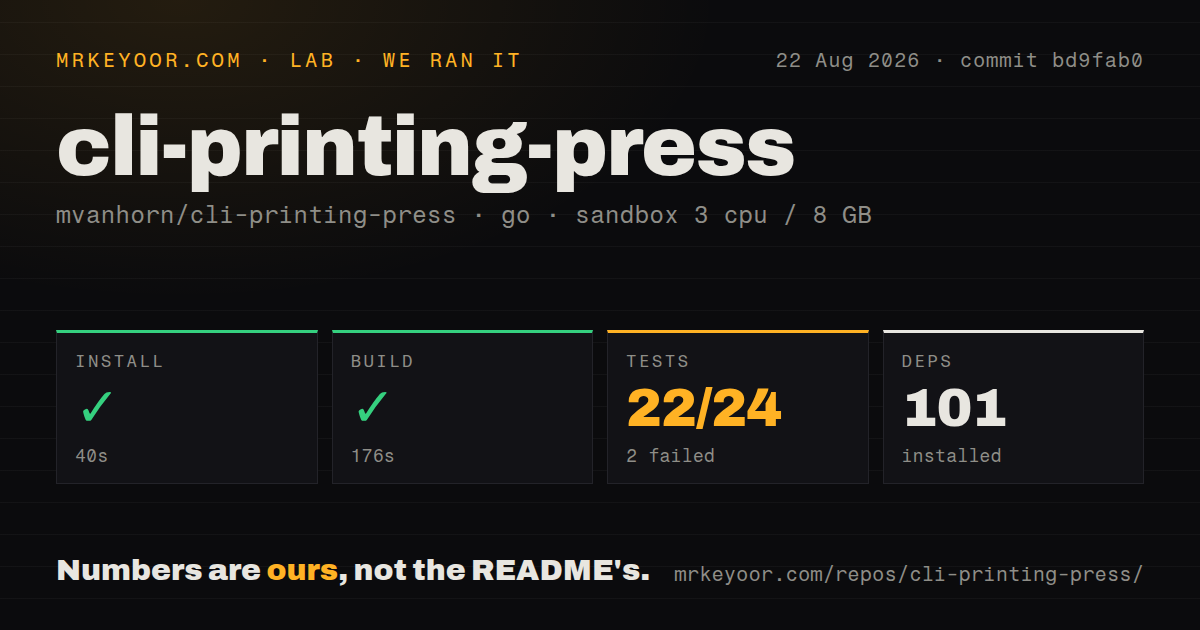
Our sandbox installed commit bd9fab0 in 40 seconds, adding 101 Go packages. The repository checkout was 161.5 MB with 3,840 files and roughly 410,265 lines of source. A full build succeeded, but it took 176 seconds on 3 CPUs with 8 GB of RAM. That is acceptable for a large generator during evaluation, though it is far beyond the feedback loop of a small Go CLI project.
The test command ran for 614 seconds and exited with status 1. Go reported 22 packages passing and 2 failing out of 24. The supplied tail lists successful internal packages, one package with no test files, and a final FAIL; it does not identify the two failing packages or print their assertions. We therefore cannot attribute the failure to networking, environment, timing, or code. The checkout had 10 CI workflows, no Dockerfile, and no top-level tests directory.
Live verification can change the system it examines
The project's central promise depends on dogfooding generated commands and proving live behavior. Open issue 4355 documents why that deserves a hard boundary. The dogfood harness executed Example: strings against a real Synology NAS, created several folders, accepted a cleanup command's success status, and left those folders behind. The report recommends separating human documentation examples from executable fixtures and verifying cleanup by reading the resource back. That is a specific production-safety failure, not a theoretical concern.
A safe evaluation should use a disposable tenant, test account, sandbox API, or isolated device. The 614-second suite result does not cover what a generated tool will do against a third-party service. Generated write commands need explicit fixtures, bounded namespaces, teardown, and post-teardown reads. Browser sniffing also captures traffic that may contain session or account data, so stored manuscripts and research artifacts need the same access rules as credentials.
Generated shell guidance has an open trust-boundary report
Issue 4358 describes another boundary: learning-loop templates place user-controlled questions into shell command lines. The reporter found unsafe forms in generated SKILL.md, AGENTS.md, a runtime protocol constant, and command examples, and recommends writing the text with a non-shell tool before reading it as data. The issue was filed publicly because the repository had no SECURITY.md and private vulnerability reporting was disabled, according to the report.
That finding matters because both generated CLIs and MCP servers will be called by agents. A 101-package install can pass while emitted instructions still teach unsafe command construction. Reviewers should inspect generator templates, generated runtime guidance, and example execution paths, then try hostile and ordinary strings containing quotes or delimiter lines. Never auto-run printed code or skills against valuable accounts merely because the scorecard says a build or smoke test passed.
Same-day development does not make every generated CLI safe
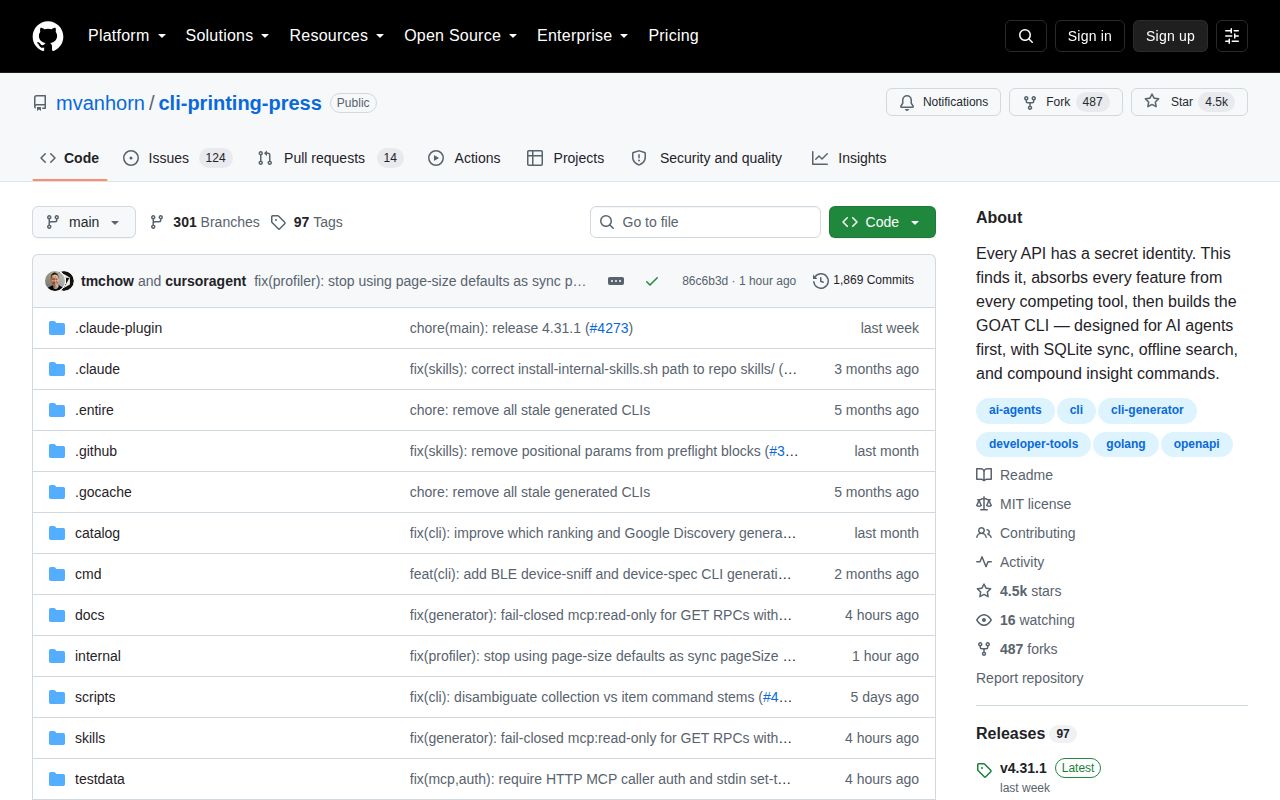
GitHub showed 4,548 stars, 138 open issues and pull requests combined, and a last push on August 26, 2026. Release v4.31.1 arrived August 19 with fixes for response bodies, sync failures, query parameters, and a Go dependency advisory. Current issue activity contains detailed retrospectives and narrowly scoped pull requests, which suggests the project is being exercised heavily. It also shows that the generator's output contracts are still being corrected.
CLI Printing Press is worth studying if API-tool creation is recurring work and your team can supply strong review and isolation. The 176-second successful build proves the large checkout compiles in our environment; 2 failed packages and the live-side-effect reports stop us from recommending unattended use. A conventional OpenAPI generator is duller and easier to constrain. Choose the press only when its research, SQLite layer, compound commands, MCP output, and agent instructions justify the larger trust surface.