mrkeyoor.com_
Tue 01 Sept 17:44 UTC
AI Toolsevaluationupdated 26 Aug 2026

claude-quickstarts review

Claude Quickstarts is Anthropic's English-language collection of deployable examples for the Claude API, ranging from customer support and browser control to managed agents and long-running coding. It solves the blank-page problem by supplying complete applications, but each directory has its own stack, credentials, and safety boundary.

+62stars / 7d
Verdict

Our Claude Quickstarts install added 34 packages in 16 seconds and built in 4 seconds, but it exposed no repository-wide test target, so this is reference code to dissect rather than a verified application base. Use the collection when one of its 9 top-level examples closely matches your problem and you can supply the missing production controls. Do not deploy the computer-control or unauthenticated chat paths unchanged.

We ran it

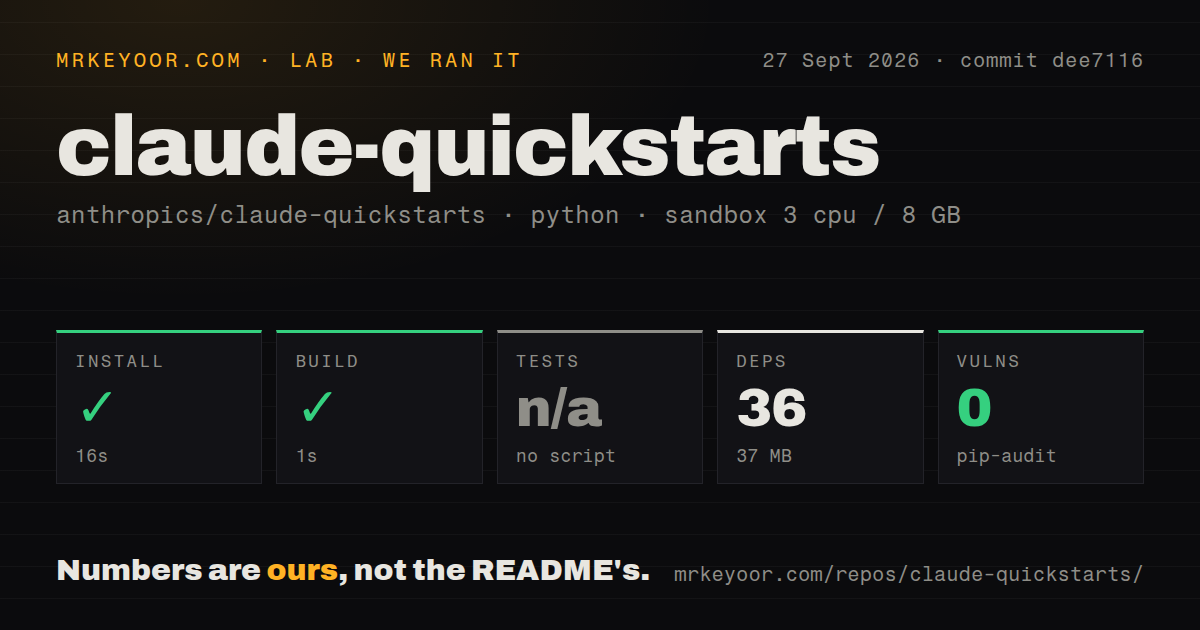
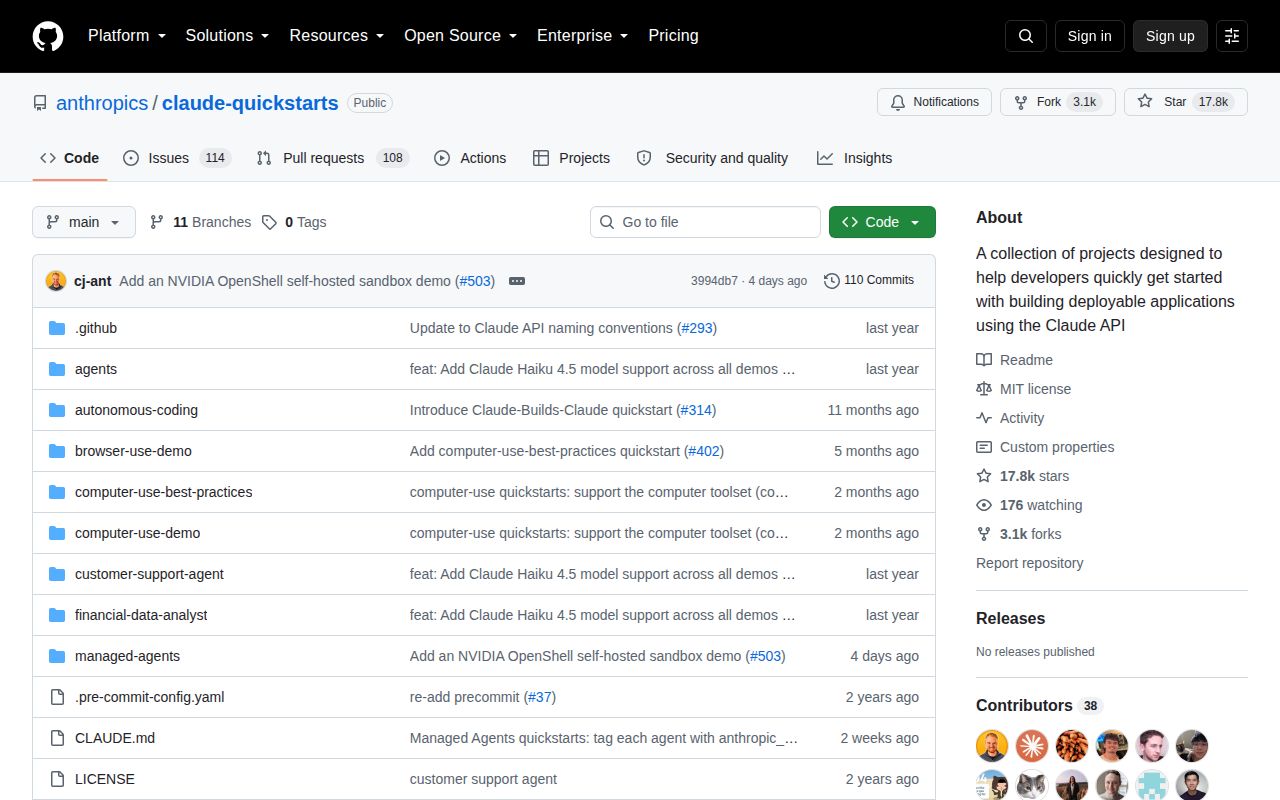
Lab card: what happened when we ran claude-quickstartsScreenshot of claude-quickstarts (github.com/anthropics/claude-quickstarts)
Install✓ · 16s34 packages · 36 MB
Build✓ · 4s
Testsn/ano test script
Known vulns0(pip-audit)
Repo458 files~37,738 lines of source · 7.9 MB · 3 CI workflows

Answers from our run

Does claude-quickstarts build from source?

Dependencies installed in 16 seconds (34 packages), and the build succeeded in 4 seconds. We cloned commit 5264b72 into a clean Debian container with 3 CPUs and no project-specific setup.

Does claude-quickstarts have tests you can run?

Not through a standard command: the project exposes no test script or target that our harness could run.

Does claude-quickstarts have known vulnerabilities in its dependencies?

pip-audit found none in the dependency tree at the time of our run.

Who should not use claude-quickstarts?

Teams seeking one maintained starter with one setup path: the repository contains separate Python and TypeScript applications with different prerequisites.

What are the alternatives to claude-quickstarts?

Claude Cookbooks, OpenAI Cookbook, LangChain. Our Claude Quickstarts install added 34 packages in 16 seconds and built in 4 seconds, but it exposed no repository-wide test target, so this is reference code to dissect rather than a verified application base.

Setup3/5Root checks pass, but each quickstart has separate services
Docs4/5Detailed per-demo guides expose deployment and safety limits
Community4/517,524 stars and 197 active issues and pull requests
Maturity3/5Official examples are current, with no shared test target

Who it’s for

Developers who learn faster from complete Claude API applications than isolated request snippets.
Teams prototyping computer use, browser automation, support search, or managed-agent chat.
Engineers who will extract a pattern and add their own authentication, permissions, evaluation, and deployment controls.
Claude Code users studying a resumable two-agent coding harness.

Who it’s NOT for

Teams seeking one maintained starter with one setup path: the repository contains separate Python and TypeScript applications with different prerequisites.
Anyone ready to deploy the demos unchanged: the browser demo says it is not for production, while the managed-agent chat trusts every caller until getUser is replaced.
Operators who cannot isolate computer control: Anthropic's macOS reference says the agent can see the screen, operate applications, and overwrite data, and strongly advises a disposable VM.
Developers expecting a repository-wide regression suite: our run found no tests directory and no test script or target, so tests were skipped.
Teams needing uniform licensing inside every example: the repository reports MIT, but the autonomous coding README labels that demo for internal Anthropic use.

Setup reality

Our sandbox installed 34 Python packages in 16 seconds and used 36 MB. The build succeeded in 4 seconds. There was no tests script or target, so we skipped tests; pip-audit found 0 known vulnerabilities.

Every useful demo needs Anthropic authentication. Some add Docker, Playwright, VNC, AWS credentials, a Bedrock knowledge base, Node 22.9, Claude Code, or managed-agent IDs. The top-level five-step setup hides those per-directory differences.

The 458-file checkout spans about 37,738 source lines and 7.9 MB. It has 3 CI workflow files, no root Dockerfile, and no tests directory. Computer-control examples require isolation, while public chat deployments need real user authentication.

Nine examples cover very different Claude applications

The top-level README currently links 9 quickstarts: customer support, financial analysis, computer use, computer-use best practices, browser use, autonomous coding, and 3 managed-agent applications. That breadth is useful when you want to see request handling inside a real interface. It also means the repository is a collection, not a framework. Code shared by one directory should not be assumed to govern another.

The checkout at commit 5264b72 contained 458 files and about 37,738 source lines. Some projects are Python applications, others use TypeScript, and several bring their own UI. The root README reduces setup to cloning, entering a directory, installing dependencies, adding an API key, and running the app. Each child README is the authoritative setup document because the extra requirements vary sharply.

Browser control requires Docker and explicit human limits

The browser-use demo combines Playwright, Chromium, Streamlit, a virtual display, and VNC inside Docker Compose. It exposes a chat UI on port 8080 and a NoVNC view on port 6080. DOM references give Claude a steadier target than raw screen coordinates. The README still warns that Google searches can hit CAPTCHAs and that websites may contain instructions capable of steering the model away from the user's request.

Anthropic labels this browser demo as learning code, not production software. Its advice is concrete: isolate the browser, keep credentials out, restrict domains, and require human confirmation before financial transactions, consent, or other consequential actions. The native macOS best-practices project is even stricter. It advises a disposable VM because the agent can control the keyboard, mouse, screen, files, and applications.

Managed-agent chat ships with authentication unfinished

The managed-agents Chat SDK example needs Node 22.9 or later plus Anthropic authentication. Its setup command creates an agent and environment, then writes their identifiers into configuration. The server stores no local transcript because the managed session owns history. A browser client shows replies and tool activity, and the same handler can be adapted to supported messaging services.

The demo's getUser function trusts every caller, so it binds to 127.0.0.1 by default. The README tells deployers to replace that function with a real session lookup before binding publicly. Long-held chat responses can also exceed short serverless duration limits. Those details make the example useful: they show exactly where application authentication and hosting choices begin, instead of implying that an API key completes the product.

What happened when we ran it

Our fresh Debian sandbox installed 34 Python packages in 16 seconds, occupying 36 MB. The build succeeded in 4 seconds. Pip-audit reported 0 known vulnerabilities in the installed Python environment. These are clean repository mechanics for commit 5264b72, and they say nothing about model response quality, token cost, browser accuracy, or the cloud services required by individual demos.

There was no tests script or target, so we skipped tests. Our scan found 3 CI workflow files, no root Dockerfile, and no tests directory. The absence of one repository-wide suite matters because the collection contains several independent products. A successful 4-second build cannot verify a Bedrock knowledge base, Docker browser, managed-agent session, or macOS desktop controller without their credentials and runtime environments.

The support starter asks for broad AWS access

The customer-support example is a Next.js interface backed by Claude and Amazon Bedrock Knowledge Bases. Its guide asks users to create AWS credentials, attach AmazonBedrockFullAccess, prepare a knowledge base, select a data source, and place knowledge-base IDs in the application. It also documents Amplify deployment. That is much more infrastructure than the top-level promise of adding one Claude API key.

A competent AWS team can narrow permissions and move secrets into its normal deployment system. The starter does not do that design work for you. Its sample configuration also names dated Claude models, so model availability should be checked before copying it. This example is best treated as a UI and retrieval walkthrough, with identity, authorization, data governance, and least-privilege IAM supplied by the adopter.

The coding harness can run for many hours

The autonomous-coding directory uses an initializer and a coding agent across repeated sessions. The initializer creates 200 test cases, and subsequent sessions implement them while saving progress in Git and a feature list. Its README says each coding iteration can take 5 to 15 minutes and a full 200-feature application can require many hours. Those are upstream expectations, not results from our sandbox.

The harness has a command allowlist and project-directory restrictions, which are useful examples of containing generated shell work. It still produces code and setup scripts that need review before execution. There is also a licensing ambiguity worth resolving: GitHub reports MIT for the repository, while this directory's README ends with "Internal Anthropic use." Ask Anthropic before using that specific demo as a commercial project base.

August pushes coexist with a large review queue

GitHub recorded a push on August 25, 2026, 17,524 stars, and 197 combined issues and pull requests. There is no latest GitHub release. Open pull requests address MCP transport imports, Python version documentation, screenshot-history pruning, and dated computer-tool behavior. That activity shows people are testing details, while the queue also signals that fixes may wait outside the default branch.

Claude Quickstarts earns a place beside the API documentation because complete applications reveal integration boundaries that snippets omit. Pick one directory, pin its dependencies, add tests around the behavior you retain, and rework every permission boundary. If none of the 9 examples matches your architecture, the smaller Claude Cookbooks will leave less code to unwind.

Alternatives

ProjectWhat it isPick it when
Claude CookbooksSmaller notebooks and recipes for individual Claude API techniques.pick this instead when you need a focused API pattern without adopting a complete demo application.
OpenAI CookbookExamples and guides for building with OpenAI models and APIs.pick this instead when your application is based on OpenAI rather than Claude.
LangChain gh↗A provider-spanning application framework with reusable agent and retrieval components.pick this instead when provider portability matters more than direct Claude patterns.

What people are saying

  1. [github-trending] anthropics/claude-quickstarts

Sources

  1. Claude Quickstarts README
  2. Browser use demo guide
  3. Managed Agents Chat SDK guide
  4. Autonomous coding demo guide
  5. Open issues and pull requests

More ai tools reviews

claudian · SkillSpector · robin · mjlab · MoGe · awesome-design-md · the whole board →