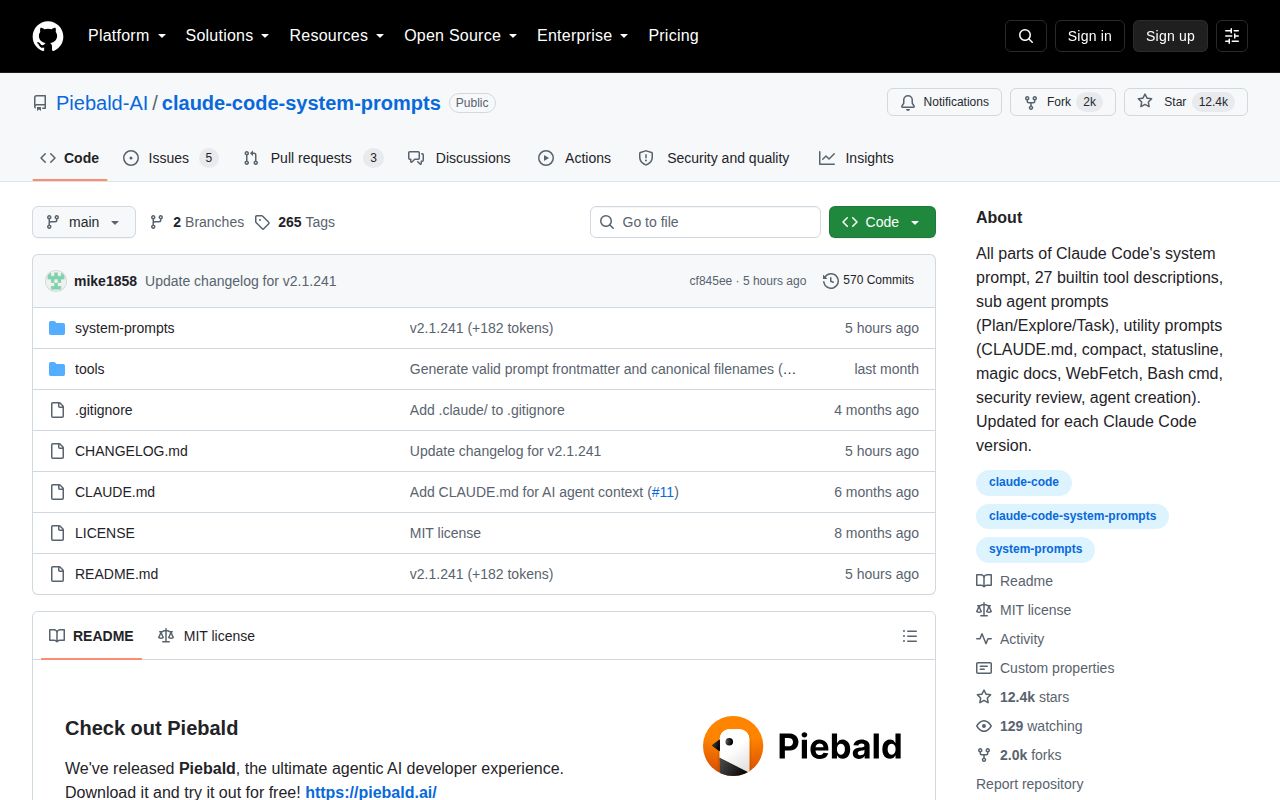
Claude Code has many prompts, not one
The useful insight behind this repository is that Claude Code cannot be understood by reading one master instruction. Its behavior is assembled from many pieces: core system guidance, descriptions for built-in tools, prompts for specialized agents, reminders injected under certain conditions, utility prompts for jobs such as compaction, and increasingly large skills and data references. Which pieces appear depends on the environment, configuration, available tools, and task.
Piebald AI extracts those strings from the compiled @anthropic-ai/claude-code npm package and writes each one to a Markdown file. The archive labels files by role and includes comment-based frontmatter with a name, description, Claude Code version, template variables, and agent metadata where available. The README acts as a generated index with token counts and short explanations. This turns a large minified JavaScript bundle into something humans can search, link to, and diff.
That organization is genuinely valuable. A tool author can examine the instruction shown to an editing tool. A prompt engineer can compare the planning agent with the exploration agent. A team considering an upgrade can open the changelog and see which instructions appeared, changed, or disappeared instead of guessing from user-visible release notes alone.
Version tracking is the standout feature
The repository follows Claude Code's version numbers. Version 2.1.235 of the archive was released on August 19, 2026, the same day as the latest repository push, and the README ties it to the corresponding npm package. Releases link directly to a commit diff and summarize newly added, changed, and removed prompt pieces. Even Claude Code releases with no prompt changes receive an explicit archive release saying so.
The changelog covers 260 versions since 2.0.14. That history makes the project more useful than a one-time prompt dump. You can trace how a tool description evolved, determine when an agent workflow appeared, or review sudden token growth. The Markdown files are also far easier to inspect with Git than copied terminal output or screenshots.
Token counts help identify unusually large instructions, but they are not measurements of one real session. The README says some files retain placeholders for tool names, agent lists, and other runtime values, and estimates that substitution can move counts slightly. More importantly, conditional files in the repository are not all loaded at once. Adding every listed number would misrepresent the context Claude Code actually sends for a given turn.
Exact text does not mean complete runtime context
The extraction method supports a strong claim: when a string is found and reconstructed, it comes from compiled Claude Code rather than a community rewrite. That does not make the archive an official specification. Piebald AI maintains it, not Anthropic, and the repository's CLAUDE.md explicitly says these files are extracted reference material. Editing them does nothing to an installed copy of Claude Code. The project points users to tweakcc for local patching and conflict handling.
Coverage also has edges. Issue #35 showed that the archive had only the second fragment of the ToolSearch description and missed related fragments for other tools. Pull request #36 fixed the extraction shape within a day, which reflects well on maintenance, but it also demonstrates that source strings can be present without the extractor recognizing how they combine at runtime. Open issue #33 asks for built-in output-style prompts that are not included.
Tool descriptions are only one half of a callable tool contract. Issue #22 and open pull requests #24 and #25 discuss adding JSON input schemas for built-in tools. Until that work is accepted, someone recreating a compatible runtime would have prose descriptions but not the full required fields, enums, and validation rules. This archive is excellent evidence, but it is not a complete protocol definition.
Reading is easy, reproduction is not
There is nothing to install for normal use. GitHub renders each prompt, cloning enables fast local search, and release tags preserve version snapshots. The 170 KB README is long because it lists hundreds of artifacts; browser search or repository search is more practical than scrolling. The 433 KB changelog needs the same targeted approach.
The tracked update tooling is aimed at maintainers. updatePrompts.js reads a JSON export containing prompt pieces and identifiers, reconstructs Markdown, carries forward unchanged token counts, and calls Anthropic's token-counting API for new or changed text. It then updates the index and removes stale generated files. An ANTHROPIC_API_KEY is mandatory for that counting step. The repository does not include a root package manifest or a documented command that produces the input JSON from a fresh Claude Code package, so cloning alone does not reproduce the entire extraction pipeline.
There are tests for Markdown filename and frontmatter utilities, which is good, but users must still trust the unpublished or separate extraction stage that finds the original strings. For research requiring repeatability, document the archive commit, matching Claude Code version, and any runtime capture used to confirm assembly.
Healthy maintenance with a narrow mission
On August 19, the open queue contained six issues and three pull requests. Some requests are intentionally adjacent to the project's mission, such as architecture diagrams, tool schemas, and prompts from another coding product. More telling is the response to actual archive defects: the missing ToolSearch fragments reported on August 13 were repaired and merged on August 14. Releases arrived repeatedly throughout the same week as upstream versions changed.
This is a mature reference workflow despite being less than a year old. Its best use is comparative research: find a prompt, read its variables and metadata, then inspect the version diff. Do not copy an isolated instruction and expect Claude Code's behavior, because tools, schemas, runtime substitutions, surrounding prompts, and model behavior all contribute. Used with that discipline, the archive saves hours of opaque bundle inspection and makes an otherwise hidden product surface meaningfully reviewable.