Choose a feed before importing the whole directory
Chinese Independent Blogs gives you a blog address, an RSS link, and topic tags in the same row. Open an unfamiliar author's site, read a post, and subscribe if you want another one. That is a useful job for a directory to do. The README and hosting guide are in Chinese, and there is no separate English README. Readers who need English descriptions should choose another starting list or expect translation work.
Our measured checkout occupied 1.6 MB across 39 files. The small repository can seed a personal reading list or a tool that organizes blog metadata, without requiring you to host the companion site. Its entries span programming and personal writing, with tags such as mathematics, photography, and everyday life. A tag helps you find a candidate. It does not tell you whether that author writes carefully or whether the next article will interest you.
What happened when we ran it
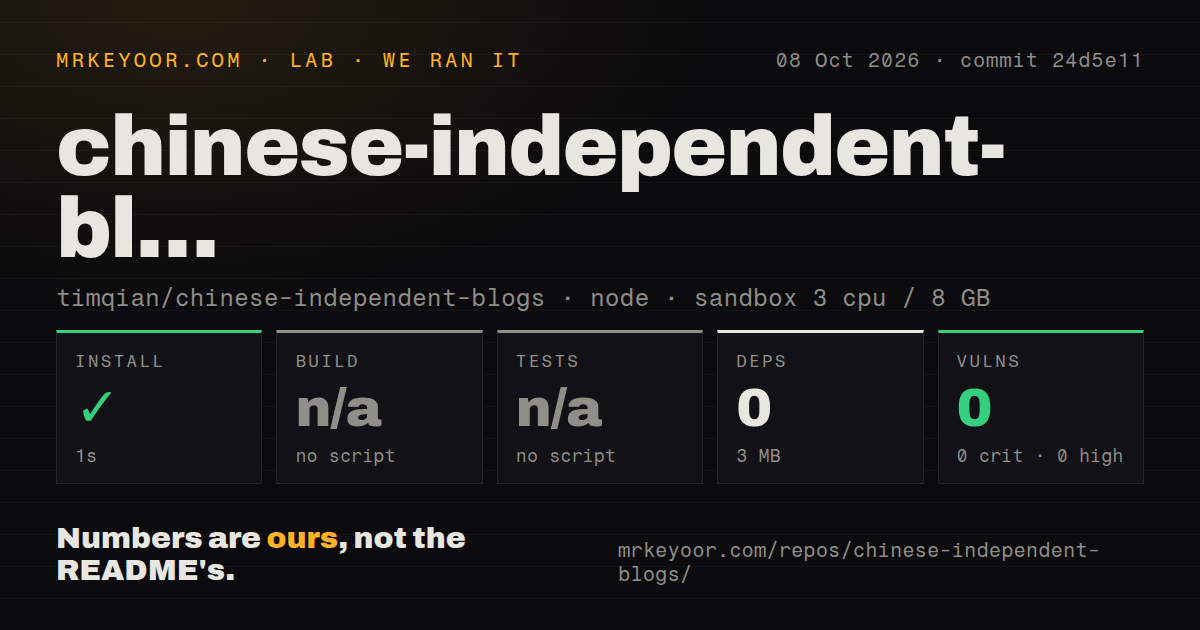
Our sandbox installed Chinese Independent Blogs in 1 second, adding 0 packages and occupying 3 MB. We cloned commit 24d5e11 on October 8, 2026, in an unprivileged Debian container using lab-node:22, with 3 CPUs, 8 GB of RAM, and no secrets. Npm audit reported 0 known vulnerabilities across all severity levels. The installation result describes the repository path measured by that run.
Build and tests were skipped because the measured path had no build or test script or target. Our scan found 2 CI workflow files, no Dockerfile, and no tests directory. There is no failed test log to diagnose, and there is no passing suite to claim. The lab results do not establish how many feeds work, how well the directory selects authors, or whether the companion website runs correctly.
The CSV is the submission source
Contributors append the blog name, address, RSS URL, and tags to blogs-original.csv, then submit a pull request. The root package provides commands for metadata linting and regenerating the README and OPML. That makes the underlying list reusable: a developer can read structured rows instead of scraping a rendered table. For a reading tool, retain the original address and feed URL so a domain migration remains traceable.
The 0-package install needs a careful interpretation. Current root scripts use Node's built-in facilities for maintaining directory files, while the companion website has its own package manifest under frontend/. Its hosting guide describes a Cloudflare Worker and D1 database. You can use the directory without adopting that stack. Running your own version of the website is a separate operating decision, with cloud configuration and account features to maintain.
The OPML export includes feeds flagged as unhealthy
The OPML generator filters CSV rows only for the presence of an RSS address. It does not consult the health data used by the README renderer. A feed can therefore appear in the export even when the rendered directory has moved its blog into the suspected-failure section. That is a concrete reason to select feeds deliberately before importing the whole file into your reader.
The roughly 3,111 source lines in our checkout are enough to make this boundary inspectable. The README renderer uses data/blogs.json to separate entries flagged as dead and sort the rest by the latest known post date. That is a recency order, not an editorial ranking. A prolific blog can appear ahead of a slower author you would rather follow. Start with a topic and an article, rather than treating table position as a recommendation.
Failed status downloads preserve the previous snapshot
The status synchronization script retrieves crawl data from the companion website. If the request fails or the response fails its checks, the script keeps the previous data/blogs.json and exits successfully after logging the problem. That protects a useful snapshot from a bad response. It also means a successful automation job can still leave yesterday's feed-health information in place.
Our scan's 2 workflow files correspond to metadata linting and directory updates in the current source. Neither the workflow count nor the dependency audit substitutes for fresh feed checks. The stored failure section includes HTTP errors and invalid RSS responses, which describe retrieval problems rather than a judgment about an author's work. For downstream use, show the snapshot date and preserve the failure reason. An unreachable feed and an abandoned blog are different claims.
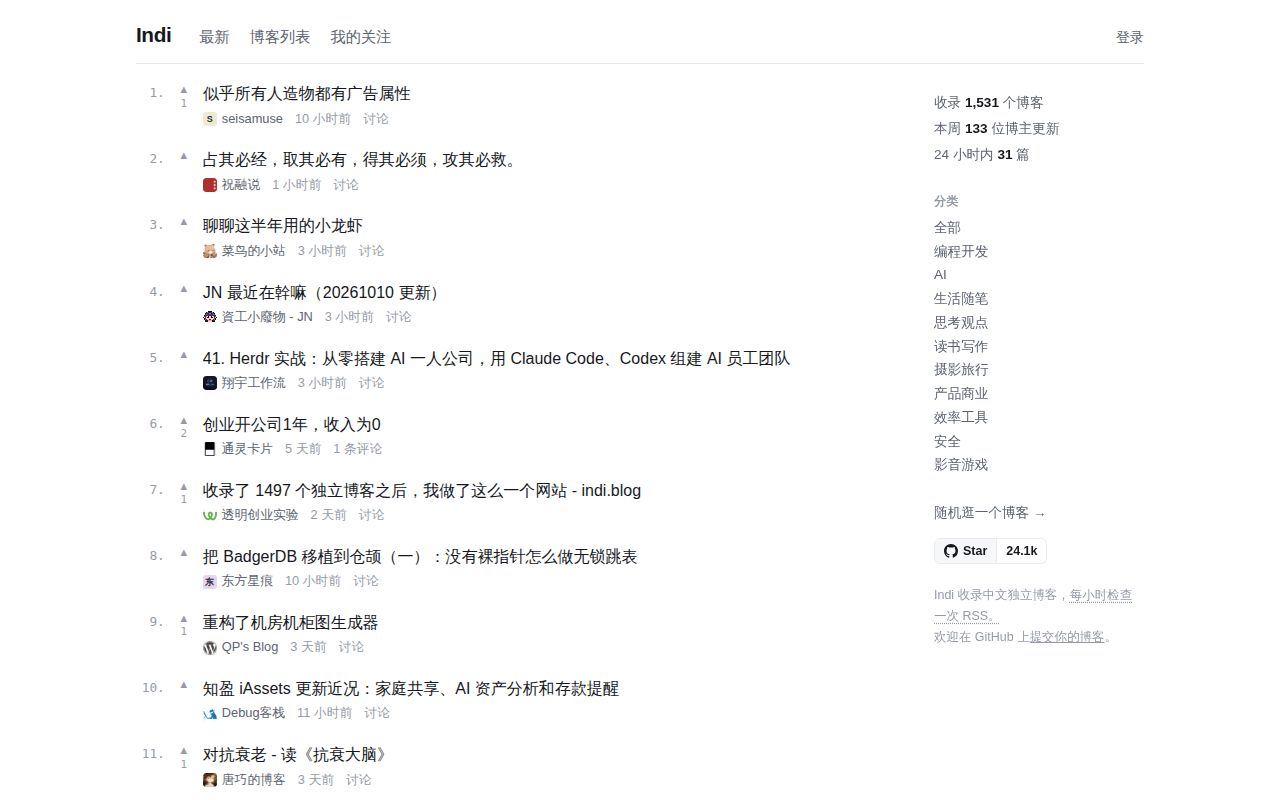
Hosting Indi adds cloud services and account configuration
The frontend guide documents local D1 emulation and deployment to Cloudflare Workers. The site supports following blogs, voting, and discussion. GitHub login needs an OAuth application and secret, while email login needs sending configuration. Manual crawling uses an administrator token. Those requirements matter if you want the whole community site rather than a CSV or OPML file.
The 3 MB footprint from our root installation does not cover a working deployment of those features. It gives you no measurement of the site's storage needs or feed-fetching workload. I'd reuse the files first if my goal were a personal reader or a research shortlist. Choose the site code only when its discussion and account functions are part of your actual requirement, and verify that deployment separately.
October submissions show a maintained, changing list
GitHub recorded the last push on October 10, 2026, with 24,059 stars and 8 open issues and PRs. Recent submissions include new blogs and domain changes. PR 2241 asks to restore a removed entry and reports that its site and feed are reachable. That is a contributor's report, not our network measurement. The activity shows ongoing upkeep, even though the latest-release endpoint returns no release.
Awesome Developer Blogs is a better starting point for developer reading without a Chinese-language focus. Awesome RSS Feeds supplies broader feed collections organized by country and category. For Chinese independent writing, this directory's CSV and RSS links are useful raw material. Keep only subscriptions whose articles you want to read, and treat the health snapshot as dated evidence when a feed disappears.