Chatwoot replaces several support inboxes with one queue
Chatwoot gathers website chat, email, Facebook, Instagram, X, WhatsApp, Telegram, Line, and SMS conversations into one support workspace. Agents can add private notes, mention teammates, apply labels, use canned replies, assign work, and filter conversations. Contacts keep interaction history and custom attributes, while the help center publishes articles and FAQs. The product is a credible open-source alternative to hosted customer-support suites because it covers the daily agent loop, not just a chat widget.
Breadth is both the reason to adopt it and the reason to avoid it for a tiny helpdesk. Our checkout contained 9,067 files and about 509,836 lines of source. Chatwoot includes reporting, contact segments, campaigns, automations, business hours, capacity management, multilingual support, and integrations with tools such as Slack, Shopify, Dialogflow, Linear, and Google Translate. If your whole requirement is two people answering one email address, much of this system becomes unused maintenance.
The inbox model fits organizations where a customer may start on web chat and continue through another channel. Shared context, assignments, internal notes, and reports are harder to recreate with separate provider dashboards. Chatwoot also keeps the customer record and conversation history under the operator's control. That benefit depends on configuring retention, access, backups, and deletion correctly; self-hosting changes who owns those jobs rather than making them disappear.
Production requires Rails, workers, PostgreSQL, Redis, and mail
The README offers Heroku and DigitalOcean buttons, while the maintained deployment documentation covers Docker, a Linux VM, Kubernetes, and cloud providers. Chatwoot's architecture lists web servers, background workers, PostgreSQL, Redis, and an email service. Its production Compose file adds persistent application storage and separates the Rails and Sidekiq processes. This is normal for a customer-support product, but it is materially more than starting one container.
Environment configuration controls the useful edges: the public URL, mail delivery, object storage, channel providers, authentication, and optional integrations. The README warns that relevant features can break when variables are omitted. External channels bring their own credentials, webhooks, account reviews, templates, and provider policies. A green local test cannot tell you whether a WhatsApp callback reaches the server or whether outbound support email passes authentication.
Stable deployment also means choosing the correct branch. The repository's default branch is develop, following its git-flow model. Chatwoot tells users who need a stable version to use master or a tagged release. That is a small line in the README with a large operational consequence: cloning the default branch for production puts unreleased work into a customer-facing communications system.
What happened when we ran it
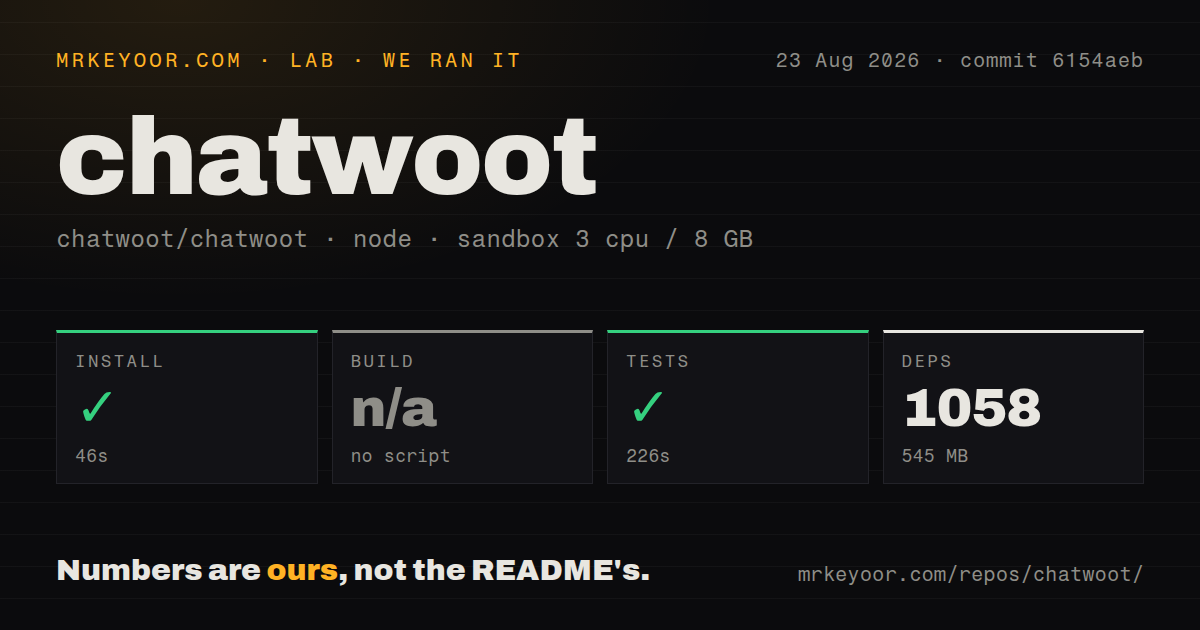
Our sandbox install at commit 6154aeb succeeded in 46 seconds, pulling 1,058 packages and consuming 545 MB on disk. We ran it in a fresh unprivileged Debian container with 3 CPUs, 8 GB of RAM, Node 22, and no secrets. The repository used pnpm. Installation was reasonably quick for the size of the front end, although the result is only the JavaScript dependency layer of a Rails application.
The test command passed in 226 seconds. Our measurement block did not include a case count, so the defensible claim is that the invoked command completed successfully. The harness found no build script or target and skipped that step; it did not record a build failure. The checkout had 16 CI workflow files and a tests directory.
No Dockerfile appeared in the measured repository signals, despite Chatwoot publishing container images and keeping a production Compose file. That distinction is worth preserving: users can deploy official images without the source tree containing a root Dockerfile detectable by our harness. The measured run supports a clean dependency and test result, not a complete production boot with PostgreSQL, Redis, mail, storage, and channel secrets.
Open core boundaries need a feature-by-feature check
The README presents Captain as an AI support agent and lists a wide set of customer-service features. Release v4.17.0 makes the commercial boundary more visible. Its notes mark WhatsApp campaign outcome tracking, several Captain controls, Twilio call transcription, and audit-log filtering as Enterprise functions. The release also includes open changes such as Freshdesk import, macros in the reply editor, canned-response search, and a Slovenian translation.
That split is legitimate, but buyers should map requirements before committing to self-hosting. The MIT-licensed repository may cover the core inbox while a desired governance or AI feature sits in a paid tier. Compare the edition matrix against concrete needs such as audit records, automation controls, and campaign reporting. Do not select an open-source helpdesk based on the longest feature list and discover the licensing boundary during rollout.
Current releases and daily work support a production shortlist
GitHub recorded a push on 2026-08-26, and v4.17.0 was published on 2026-08-20. Recent work covered email recipients, WhatsApp contacts and recordings, Twilio calls, help-center editing, automations, session cleanup, and CRM additions. The repository had 1,355 open issues and PRs, which is GitHub's combined count rather than 1,355 confirmed defects. The queue is large, while its newest entries match actively maintained product areas.
Chatwoot belongs on the shortlist for a support team consolidating several live channels and willing to run a serious web application. Our 46-second install and passing 226-second test command reduce concern about the measured checkout. They do not reduce the operational surface of customer messages, worker queues, provider webhooks, storage, and backups. Use the product for its channel breadth; avoid it when that breadth is unnecessary.