The current repository cannot read WeChat data by itself
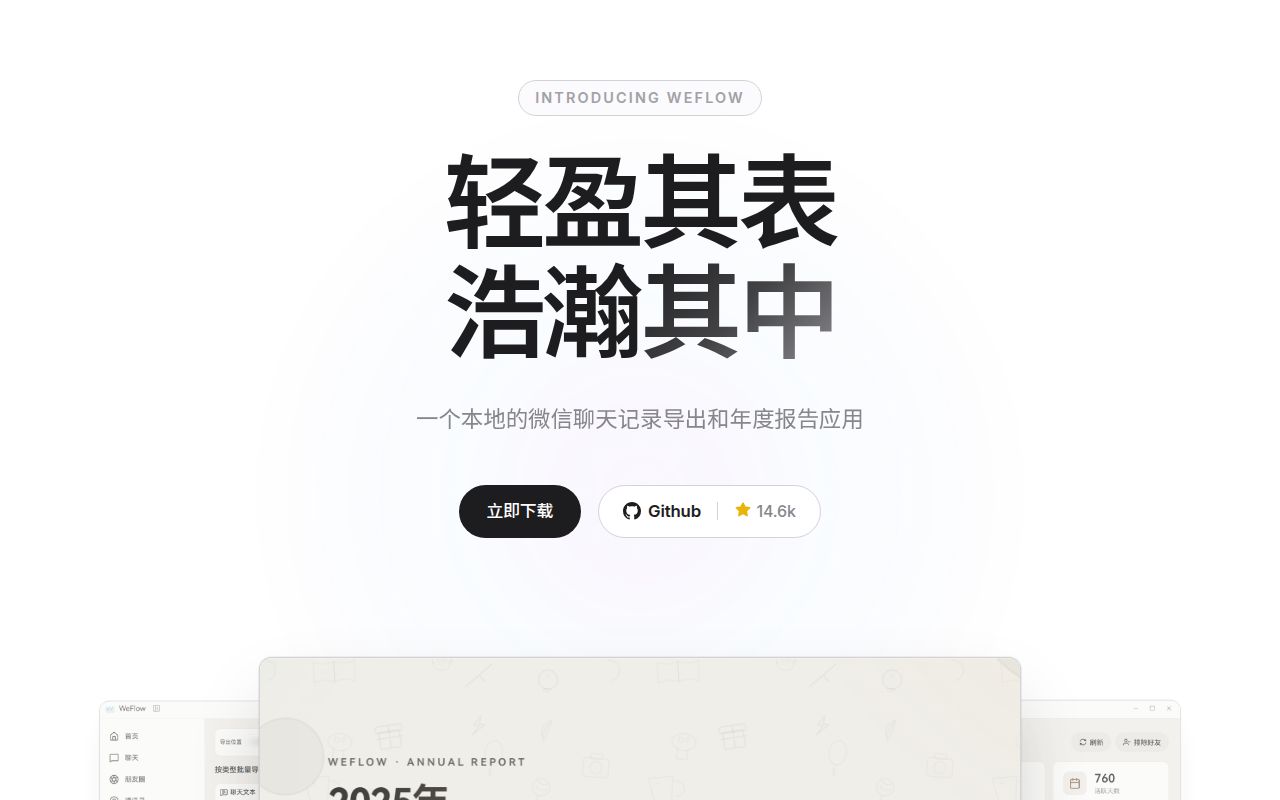
WeFlow presents a polished local app for browsing chats, analyzing private and group conversations, generating annual reports, and exporting records. The format list is unusually broad: JSON, HTML, Markdown, text, Excel, CSV, PostgreSQL, and ChatLab are all named. There is also a local HTTP API for messages, sessions, contacts, group members, media, and server-sent events. That feature list describes the interface. The current source does not contain the complete path to the data.
The linked component guide says WeFlow no longer bundles native code for reading or decrypting local data. Four classes of capability must come from paths you configure in the app, including a WCDB library, a media-decryption addon, and a batch export executable. If a path is empty or missing, the matching function returns an unconfigured error. In plain terms, npm run dev can start the shell, but it cannot turn an ordinary checkout into a working chat exporter.
Four external component paths move trust onto the user
The database bridge loads a .dll, .dylib, or .so through a C interface. Media decryption uses a Node native addon, while batch export launches an executable and exchanges newline-delimited JSON over standard input and output. The guide is specific enough for an experienced systems developer to implement those contracts. It does not provide the implementations, which is the difference between an interface specification and a usable desktop package.
WeFlow also states that it does not verify the source, signature, or implementation of the executable, library, or plugin you select. That is a serious boundary because the components receive access to private chat databases and media. A random binary found in an issue thread or file-sharing site should not inherit that access. Require source, reproducible build instructions, hashes from a trusted publisher, and a review of where decrypted output is written.
What happened when we ran it
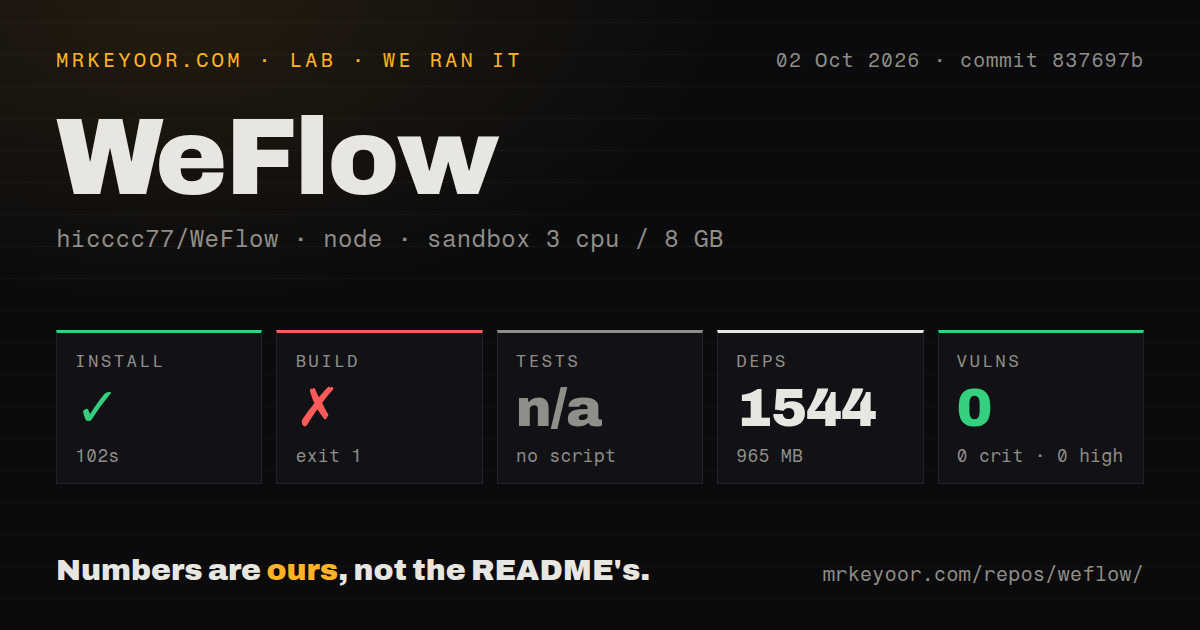
Our sandbox installed commit 837697b in 102 seconds. Npm added 1,544 packages, and the resulting installation occupied 965 MB. The repository had 550 files, about 197,286 lines of source, and a 49.4 MB checkout. Npm audit reported 0 known vulnerabilities. We ran this in a fresh unprivileged Debian container with 3 CPUs, 8 GB of RAM, Node 22, and no secrets.
The build failed after 93 seconds with exit code 1. Its final lines show a call stack through Vite and Rolldown, ending at aggregateBindingErrorsIntoJsError, with an errors getter on the thrown object. Those lines do not contain the original binding error, so they do not support a claim about a missing system package, broken source file, or incompatible runtime. The defensible finding is that commit 837697b did not produce a package in our clean container.
WeFlow has no test script or target, so the lab skipped tests. The repository has 1 CI workflow, no Dockerfile, and no tests directory. A zero-result npm audit is useful, but it only covers advisories known to that audit. It does not validate the Electron app, the absent native components, export correctness, or the safety of any binary a user supplies.
The API stays local and uses a token
The documented server listens on 127.0.0.1:5031 by default. Routes under /api/v1/* require an access token, apart from health checks, and clients may send it in a bearer header, query parameter, or POST body. The API can return raw JSON or ChatLab records and can push new-message and revoke events over SSE. That is useful for local scripts, provided the loopback binding is preserved.
Query-string tokens can appear in client history and logs, so the bearer header is the better choice outside the documented SSE exception. A reverse proxy or changed bind address would widen access to chat content. WeFlow stores whether the API and push service are enabled and restores those settings after restart. Treat that persistence as a service exposure decision, not a convenience toggle. Rotate the token if it enters a log or shared command history.
Windows, Apple Silicon, and Linux are named, but releases are absent
The README lists Windows 10+ on x64, Apple Silicon macOS, and x64 Linux, with .exe, .dmg, .AppImage, and .tar.gz packages. On October 2, 2026, GitHub's latest-release endpoint returned 404. Open issue 1221 asks why every release was removed, while issue 1217 asks for hashes of older binaries circulating elsewhere. Those are user reports, but the missing official artifact is directly observable.
Repository activity needs the same qualification. GitHub showed 14,648 stars, 94 open issues, and a last push on September 28, 2026. The visible history returned 2 commits: an initialization and a README update. Issues were still receiving activity on October 2, yet a recent issue timestamp does not provide a maintained installer. The source may be current by date, but its distribution and trust story are unresolved.
The license and language narrow the practical audience
WeFlow's README, HTTP API guide, and native component specification are in Chinese. The current tree contains no English guide, so non-Chinese readers will need translation for security-sensitive setup details. Its license file is CC BY-NC-SA 4.0 and limits licensed use and sharing to noncommercial purposes. GitHub reports the license as unclassified, but the restriction is explicit in the text.
For a Chinese-reading developer, the interface definitions could support a private fork built around known native code. That is a specialist project, not a download-and-export recommendation. Our 93-second build failure is fixable only after its underlying error is captured, and a fixed JavaScript build would still leave the 4 external component classes. Until complete, auditable components and official artifacts return, WeFlow is better treated as a UI codebase and protocol reference than an end-user backup tool.