Choose a supported ternary model before choosing BitNet
BitNet's own supported-model table is the place to start: the model, CPU architecture, and kernel have to match. This repository provides bitnet.cpp, Microsoft's runtime for language models trained with ternary weights. That means weights drawn from a small set of values, rather than an arbitrary model made smaller after training. If you already have a model picked out, check the table before spending time on the toolchain.
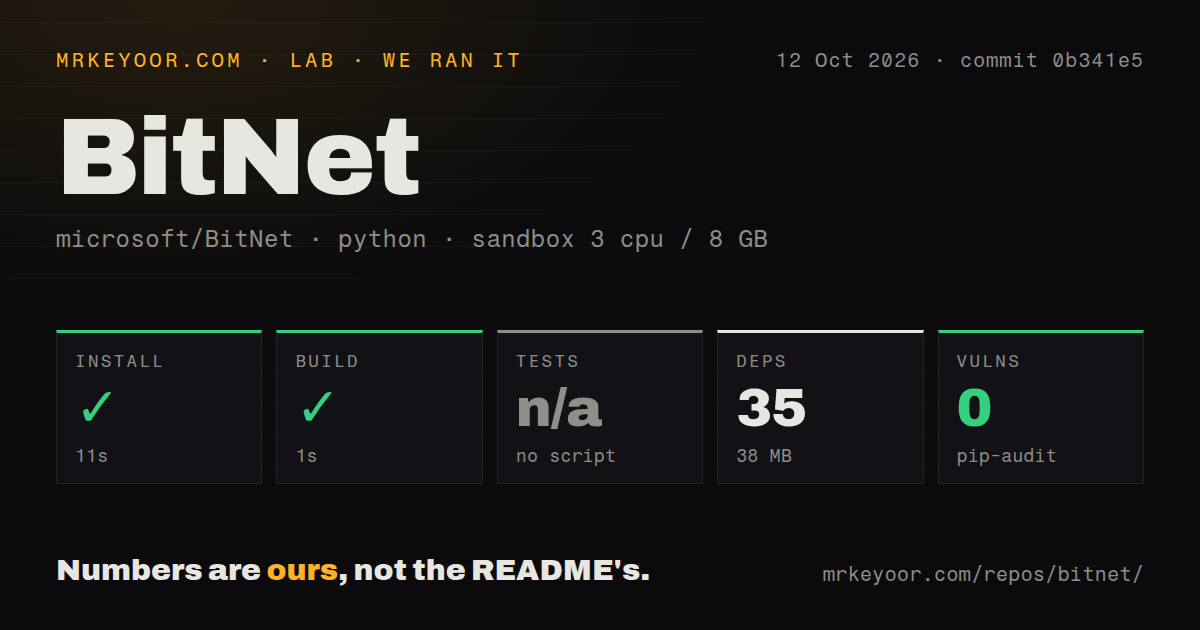
The small Python environment can make the project look lighter than it is. Our install added 35 packages and used 38 MB, while the checkout contained 3,130 files and about 681,264 lines of source. GitHub identifies C++ as the main language, although our lab used the Python setup ecosystem. You'll be working across Python wrappers, native code, model files, and a llama.cpp submodule. The modest dependency footprint doesn't describe that whole job.
What happened when we ran it
Our sandbox installed commit 0b341e5 in 11 seconds and completed its build step in 1 second. We ran it on October 12, 2026, in an unprivileged Debian container with 3 CPUs and 8 GB of RAM, using ghcr.io/astral-sh/uv:python3.12-bookworm without secrets. The installed environment held 35 packages and occupied 38 MB. Both measured steps succeeded, with no failure log supplied.
Tests were skipped because the lab found no test script or target. Pip-audit reported 0 known vulnerabilities. That combination is encouraging for the audited Python environment, but it leaves model output unverified. A successful build step cannot tell you whether a kernel computes the right values, whether a downloaded model answers usefully, or whether the hardware you're targeting follows the same code path.
ARM generation support doesn't imply ARM embedding support
The README's compatibility table lists CPU generation paths for the official BitNet model on both x86 and ARM, with different kernel choices. The embedding models have an x86 I2_S path, while their ARM entries are marked unsupported. That's a specific reason an ARM developer building retrieval software should walk away from this documented embedding route. General statements about CPU support hide a distinction that matters immediately when you pick hardware. Our scan found 0 CI workflow files, no Dockerfile, and no tests directory in the 157.8 MB checkout. Those findings leave deployment and regression coverage to inspect directly.
You also need actual model files. The README's source workflow uses a recursive clone, a Hugging Face download, and setup_env.py before the inference wrapper points at a GGUF file. Our 38 MB installed environment isn't a measurement of those weights or of a running model's memory. Keep the repository revision and model revision together in deployment records, so a later output change can be traced to more than a package lock.
The compiler requirements are explicit
The README requires Python, CMake, and Clang, and gives Windows users a Visual Studio developer-shell route. Its Debian guidance points to LLVM tooling, while conda is recommended for the Python environment. That's useful documentation for someone comfortable with native development. A developer who wants to choose a model and immediately get a desktop chat application will have several pieces to assemble before reaching the prompt.
Our 11-second install is evidence that the measured dependency step was straightforward in this container. It doesn't override the documented compiler requirements on a clean workstation or prove the source workflow completed model preparation. Once the runner works, keep its compiler configuration and submodule revision pinned. The inference wrapper exposes thread and context controls, so preserve those settings too when comparing output across machines.
Open reports describe output that can look valid and still be wrong
Issue 598 reports that the official I2_S model loads on an ARM board but produces nonsense. Issue 602 reports an activation-function mismatch for the official generation model. These are user reports, not findings from our sandbox. Their practical warning is nevertheless direct: getting text back from the runtime is a weak acceptance check when the disputed behavior concerns the calculations that produced it.
Our run on 3 CPUs executed no test target, leaving no measured numerical regression result to resolve those reports. For an application trial, compare representative prompts against a trusted reference and inspect the model's configuration as well as its output. Keep that acceptance workload separate from a speed comparison. A fast answer to an easy prompt is a poor reason to approve a kernel whose correctness your trial hasn't established.
Embedding users face a related concern in issue 640. The reporter says the published GGUF metadata selects mean pooling while the documentation describes last-token pooling. Pooling is how token-level representations become the vector your search index stores. Confirm that choice before building an index, since changing it later can require regenerating stored vectors. The report concerns the published BitNet embedding files, rather than an unrelated embedding component.
July code activity and October reports show different kinds of motion
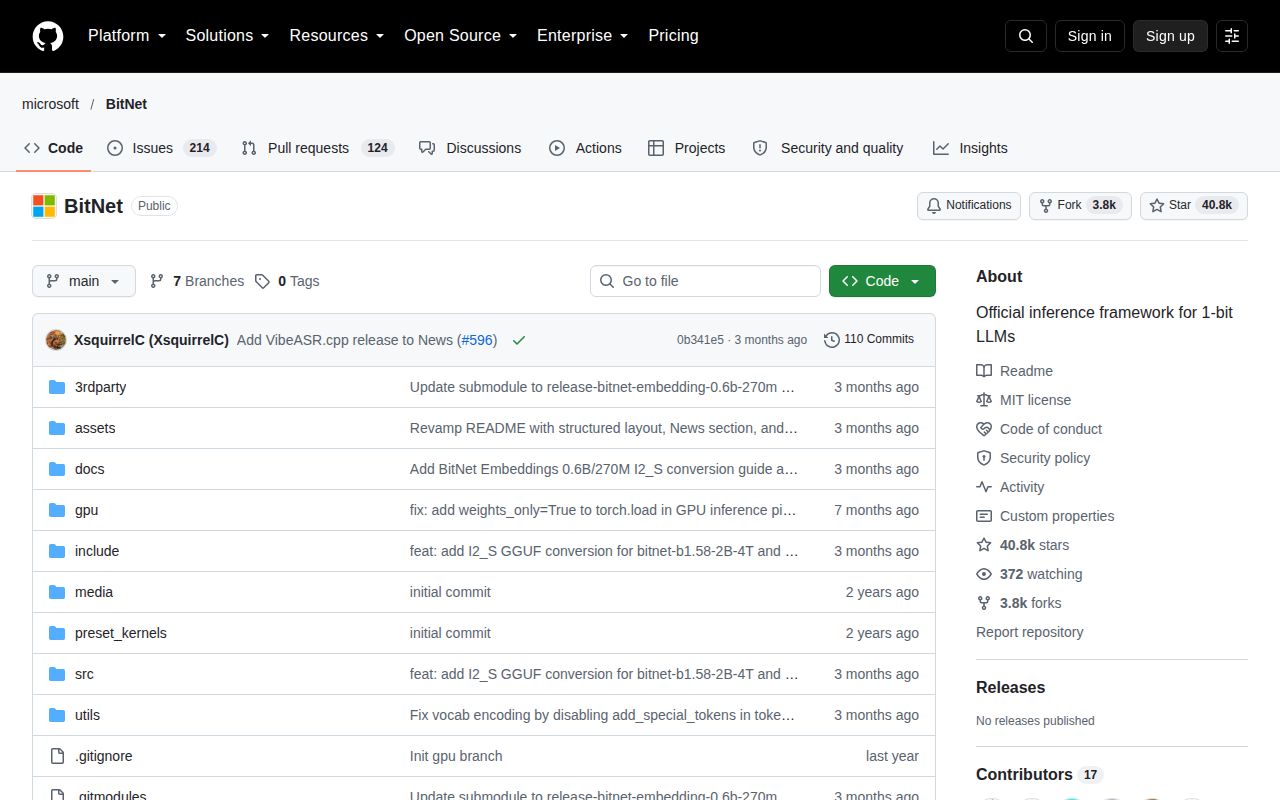
Our 157.8 MB checkout came from a repository last pushed on July 27, 2026. GitHub lists 40,767 stars and 338 open issues and PRs, and the issue feed includes reports and proposed fixes updated in October. The latest-release endpoint returned no release entry. Together, those facts show a repository with continued user activity and a gap since its last code push. They don't establish abandonment, or prove that the proposed corrections have reached the revision you will run.
llama.cpp is worth comparing for broader local model inference. For general low-bit models beyond ternary weights, BitNet's README itself recommends T-MAC. Choose BitNet when a supported model and its specialized runtime are the thing you want to evaluate. Before keeping it, require useful answers or retrieval results on your hardware, with the exact model and kernel recorded beside them.