Bifrost gives 23-plus providers one gateway API
Bifrost sits between applications and model providers. An application can send OpenAI-compatible requests to one endpoint while the gateway chooses credentials, translates payloads, applies retries or fallbacks, records usage, and enforces budgets. The README lists OpenAI, Anthropic, Bedrock, Vertex, Ollama, Groq, Mistral, and other providers. Teams can run the HTTP gateway with its web interface or import the Go core directly into an application.
Centralization helps when several services otherwise repeat the same provider code and policy. It also creates one place where a translation error affects every caller. Messages, tools, streaming, reasoning fields, media, usage accounting, and failure semantics differ between providers. A common request shape reduces integration work, but it cannot make those behaviors identical. Bifrost should be treated as a compatibility layer that needs application-specific contract tests, not as proof that one provider can replace another without changes.
One command starts a trial, while production needs state and secrets
The quick start offers an NPX command or a Docker container on port 8080. A browser interface then configures providers and shows activity. That is enough to send an initial request once a provider key exists. The repository also supports file and API configuration, environment-variable references for secrets, plugins, semantic caching, cost controls, and an MCP gateway. Those options explain why a gateway can replace several smaller pieces of platform code.
A durable deployment has more parts. Provider credentials, a stable encryption key, gateway authentication, TLS, backups, and persistent storage must survive container replacement. Streaming responses and WebSockets place requirements on the reverse proxy. SQLite can suit one instance; PostgreSQL fits deployments that separate state from the process. Release pinning matters because startup migrations and provider conversions can change independently of the applications sending traffic.
What happened when we ran it
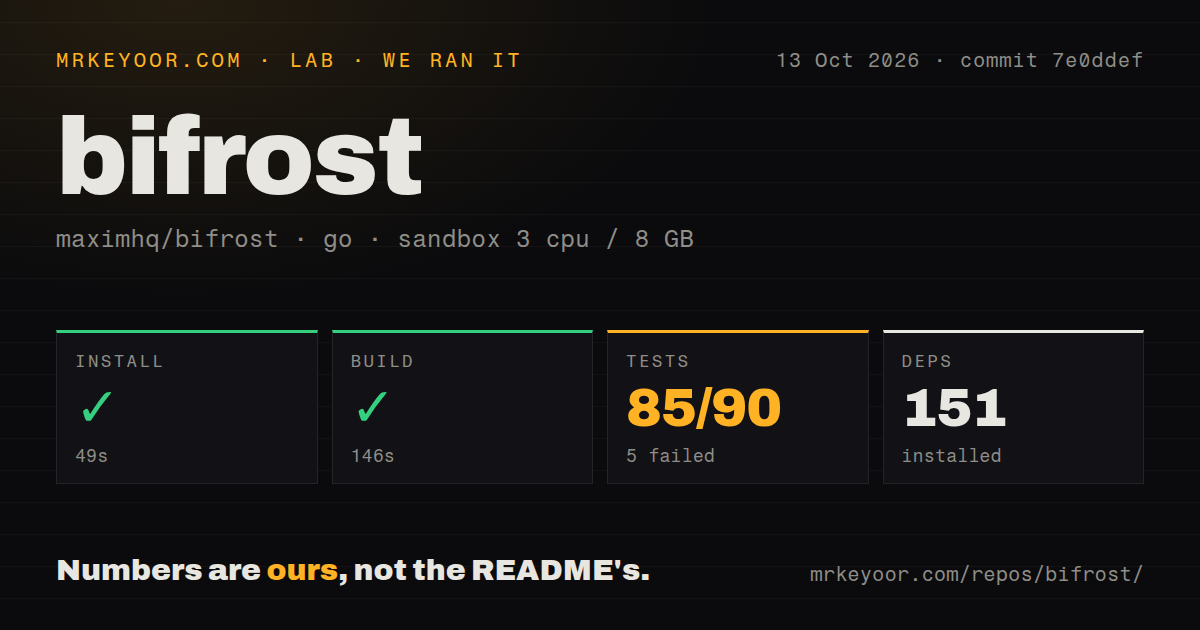
Our sandbox installed 138 Go packages in 37 seconds. Building the project under core/ succeeded in 96 seconds. The repository at commit 5f7103b was large: 4,452 files, roughly 969,467 lines of source, and 622.5 MB checked out before package installation. Our scan found 16 CI workflow files, a tests directory, and no Dockerfile in the measured repository layout.
The Go test step failed with exit code 1 after 330 seconds. Its summary counted 37 passed packages and 1 failed package out of 38. The supplied tail showed successful results for Replicate, Runware, Runway, Sarvam, SGL, Vertex, vLLM, xAI, schemas, and other packages, then only FAIL. It did not identify the failing package or assertion, so we cannot responsibly assign a cause from that log.
Translation bugs can change cost and output behavior
Open issue 6132 reports that max_tokens and max_completion_tokens were removed before requests reached an Ollama OpenAI-compatible endpoint. The reporter sent a 5-token limit through Bifrost and received 1,150 completion tokens, while the direct Ollama request stopped at 5. Packet capture showed the limit missing from forwarded bodies. That is one configuration and report, but it demonstrates why token caps and finish reasons belong in provider contract tests.
Issue 6188 concerns fallback behavior. When Bifrost could not automatically resolve the primary provider, it returned HTTP 400 before reaching a configured valid fallback. The report covers streaming and non-streaming requests. Teams should test missing models, disabled providers, expired keys, rate limits, timeouts, malformed streams, and tool calls. A fallback list in configuration is useful only if each failure class reaches it as expected.
MCP and governance add value, with an edition boundary
Bifrost can connect to MCP servers and expose their tools to clients. Its documented flow allows a model to propose a tool call and the application to approve execution separately; filtering can reduce the available tool set. Central tool credentials and policy are easier to inspect than direct MCP access from every application. Autonomous execution increases the need for tool allowlists, limited credentials, and request logging.
The Apache-licensed gateway includes routing, the dashboard, plugins, MCP, storage, and governance building blocks. The README describes clustering, adaptive load balancing, guardrails, advanced identity, and other controls as Enterprise capabilities. Decide which edition meets the availability and compliance requirements before designing around the entire feature list. Open-source replicas do not automatically gain the behavior of the paid clustering system merely because they share a database.
Fast-moving Go modules can force upgrade work downstream
Issue 6583 says the core module now declares Go 1.27, making that toolchain the minimum for SDK consumers even though the reporter did not find language changes that required it. The request proposes separating the preferred toolchain from the minimum language version. Teams embedding Bifrost should test upgrades in their own build image and follow module changes, rather than assuming a patch release can drop into an older Go pipeline.
GitHub recorded 7,587 stars, 972 combined open issues and pull requests, and a last push on August 26, 2026. Helm chart v2.1.37 was released the same day. The queue includes rapid provider fixes, dependency updates, pricing work, and contributor changes. That activity is healthy, but the 972 figure also reflects how much surface the project maintains. Pin components and read changes around each provider you use.
Bifrost makes sense once a company needs shared routing, usage policy, MCP access, and provider credentials in one service. Our successful 96-second build shows the core compiles in a fresh Go container, while the 37-of-38 test result keeps this exact commit from earning a clean bill of health. Adopt it behind representative contract tests, independent cost reconciliation, staged migrations, and a direct-provider escape path for critical workloads.