This is a catalog of agent behavior, not one tool
claude-skills collects instruction packages for many kinds of work. A skill may be a Markdown method, a set of references, a Python helper, a command, an agent definition, or a Claude Code plug-in with hooks. The current README claims 388 skills across 20 domains, covering software engineering, product work, marketing, research, compliance, operations, finance, and executive advice. That range is the attraction. It is also the main risk, because installing the repository does not tell you which parts deserve authority in your workspace.
commit 19392f7 filled 3,869 files, roughly 284,978 source lines, and 36 MB before installation. The README also lists 118 agents, 150 commands, and support for 13 coding assistants. Those headline numbers describe a distribution, not a consistent user experience. A security-audit helper and a content-writing brief have different failure modes. Review them separately, with the same care you would apply to two unrelated dependencies.
Start with one domain and inspect every executable path
Claude Code users can add the marketplace, then install a domain bundle or one skill. Codex users get an npx route and a repository script. Gemini CLI, OpenClaw, Hermes Agent, Mistral Vibe, Cursor, Aider, Windsurf, Kilo Code, OpenCode, Augment, and Antigravity have native mirrors or conversion steps. This flexibility is useful for a mixed-tool team, but conversion does not prove that each host interprets permissions, hooks, and instruction precedence the same way.
The README says its Python tools use the standard library, yet several skills can still reach beyond local text. The collection includes MCP work, optional services, installer scripts, hooks, and workflows that may need credentials. Version 2.12.0 fixed plug-in manifests that Claude Code rejected and moved an unreachable C-level bundle. That release history is a reminder to read both the selected skill and its wiring. Install a commit, not an unbounded branch, and test in a disposable repository first.
What happened when we ran it
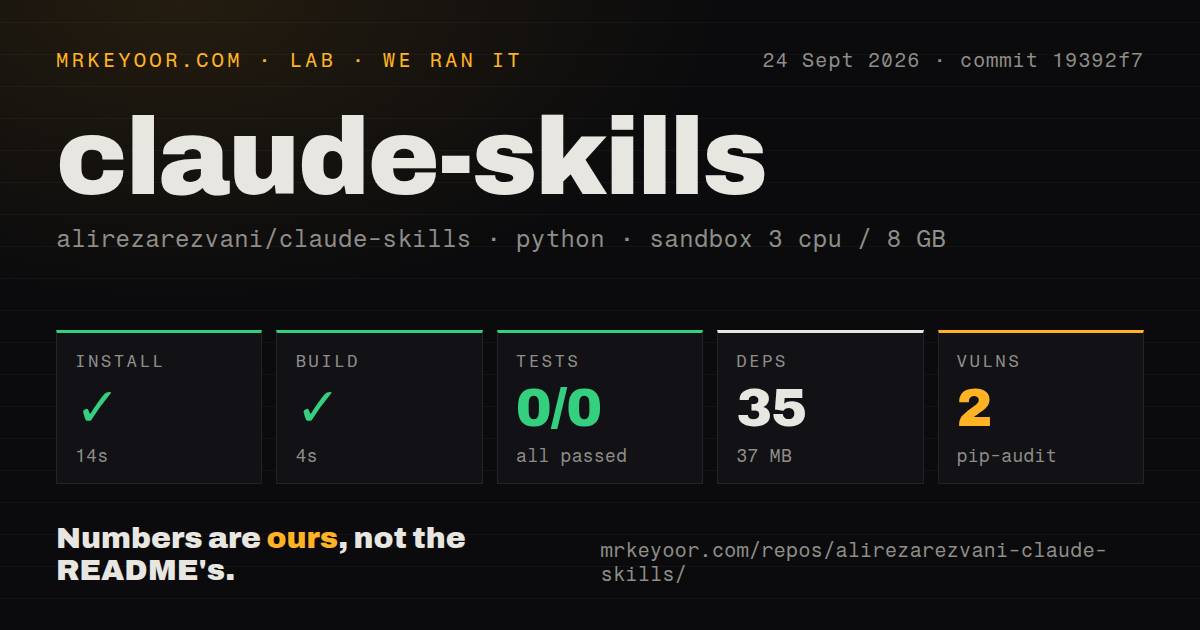
Our sandbox installed the checkout in 14 seconds, adding 35 packages and occupying 37 MB. The build succeeded in 4 seconds. Pip-audit found 2 known vulnerabilities in the installed Python environment. The run used commit 19392f7 in a fresh unprivileged Debian container with 3 CPUs and 8 GB of RAM. The repository scan also found 12 CI workflow files and no top-level tests directory or Dockerfile.
Pytest failed after 4 seconds with exit code 3. It ran 0 tests, then raised an internal error while importing engineering/autoresearch-agent/evaluators/test_pass_rate.py. The log shows line 48 calling sys.exit(1), which pytest caught as an unexpected SystemExit. We do not need to guess why the evaluator exits. The finding is that repository-wide pytest collection treats an executable evaluator as a test module and does not reach a passing suite in our environment.
The documentation numbers disagree with each other
The top of the README says 388 skills and 13 platforms. A later conversion section says 345 skills and tells the user to expect 346 converted files. The Python-tool count appears as 706 near the introduction and 727 in two later passages. Release v2.12.0 lists 380 skills and 706 Python tools, which may describe the release rather than the current branch. Some drift is expected in a fast-growing catalog, but these mismatches make selection and verification harder.
Do not use the biggest number as evidence of quality. Ask whether the one skill you need has clear activation rules, bounded actions, safe defaults, references you can inspect, and a test or sample that exercises its helper scripts. The repository's own issue tracker reinforces this point. Issue 1019 says 22 C-level skills are absent from a Codex index, while issue 1018 says one CI compile step skips the agent-launcher domain and can exit successfully for a path it cannot list. Both concern coverage gaps rather than prose quality.
Windows and cross-agent mirrors need their own check
Windows users are told to clone with symlink support enabled. Otherwise, mirror trees for several agents can appear as one-line pointer files instead of working skills. The README also recommends PYTHONUTF8=1 for legacy console code pages. These are specific, documented fixes, but they make a plain ZIP download a poor installation choice for a Windows team. Verify a selected skill through the target agent after cloning.
Repository health is active, though not perfectly current. The last push was August 30, 2026, release v2.12.0 arrived on August 25, and issue discussion continued through September 23. GitHub showed 26,393 stars, 26 combined open issues and pull requests, and 10 open issues when searched separately. The recent reports are detailed enough to help maintainers reproduce indexing and validation gaps. They do not replace an end-to-end test of the bundle you plan to use.
A catalog works only when adoption stays selective
The best use of claude-skills is as a shelf, not a default policy for every task. Pick one domain, read its SKILL.md, list every script and external connection it can invoke, and compare its decisions with your existing engineering or editorial rules. Run deterministic helpers directly with sample inputs. For anything that edits code, changes infrastructure, handles credentials, or advises on compliance, keep a person at the approval point.
Our 4-second build shows that the repository can package successfully in the measured environment. The 0-test internal failure means it did not supply repository-wide behavioral assurance there. Experienced users can still find useful methods and scaffolding among 388 advertised skills. The sensible unit of trust is one pinned skill after inspection, never the star count or the catalog total.