mrkeyoor.com_
Fri 18 Sept 16:00 UTC
LLM Toolsevaluationupdated 18 Sept 2026

agent-lightning review

Agent Lightning is a Python framework for improving an existing AI agent through reinforcement learning while the agent keeps using its real tools and control flow. It places a model gateway between the agent and trainer, records what happened, assigns rewards, and turns those interactions into training data.

Verdict

Our Agent Lightning run installed 83 packages and built in 21 seconds combined, but its test command still exited 1 with 2 collection/setup errors. Trial it if you already operate GPU training and need the real agent loop, tools included, to generate policy data. Wait or isolate the Verl integration first if clean tests, custom tool parsers, or settled loss semantics are release requirements.

We ran it

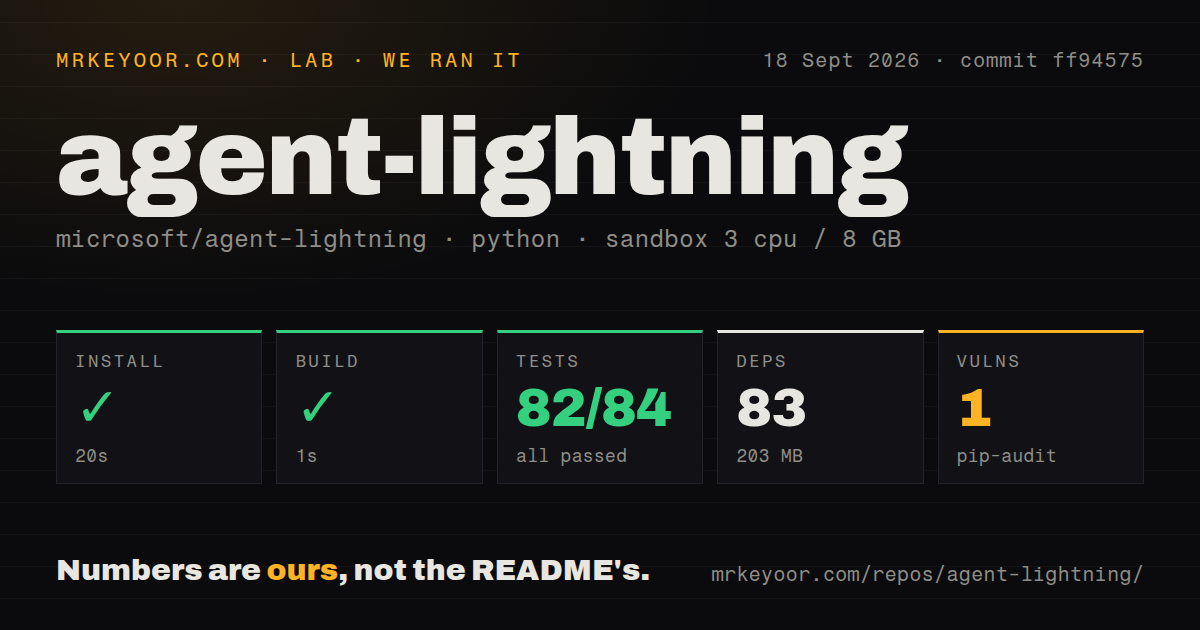
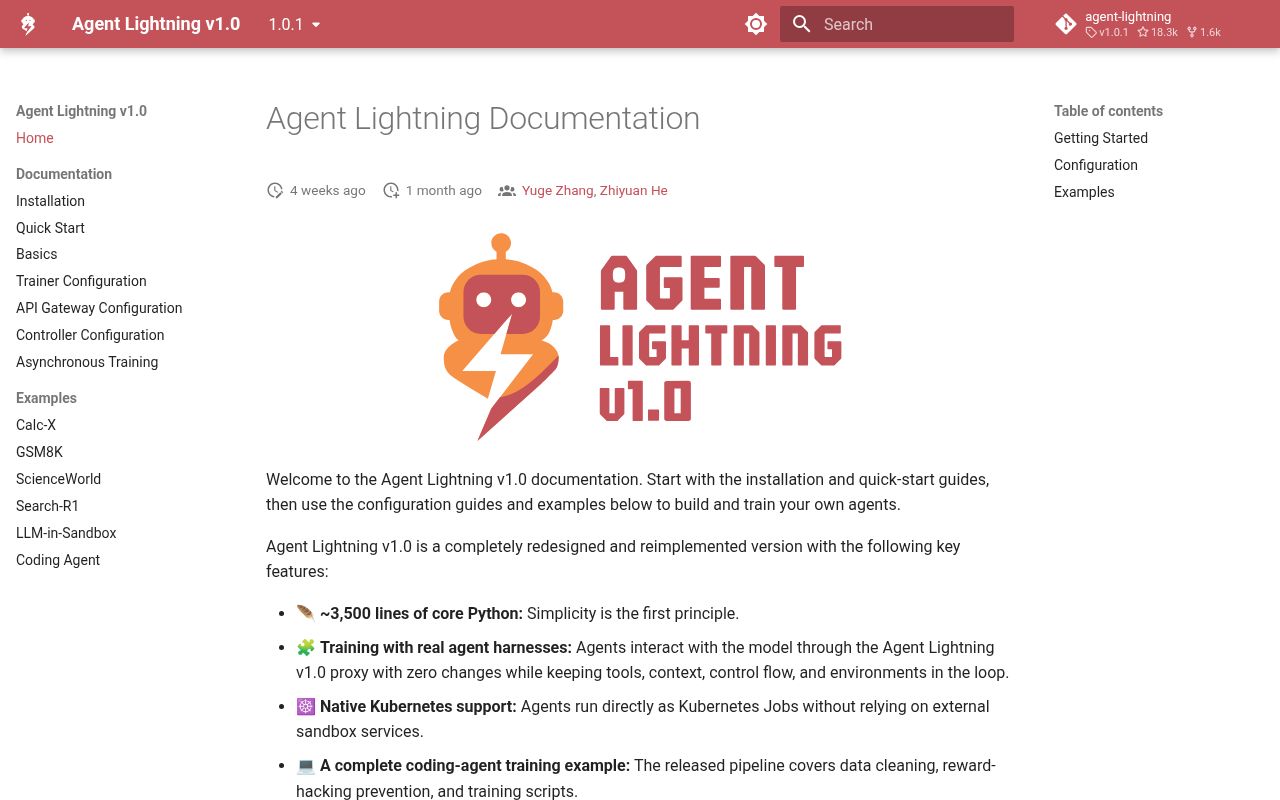
Lab card: what happened when we ran agent-lightningScreenshot of agent-lightning (microsoft.github.io/agent-lightning)
Install✓ · 20s83 packages · 203 MB
Build✓ · 1s
Tests✗ · 8s82 passed · 0 failed · 2 skipped · 2 errors of 84 (pytest)
Known vulns1(pip-audit)
Repo164 files~14,049 lines of source · 2.8 MB · 5 CI workflows · tests dir

Answers from our run

Does agent-lightning build from source?

Dependencies installed in 20 seconds (83 packages), and the build succeeded in 1 seconds. We cloned commit ff94575 into a clean Debian container with 3 CPUs and no project-specific setup.

Do agent-lightning's tests pass?

Yes: 82 of 84 passed when we ran the project's own test command (pytest), with 2 collection errors. Some failures need services or credentials a bare container does not have.

Does agent-lightning have known vulnerabilities in its dependencies?

pip-audit flagged 1 known advisory in the dependency tree at the time of our run.

Who should not use agent-lightning?

CPU-only teams expecting to run the documented training path: the quick start calls for one A100 GPU, and installation supports CUDA 12.9 or 13.0.

What are the alternatives to agent-lightning?

TRL, Verl, OpenRLHF. Our Agent Lightning run installed 83 packages and built in 21 seconds combined, but its test command still exited 1 with 2 collection/setup errors.

Setup2/5Base install is quick; real training needs a tightly pinned GPU stack
Docs5/5Versioned install, gateway, trainer, controller, and example guides
Community5/518,329 stars with pushes, issues, and pull requests active this week
Maturity3/5v1.0 is documented, but tests and open training semantics need work

Who it’s for

Machine-learning teams with an editable agent, a repeatable benchmark, and rewards they can compute.
Researchers who want tool use and multi-step agent behavior present during policy training.
GPU operators comfortable with CUDA, vLLM, Verl, Ray, and Weights & Biases.
Kubernetes teams that need agent rollouts launched as isolated jobs.
Claude Code, Codex, or GitHub Copilot users who want the included optimization skill for measured agent edits.

Who it’s NOT for

CPU-only teams expecting to run the documented training path: the quick start calls for one A100 GPU, and installation supports CUDA 12.9 or 13.0.
Native Windows users who need the local controller: the quick start says that runner is unsupported on native Windows and directs users to WSL.
Teams that require a green checkout before evaluation: our test command exited 1 with 82 passed, 2 skipped, and 2 collection/setup errors in the Verl test modules.
Models that depend on a custom vLLM tool-parser plugin: issue 592 reports that the pinned Verl 0.7.x and 0.8.x server path skips plugin import and dies at startup.
Users bringing v0.x examples or configuration unchanged: the README says v1.0 was a complete refactor and sends legacy users to a separate branch.
Agent projects without a stable benchmark or reward signal: neither the training framework nor the optimization skill can decide improvement from taste alone.

Setup reality

Our sandbox installed 83 Python packages in 20 seconds and used 203 MB. The build passed in 1 second. Tests exited 1 after 8 seconds: 82 passed, 0 failed, 2 skipped, and 2 modules hit collection/setup errors. Pip-audit found 1 known vulnerability. The log tail names the two Verl test files but does not show the underlying exception.

The documented training setup needs Python 3.12, uv, NVIDIA CUDA 12.9 or 13.0, a pinned Verl and vLLM pairing, and FlashAttention built locally. Tasks log to Weights & Biases by default, so its login is part of the standard route. Kubernetes, model, dataset, and registry credentials depend on the runner and example you choose.

The shortest real quick start assumes one A100 GPU and a separately downloaded Calc-X dataset. Native Windows cannot use the local runner without a Linux environment such as WSL. The v1.0 API replaced the earlier design, and the repository root has no Dockerfile even though individual examples include images.

Version 1.0 trains the agent loop, not a chat transcript

Agent Lightning v1.0 separates agent execution from policy training. A rollout controller runs the existing agent locally or as a Kubernetes Job. An API gateway proxies model calls and records events, while a trainer backed by Verl and vLLM turns those events into samples and updates the model. The agent can keep its tools, context, and branching logic in the loop, which is the feature that distinguishes this project from a plain prompt log or preference dataset.

Our checkout contained 164 files, about 14,049 lines of source, and 2.8 MB before installation. The README calls the core framework roughly 3,500 lines, so its claim is using a narrower boundary than our repository-wide source count. Microsoft also reports a coding-agent run that moved SWE-bench Verified from 41.8% to 56.4% using 6K training samples. That is the project's result, not a benchmark we reproduced.

What happened when we ran it

Our sandbox installed 83 packages in 20 seconds and occupied 203 MB. The package build completed in 1 second. That base result is encouraging for developers who want to read the APIs, run light components, or inspect the included Agent Lightning skill. It does not cover the documented training stack, model weights, Calc-X data, an A100, or a Kubernetes cluster. Those were outside this measurement.

Pytest exited 1 after 8 seconds. It reported 82 passed, 0 failed, 2 skipped, 2 warnings, and 2 collection/setup errors. The errors were in tests/verl/test_agl_rollout_manager.py and tests/verl/test_rollout_level_advantage.py. The supplied tail shows Starlette and AnyIO deprecation warnings plus the summary, but not the exception that caused collection to fail. Pip-audit also found 1 known vulnerability, with no severity given in our result.

The 83-package base is the small part of setup

The 83-package environment does not include the whole training route described by Microsoft. Agent Lightning requires Python 3.12. Its installation guide supports CUDA 12.9 and 13.0, recommends Verl 0.8.0 on CUDA 13.0, pins compatible vLLM versions, and builds FlashAttention against that environment. These coupled packages are common sources of friction in GPU work, and the guide acknowledges that FlashAttention installation can be error-prone.

Our base install took 20 seconds, while an actual task also needs data, a model, reward logic, storage, and process cleanup. Weights & Biases receives logs and trajectories by default, so the standard setup includes a W&B login and an explicit decision about what may leave the machine. Kubernetes mode adds cluster access and runnable images. The repository has 5 CI workflow files and a tests directory, but no root Dockerfile that freezes the entire training environment.

One A100 is the documented starting point

The shortest v1.0 quick start asks for one machine with one A100 GPU. It downloads Calc-X data, installs AutoGen, MCP calculator packages, OpenAI client libraries, and starts Ray, the Verl and vLLM backend, the gateway on port 8181, and a local controller. The launcher writes service logs under /tmp/. Native Windows cannot use that local runner, so Microsoft directs Windows users to a Linux environment such as WSL.

The 203 MB measured install therefore answers whether the Python package is approachable, not whether your team can afford or operate training. Kubernetes helps isolate rollouts, but issue 567 describes missing example images leaving jobs in image-pull backoff until a 1,800-second deadline while GPUs wait. An open pull request proposes a readiness check. Before committing compute, test one dataset row through image lookup, agent execution, reward emission, and cleanup.

Version 1.0.1 is active while training questions remain open

Agent Lightning v1.0.1 was released on August 24, 2026, and GitHub recorded the last push on September 17. The repository had 18,329 stars and 160 combined issues and pull requests when fetched. Current September issues and patches show active maintenance. The release also introduced an Agent Lightning skill for Claude Code, Codex, and GitHub Copilot that guides measured changes to an editable agent against a benchmark.

The 2 collection errors in our run land beside two specific open questions. Issue 592 reports that the pinned Verl server cannot load custom vLLM parser plugins, blocking models without a built-in parser. Issue 593 questions whether the default per-rollout loss divides by rows rather than distinct rollouts when one rollout spans several rows. The reporter supplied a reproduction, but the issue remains open, so verify the intended loss semantics before treating a long training run as comparable.

Eighty-two passing tests justify a trial, not a blind run

The 82 passing tests show that most of the collected suite worked in our clean container, while the 2 setup errors keep the checkout from earning a clean bill of health. TRL is the simpler choice for standard fine-tuning and preference work. Verl exposes the lower training layer directly. OpenRLHF fits teams focused on large-scale post-training. Agent Lightning earns its place when rewards must come from a working agent using real tools and environments.

Our 20-second install and 1-second build make source evaluation cheap. Actual adoption starts after that: pin the GPU matrix, reproduce the two failing collections, inspect the single audit finding, and run a small held-out benchmark through the same gateway and controller used in training. If the real harness is the data you need, those jobs buy something. If ordinary model post-training is enough, a narrower framework leaves fewer services and failure modes to own.

Alternatives

ProjectWhat it isPick it when
TRLHugging Face's library for supervised fine-tuning, preference training, and reinforcement learning.pick this instead when the training job is model-centric and does not need Agent Lightning's gateway and rollout controller.
Verl gh↗The distributed reinforcement-learning backend that Agent Lightning uses for policy training.pick this instead when you want to own the rollout integration and work directly at the trainer layer.
OpenRLHFA Ray-based framework for large-scale RLHF and related post-training methods.pick this instead when conventional model post-training is the main job and real agent harness capture is secondary.

What people are saying

  1. [github-trending] microsoft/agent-lightning

Sources

  1. Agent Lightning README
  2. Agent Lightning installation guide
  3. Agent Lightning quick start
  4. Agent Lightning v1.0.1 release
  5. Issue 567: Kubernetes image readiness
  6. Issue 592: custom tool parser plugins
  7. Issue 593: per-rollout loss scaling

More llm tools reviews

cc-haha · harness-sdk · 12306-mcp · ouroboros · headcount · useagent · the whole board →