
A Go toolkit for an application you still need to build
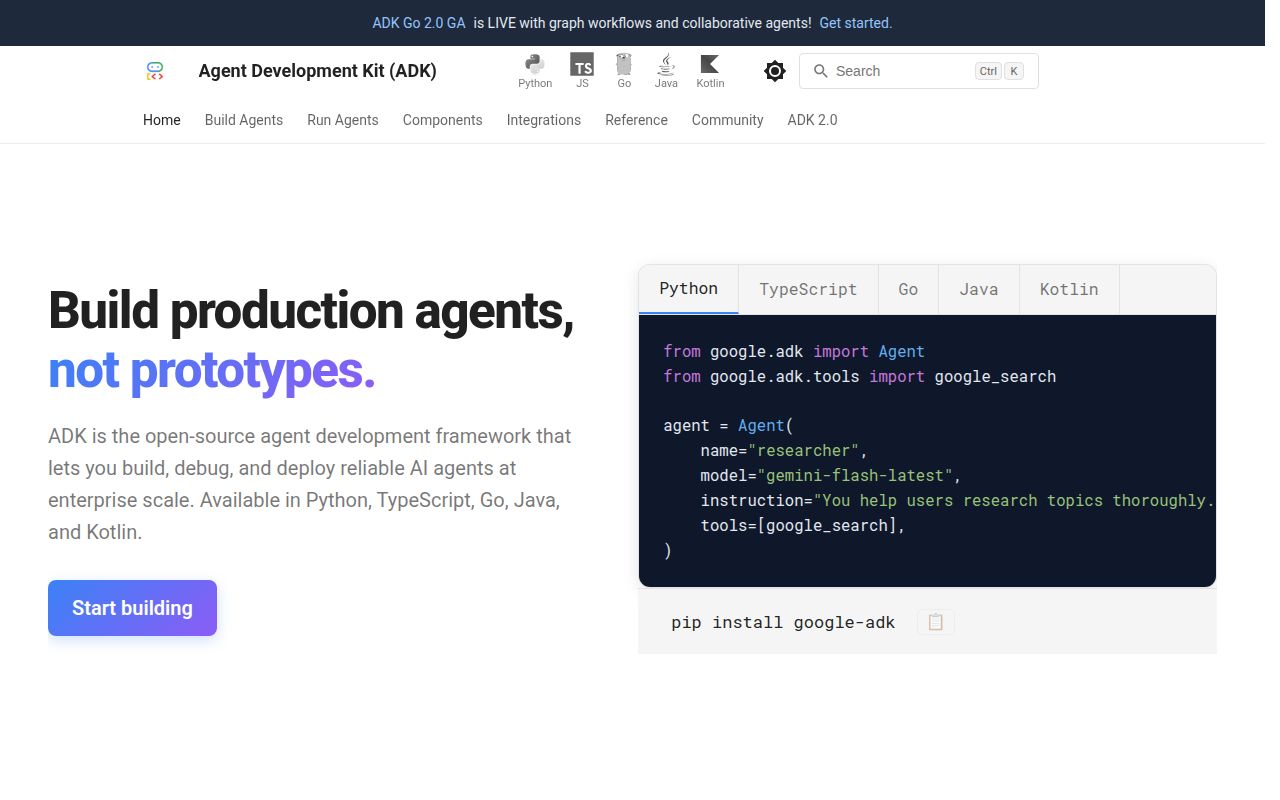
Google's Agent Development Kit (ADK) for Go lets developers define agent logic, tools, and orchestration in Go. The README describes a code-first toolkit for building, evaluating, and deploying agents, including systems composed of multiple agents.
That makes it a reasonable candidate when agent behavior belongs inside an existing Go application. It remains a toolkit: the application team must choose its prompts, permissions, model configuration, storage, and operational controls.
Google describes ADK as model agnostic and optimized for Gemini. It also advertises container deployment and support for cloud-native environments such as Google Cloud Run. Those are project claims, not deployment results from this review. The README identifies Apache 2.0 as the project license and explicitly notes a separate license for internal/httprr; inspect that exception when reviewing licensing.
What the October 12 sandbox run establishes
The stored run began at 03:59:51.971 UTC on October 12, 2026. It measured commit 987c7bc0bed6af5a4bae305df54c00019033d6d0, dated October 9, 2026, rather than an unspecified current branch or the v2.2.0 release.
| Recorded step | Result | Rounded duration |
|---|---|---|
| Installation | Succeeded, exit 0 | 45 seconds |
| Build | Succeeded, exit 0 | 165 seconds |
| Testing | Succeeded, exit 0 | 81 seconds |
The record lists 317 dependencies, 1,090 files, 226,590 source lines, and an 18.3 MB checkout. It detected six CI workflow files, no Dockerfile, and no top-level tests directory. The absence of that directory does not imply missing Go tests, which can live beside package source.
The raw parser summary records 156 successful package results, zero failed package results, and 83 packages without tests. These counts are not individual test-case totals. They have not been reconciled against complete logs to establish exhaustive unique coverage. This correction uses the stored run and adds no new execution.
Successful commands support a prototype decision. They do not establish model response quality, live cloud deployment behavior, security, or performance under an application's workload. The supplied record does not document which external services, if any, the tests contacted.
The container image did not fix the compiler at Go 1.24
The sandbox had 3 CPUs, 8 GB of RAM, and a golang:1.24-bookworm base image. Its installation tail contains go: downloading go1.26.6 (linux/amd64).
The practical distinction is between the image's bundled toolchain and the toolchain selected during the run. A successful build in that image does not prove the repository builds with the Go 1.24 compiler. Conversely, the download line alone does not establish that Go 1.26.6 is the minimum supported version. The supplied primary-source extracts do not include go.mod.
The README gives this installation command: go get google.golang.org/adk/v2. For an adoption trial, pin a revision and inspect its module requirements and toolchain selection in CI. Check whether your build environment permits toolchain downloads before relying on the same setup path.
MCP reports need a version-specific reading
Issue 1391 was opened on August 23, 2026. Its reporter observed that v2.2.0's MCP result conversion retained text while dropping embedded resources, resource links, images, and audio. The reported example involved a file-read response whose status text survived while the embedded file content did not.
The supplied issue extract still labels the issue open, but its later activity references changes to report non-text-only results and render non-text unstructured results, including a September 8 commit. The August report therefore does not establish that every reported behavior remains unchanged in the October measured revision. The extract also does not prove that all content types now work or identify the release containing each change.
If MCP is part of your application, test the actual response types your server returns against your pinned ADK version. Include a file body and a resource link rather than checking only a successful status message. Treat that as application acceptance work; this review did not reproduce the report or verify its fixes.
The A2A isolation report was closed
Issue 1220 reported that an isolation-scoped remote-agent dispatch could include shared-session history and inherit a previous dispatch's context ID. The report named v2.1.0, and a contributor documented a unit-level reproduction at a specific HEAD revision.
The issue timeline says it was closed as completed in PR 1259 on September 14, 2026. That status matters: this is a historical report with a recorded completion, not evidence of a confirmed open defect in the October checkout. The supplied extract does not establish the first release containing the fix or independently verify its behavior.
For an application that delegates to remote agents, inspect a redacted outbound payload during acceptance testing. Check that each dispatch includes only the history and context identifiers your application intends to share. This is a useful boundary check even when an issue is closed.
Model coverage requires more than a label
Issue 1358, opened on August 18, 2026, requests an LLM gateway backend. Its author described support at that time as Gemini and the OpenAI Responses wire API format. That is a dated issue-author description, not a complete current compatibility matrix.
The October test-log tail includes package results for model/apigee, model/gemini, and model/openaimodel, including completions and responses subpackages. Package names and passing package commands do not establish compatibility with every provider or endpoint.
Choose the provider and API behavior you need, then verify that adapter path with a small agent. The README's model-agnostic description should not substitute for this check.
Release notes provide context, not a deployment verdict
The v2.2.0 release notes list changes for Vertex AI session-deletion ownership, configurable agent-tool path traversal, concurrent artifact saves, cancellation propagation, and streaming usage metadata. These are upstream release-note entries, not security findings from our sandbox.
The measured October commit is a separate revision. Neither those release notes nor the successful stored commands establish that every integration is ready for a particular production workload.
Start with one bounded agent
Choose ADK Go when keeping agent logic and orchestration in Go is a concrete requirement. Start with one agent and a limited tool set, then verify the model adapter, tool failures, cancellation, and session behavior your application will use.
Before expanding to MCP servers or remote agents, check their returned content and outbound payloads. The stored run supports trying the toolkit; your application's integration checks must support the deployment decision.