Faker review
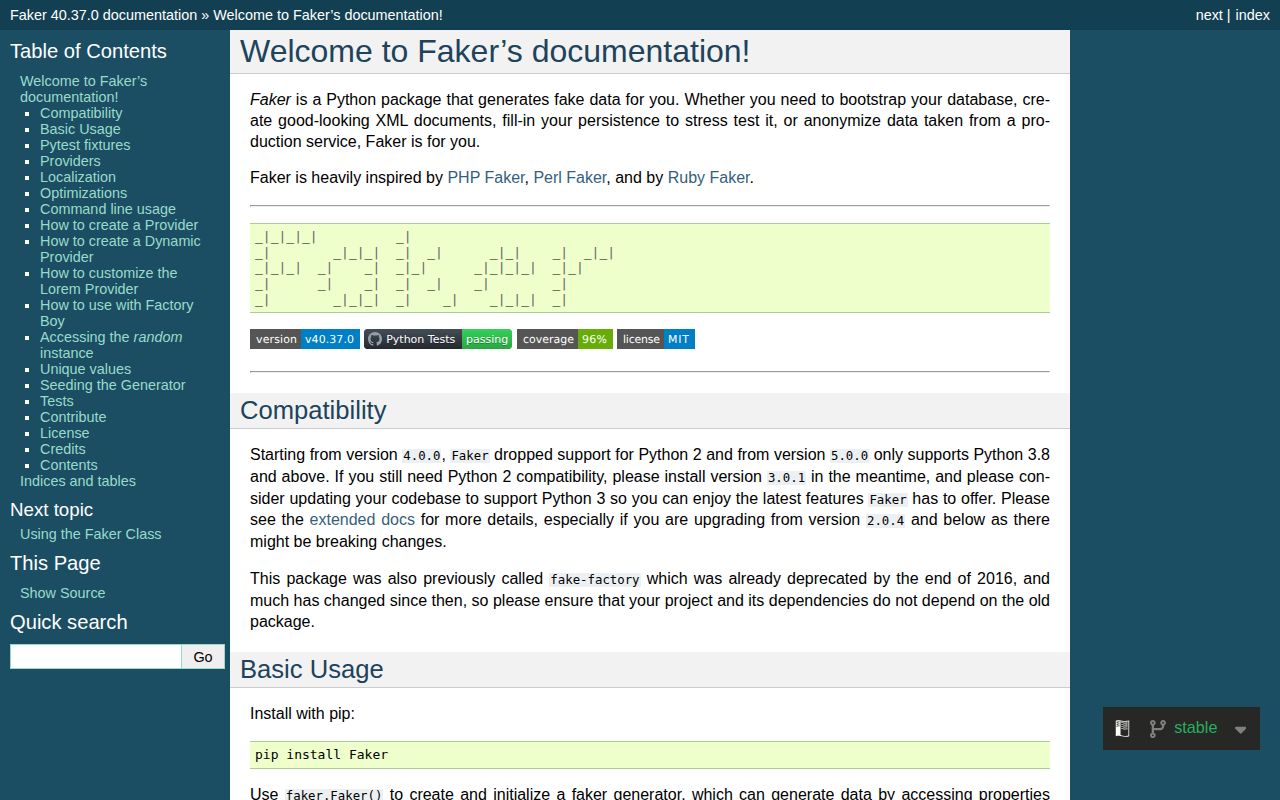
Faker creates plausible names, addresses, dates, identifiers, text, internet values, and other disposable test data through locale-specific providers. A Faker instance routes calls such as name() or iban() to the providers loaded for its locale, and applications can add their own provider methods. Version 40.37.0 fixes the structure of Irish IBANs for en_IE and adds Pillow as an optional dependency. Our Python 3.12 install was pure Python, included type information, and imported in under half a second. Use its output to exercise layouts and seed examples, never as proof that business rules are correct.
Faker 40.37.0 installed in 0.3 seconds as one 14 MB package and imported in 0.47 seconds in our sandbox, with no known vulnerabilities from pip-audit. Use it for varied fixtures and demos, keep generated values out of assertions, and use a purpose-built masking system for production data.
We installed it
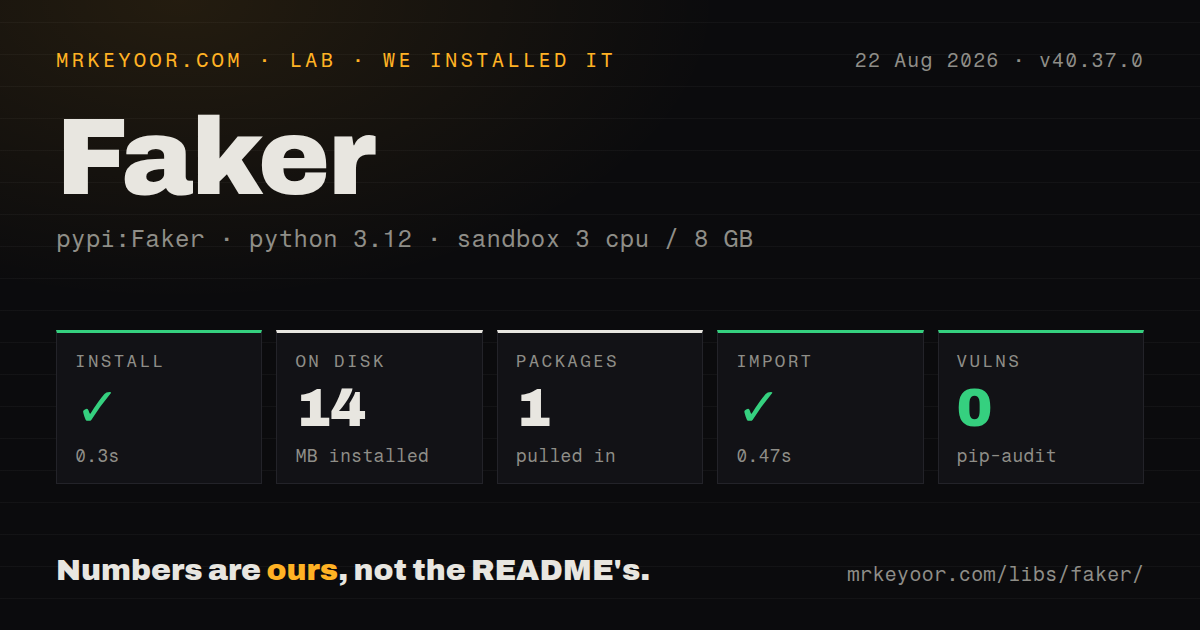
| Install | ✓ · 0.3s | 1 package on disk · 14 MB |
| Import | ✓ | import faker in 0.47s · pure Python · py.typed · requires Python >=3.10 |
| Known vulns | 0 | (pip-audit) |
Answers from our run
Does Faker install cleanly?
Yes. In a fresh container with an empty cache, pip install Faker finished in 0.3s, leaving 1 package and 14 MB on disk. pip-audit reported no known vulnerabilities.
What does Faker need to run?
Python >=3.10, and nothing compiled: it is pure Python. In our run import faker succeeded in 0.47s, and the package ships py.typed for type checkers.
Faker or mimesis: which should you use?
mimesis: Use it for fast bulk generation, schema-driven records, and a different locale catalog. Faker 40.37.0 installed in 0.3 seconds as one 14 MB package and imported in 0.47 seconds in our sandbox, with no known vulnerabilities from pip-audit.
When should you not use Faker?
The test asserts the generated value; explicit fixtures make failures reproducible and show the case being tested
Use it if
- A staging database needs varied names, addresses, dates, and identifiers so layout and pagination problems become visible
- Tests have many irrelevant fields and explicit assertions cover only the values that determine behavior
- A demo or load-test generator needs localized records through one familiar provider API
- Your project uses pytest or factory_boy and can reuse Faker's bundled fixture or provider integration
- The test asserts the generated value; explicit fixtures make failures reproducible and show the case being tested
- Seeded output must remain byte-for-byte stable after dependency upgrades; Faker's documentation warns that datasets can change between patch releases
- You are anonymizing connected production tables; independent random replacements do not preserve identity or foreign-key relationships
- The generator must satisfy a domain model's uniqueness, state transitions, or cross-field constraints; Faker knows only the requested provider call
- You need adversarial boundary cases and automatic shrinking; Hypothesis searches for failures while Faker mainly supplies plausible examples
Setup reality
We installed Faker 40.37.0 in a clean Python 3.12 sandbox in 0.3 seconds. One package occupied 14 MB, and pip-audit found no known vulnerabilities. The distribution declares three direct dependencies, requires Python 3.10 or newer, uses only Python code, carries an MIT license, and ships py.typed. Importing faker completed in 0.47 seconds. Pillow was added as an optional dependency in this release, so the base measurement does not include it.
Faker needs no credentials or config file. Locale choice happens in Faker(...), and the factory falls back to en_US when it cannot find a localized provider. That fallback can quietly mix American data into a supposedly localized fixture. Confirm that every provider used by the test exists for the chosen locale. Multi-locale instances choose among configured locales, which may also make record shape vary from one call to the next.
Seeding has two scopes. Faker.seed() changes the shared generator state for the process, while seed_instance() isolates one Faker object. The pytest fixture reseeds around each test through faker_seed, so mixing that fixture with global seeding makes test order harder to reason about. A fixed seed reproduces output only for the pinned Faker version. Provider data corrections, including the Irish IBAN fix in 40.37.0, can intentionally change results.
The unique proxy remembers returned values and retries collisions. Small domains eventually raise UniquenessException, and large runs keep a growing seen-value set until unique.clear() or instance disposal. Faker does not write to a database atomically, so two workers can still generate the same supposedly unique value. Build database uniqueness around constraints and retry the transaction. Set use_weighting=False when bulk seeding speed matters more than the provider's frequency weighting.
Patterns
Create common fixture values generate-basic-fields
from faker import Faker

fake = Faker("en_US")
record = {
    "name": fake.name(),
    "email": fake.safe_email(),
    "address": fake.address(),
}
safe_email() uses reserved example domains. Reuse one generator instead of rebuilding providers for every row.
Seed an isolated Faker instance seed-one-generator
from faker import Faker

fake = Faker()
fake.seed_instance(4321)
first = fake.name()
seed_instance() does not reset every Faker object in the process. Output may still change after a Faker upgrade.
Select a locale explicitly generate-localized-data
from faker import Faker

fake = Faker("ja_JP")
profile = {"name": fake.name(), "address": fake.address()}
A missing localized provider can fall back to en_US. Check coverage for every method used in the fixture.
Generate from several configured locales mix-locales
fake = Faker(["it_IT", "ja_JP", "en_US"])
any_name = fake.name()
japanese_name = fake["ja_JP"].name()
The general call selects among configured locales. Index the generator when one field must use a specific locale.
Track unique generated emails request-unique-values
emails = [fake.unique.safe_email() for _ in range(100)]
fake.unique.clear()
Uniqueness is local to the generator and held in memory. It does not coordinate workers or replace a database constraint.
Use Faker's pytest fixture use-pytest-fixture
def test_signup(faker):
    user = create_user(name=faker.name(), email=faker.safe_email())
    assert user.id is not None
The plugin is included with Faker. Override the faker_seed fixture when the suite needs a known seed.
Choose a repeatable pytest seed set-pytest-seed
import pytest

@pytest.fixture()
def faker_seed():
    return 20260824
The fixture controls the plugin's reseeding. Avoid calling the process-wide Faker.seed() in the same tests.
Add a domain-specific SKU provider add-custom-provider
from faker.providers import BaseProvider

class ProductProvider(BaseProvider):
    def sku(self) -> str:
        return self.bothify("SKU-??-####", letters="ABCDEFGH")

fake.add_provider(ProductProvider)
value = fake.sku()
Use provider helpers rather than Python's random module so custom output follows Faker's seed.
Expose choices as a provider method add-dynamic-provider
from faker.providers import DynamicProvider

roles = DynamicProvider(provider_name="role", elements=["admin", "editor", "viewer"])
fake.add_provider(roles)
role = fake.role()
DynamicProvider is useful for a flat set. Cross-field rules belong in a factory or application-level generator.
Build a formatted identifier generate-patterned-id
order_id = fake.bothify(text="ORD-??-######", letters="ABCDEFGHJKLMNPQRSTUVWXYZ")Pattern substitution does not guarantee uniqueness. Excluding ambiguous letters here is an application choice.
Keep a date inside a business window bound-generated-date
created = fake.date_time_between(
    start_date="-30d",
    end_date="now",
    tzinfo=timezone.utc,
)
Pass tzinfo when the destination expects aware datetimes; otherwise date_time_between returns a naive value.
Preview a localized provider in the shell generate-from-command-line
faker -l de_DE address
faker -r 3 -s ';' name
The CLI is useful for inspecting actual shapes before choosing a provider for code or fixtures.
Alternatives
| Package | Registry | Pick it when |
|---|---|---|
| mimesis | PyPI | Use it for fast bulk generation, schema-driven records, and a different locale catalog |
| factory-boy | PyPI | Use it to construct complete model graphs with sequences, relationships, and post-generation hooks |
| hypothesis | PyPI | Use it to generate edge cases, shrink failures, and test properties instead of sample data |
More testing guides
pytest · chai · vitest · jsdom · playwright · coverage · the whole shelf →
How this guide is made: grounded in the library's documentation, release notes, changelog, and issue history, on a fixed rubric — not a hands-on install of every release. The 50 most-downloaded entries are additionally install-verified in clean containers. Corrections: contact the desk.