asyncio review
PyPI's asyncio 4.0.0 is an empty compatibility marker for a backport that Python stopped needing after asyncio entered the standard library in Python 3.4. The current wheel deliberately contains no implementation. Its package description tells readers not to install it and points them to the module bundled with Python. That distinction matters because our isolated Python 3.12 install accepted the distribution, then `import asyncio` failed. Treat the PyPI name as a dependency to remove, not as the way to add asynchronous I/O to Python.
Our asyncio 4.0.0 install took 0.2 seconds and 1 MB, but `import asyncio` failed because this PyPI release contains no code. Do not install it; use the asyncio module shipped with your Python interpreter.
We installed it
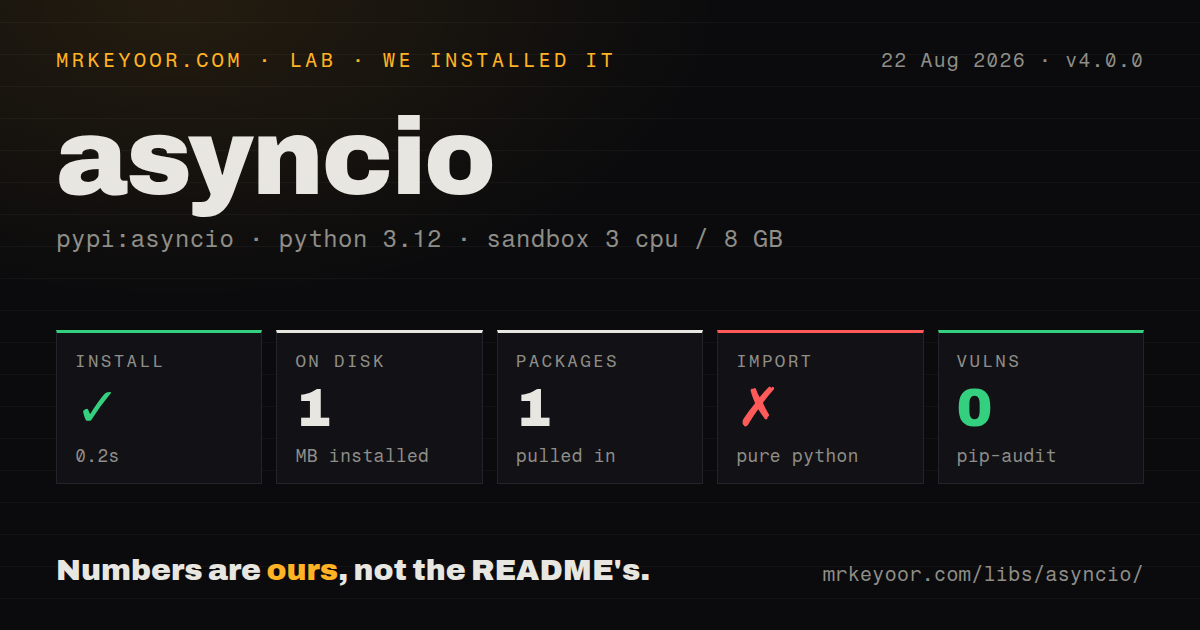
| Install | ✓ · 0.2s | 1 package on disk · 1 MB |
| Import | ✗ | import asyncio · pure Python · requires Python >=3.4 |
| Known vulns | 0 | (pip-audit) |
Answers from our run
Does asyncio install cleanly?
Yes. In a fresh container with an empty cache, pip install asyncio finished in 0.2s, leaving 1 package and 1 MB on disk. pip-audit reported no known vulnerabilities.
What does asyncio need to run?
Python >=3.4, and nothing compiled: it is pure Python. In our run import asyncio failed, so it needs extra system packages.
asyncio or anyio: which should you use?
anyio: Choose it when one structured-concurrency API must work over asyncio or Trio. Our asyncio 4.0.0 install took 0.2 seconds and 1 MB, but import asyncio failed because this PyPI release contains no code.
When should you not use asyncio?
You want to write async Python code: supported Python releases already ship the real asyncio module in the standard library
Use it if
- You found `asyncio` in a requirements file and need evidence that version 4.0.0 contains no usable module
- You are cleaning a dependency scanner report that mistakes this obsolete distribution for Python's standard-library asyncio module
- You landed on the PyPI name while looking for current coroutine, task, queue, stream, or event-loop examples
- You maintain old package metadata that still names the pre-Python-3.4 backport and need to remove that requirement
- You want to write async Python code: supported Python releases already ship the real `asyncio` module in the standard library
- You expect `pip install asyncio==4.0.0` to provide an importable package: the release says it contains no code, and our Python 3.12 import failed
- You need an actively developed repository: python/asyncio is archived, its last push was 2021-04-28, and its README redirects work to CPython
- You need a license declaration for dependency policy: PyPI and the linked historical repository do not declare one for this distribution
- You want structured concurrency across asyncio and Trio: AnyIO is built for that job, while this package supplies no runtime API
Setup reality
Our install of asyncio 4.0.0 finished in 0.2 seconds and left 1 package using 1 MB on disk. pip-audit reported 0 known vulnerabilities, and the distribution declared 0 direct dependencies. The important result came next: import asyncio failed in the fresh Python 3.12 sandbox. A successful pip command therefore does not prove that this package supplied the module.
There are no credentials, configuration files, native build steps, or optional extras to set up. PyPI requires Python 3.4 or newer and labels the wheel as pure Python, but the 4.0.0 description says the release contains no code. We found no py.typed marker, and the published metadata did not give us a license value. Those details describe the empty distribution, not the standard-library module.
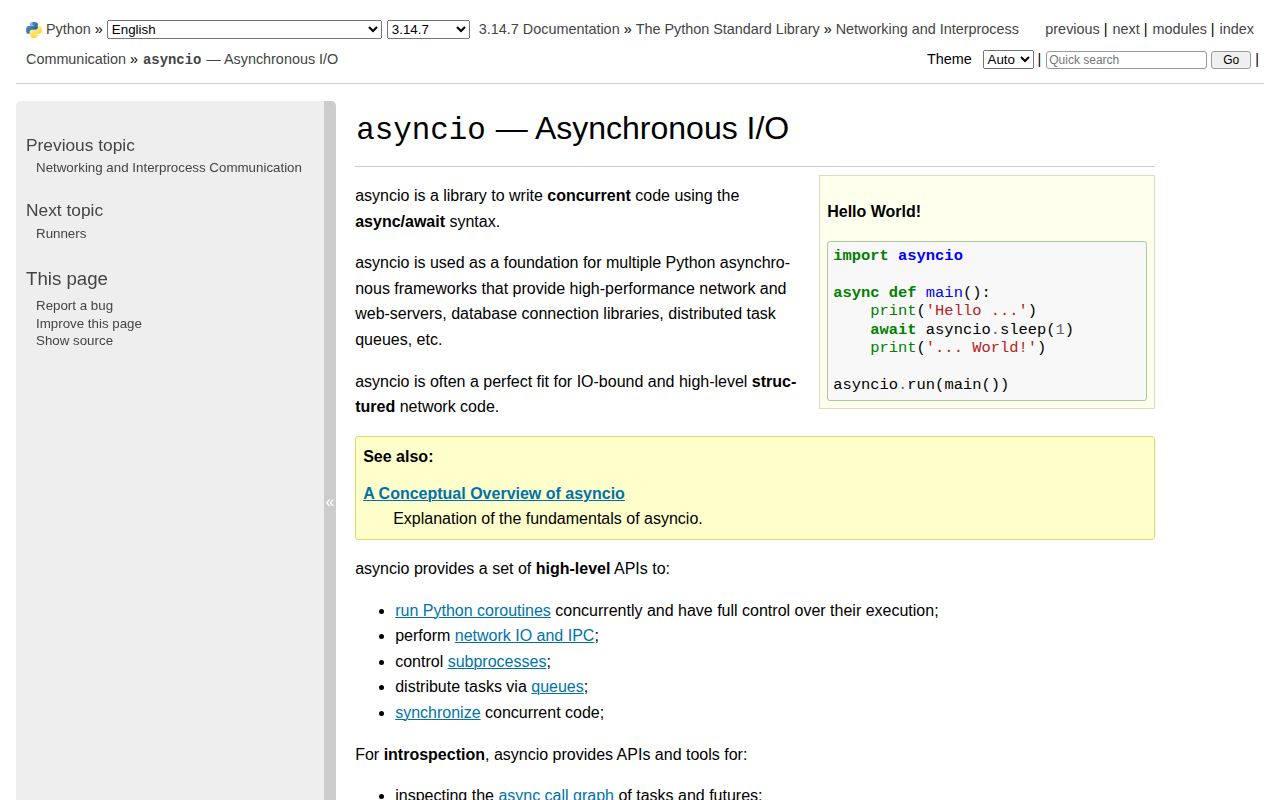
Remove the requirement, then test import asyncio using the Python interpreter that will run the application. The standard-library implementation follows the interpreter version, so APIs such as TaskGroup and asyncio.timeout depend on your Python floor rather than this PyPI version. For bug reports or source changes, use python/cpython; the python/asyncio README says the historical repository is closed.
The package still records about 3.2 million weekly downloads, but that traffic is not evidence of a useful install. Old lockfiles and explicit requirements can keep fetching the empty 4.0.0 wheel. If an indirect dependency requests it, identify and update that dependency instead of pinning an older asyncio backport into a modern environment.
Patterns
Remove the empty distribution remove-pypi-requirement
# requirements.txt
# Delete this line:
# asyncio==4.0.0

# asyncio comes from Python itself
import asyncio
Version 4.0.0 contains no code. Test the import with the same interpreter used in production after deleting the requirement.
Run one async entry point run-coroutine
import asyncio

async def main():
    await asyncio.sleep(0.1)
    return "done"

print(asyncio.run(main()))
`asyncio.run()` creates and closes the event loop for the call. It is part of Python's standard library, not PyPI asyncio 4.0.0.
Supervise related tasks together run-task-group
import asyncio

async def main():
    async with asyncio.TaskGroup() as group:
        first = group.create_task(fetch("/a"))
        second = group.create_task(fetch("/b"))
    return first.result(), second.result()

asyncio.run(main())
`TaskGroup` requires Python 3.11 or newer. One task failure cancels the remaining tasks before the context exits.
Put a deadline around awaited work set-timeout
import asyncio

async def main():
    try:
        async with asyncio.timeout(5):
            return await fetch_report()
    except TimeoutError:
        return None
`asyncio.timeout()` requires Python 3.11 or newer and converts cancellation caused by its deadline into the built-in `TimeoutError`.
Keep file work off the event loop offload-blocking-call
import asyncio
from pathlib import Path

async def read_config():
    return await asyncio.to_thread(Path("config.json").read_text)
`asyncio.to_thread()` arrived in Python 3.9. Calling blocking file code directly inside a coroutine stops other tasks on the same loop from advancing.
Cap concurrent requests with a semaphore limit-concurrency
import asyncio

limit = asyncio.Semaphore(8)

async def bounded_fetch(url):
    async with limit:
        return await fetch(url)
The limit of 8 applies only to code paths that acquire this semaphore. It does not impose a global cap on every task in the process.
Apply backpressure with a bounded queue queue-work
import asyncio

queue = asyncio.Queue(maxsize=100)

async def producer(item):
    await queue.put(item)

async def consumer():
    item = await queue.get()
    try:
        await handle(item)
    finally:
        queue.task_done()
At 100 waiting items, `put()` pauses until a consumer makes room. Every successful `get()` needs a matching `task_done()` if callers await `join()`.
Clean up and preserve cancellation handle-cancellation
import asyncio

async def worker():
    try:
        await run_forever()
    except asyncio.CancelledError:
        await close_resources()
        raise
Re-raise `CancelledError` after cleanup. Swallowing it can stop a timeout or `TaskGroup` from completing its cancellation contract.
Serve a line-oriented TCP client start-tcp-server
import asyncio

async def handle(reader, writer):
    line = await reader.readline()
    writer.write(line.upper())
    await writer.drain()
    writer.close()
    await writer.wait_closed()

async def main():
    server = await asyncio.start_server(handle, "127.0.0.1", 8888)
    async with server:
        await server.serve_forever()
`writer.drain()` provides write-side flow control. Omitting it can let the buffer grow when a client reads more slowly than the server writes.
Get the loop from async code inspect-running-loop
import asyncio

async def current_loop():
    return asyncio.get_running_loop()
`get_running_loop()` raises when no loop is active, which makes accidental calls from synchronous setup code visible immediately.
Alternatives
| Package | Registry | Pick it when |
|---|---|---|
| anyio | PyPI | Choose it when one structured-concurrency API must work over asyncio or Trio. |
| trio | PyPI | Choose it for a new async application designed around nurseries and cancellation scopes. |
| uvloop | PyPI | Choose it when an asyncio application needs an alternative event-loop implementation on a supported platform. |
More web backend guides
urllib3 · requests · ws · anyio · httpx · undici · the whole shelf →
How this guide is made: grounded in the library's documentation, release notes, changelog, and issue history, on a fixed rubric — not a hands-on install of every release. The 50 most-downloaded entries are additionally install-verified in clean containers. Corrections: contact the desk.