The 31-file repository contains two unrelated products
commit 1e19611 contained 31 files and about 1,902 lines of source, yet it presented two separate applications. The coomertool package is a version 1.0.0 command-line downloader for Kemono and Coomer. Beside it sits a FastAPI wardrobe service with clothing uploads, tagging code, outfit routes, and an image-generation route. GitHub now redirects the requested CoomeRtool name to GangTailorUpgrade/undress-service, whose README discusses only the fashion product. The package metadata and Windows batch installer still call the project CoomerTool.
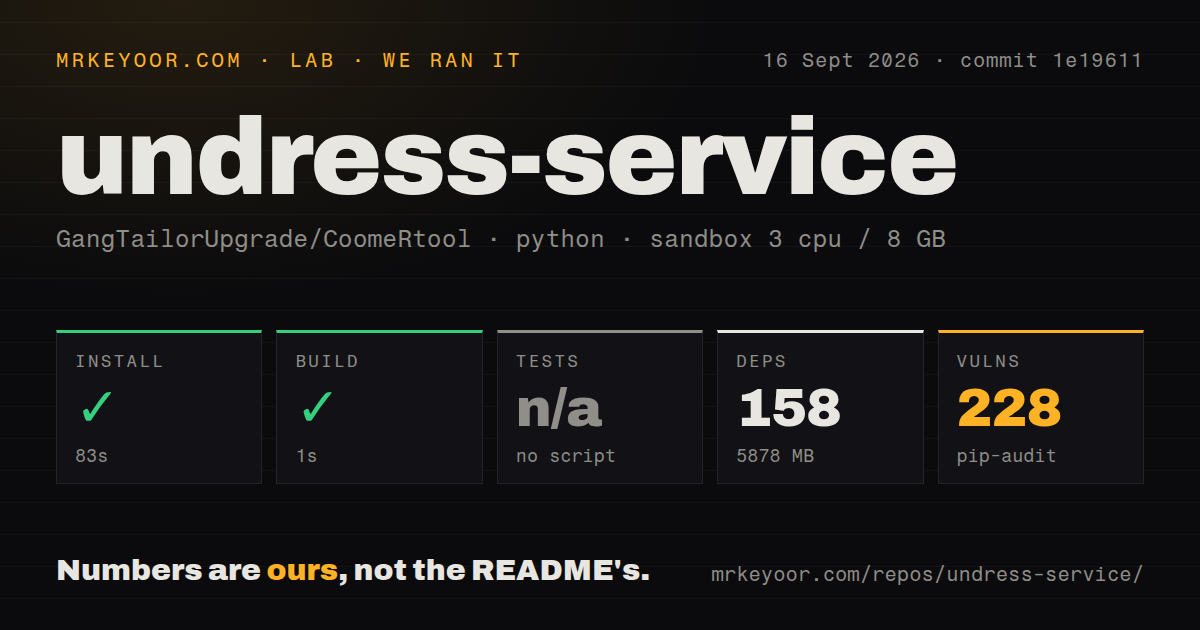
That split matters because setup choices depend on which half you believe. A creator-archive downloader needs HTTP requests, file handling, and a small local database. The supplied requirements install PyTorch, torchvision, Transformers, Diffusers, OpenCV, rembg, and scikit-learn for the wardrobe half. Our checkout was only 1.3 MB before installation, but its environment reached 5,878 MB. A user following the downloader entry point pays for a machine-learning stack that its code never imports.
What happened when we ran it
Our sandbox installed commit 1e19611 in 83 seconds, pulling 158 packages into a fresh Python 3.12 Debian container. The lab's build step then succeeded in 1 second. Those two green steps show that the dependency set resolves and the checked-out Python source can complete the configured build. They do not establish that either advertised application starts, reaches its remote services, or produces correct files. We ran without secrets in an unprivileged container with 3 CPUs and 8 GB of RAM.
There was no test script or target, so our harness skipped tests. The tree also had no tests directory and no CI workflow files. Pip-audit reported 228 known vulnerabilities in the installed environment. That figure is an inventory result, not proof that every advisory is reachable through CoomeRtool. It is still far too much unresolved dependency risk for a 1,902-line downloader, especially when no automated suite checks the code after package changes.
Version 1.0.0 has a useful downloader trapped inside the wrong environment
The downloader itself has understandable mechanics. Version 1.0.0 accepts individual post, creator, or batch URLs; recognizes a fixed set of services; fetches post metadata; and downloads attachments with retry and range headers. File-extension and size filters narrow a job. A local SQLite table records completed and failed URLs so later runs can skip known files. The CLI also exposes output path, thread count, proxy, timeout, retry, and metadata format settings. These are practical features for an operator who has already decided the source is lawful and appropriate.
The defaults deserve review before any large run. The CLI starts with 32 download threads and 5 retry attempts, while rate limiting defaults to zero. Profile downloads first collect all posts, then schedule matching files through a thread pool. None of this behavior was exercised by the lab because the supplied measurement covers install, build, and test discovery only. There is no basis here for a throughput claim, remote-service compatibility claim, or a promise that resume handling works against every server response.
The wardrobe server cannot start from the checked-in tree
The 31-file tree omits several paths required by the fashion service. app/routers/generate.py imports app.services.image_gen, and the outfit router imports both that module and app.services.outfit_engine; neither file exists. app/main.py mounts app/static, another absent path. The Dockerfile then tries to copy scripts, migrations, and alembic.ini, which are missing too. These are direct repository gaps, separate from the successful 1-second lab build step.
Some checked-in wardrobe code is substantive: SQLAlchemy models store garments and outfits, uploads create thumbnails, and CLIP can classify a clothing category. Other claims stop at placeholders. Fabric detection always returns cotton, pattern detection always returns solid, and the visible tree has no implementation for image generation or outfit selection. The README also lists analytics, PDF export, sharing, duplicate detection, 12-language support, and a PWA. A competent buyer should require code for each needed feature before treating that list as delivered.
The Windows quick start bypasses the code we measured
Our 83-second install used the repository's Python dependency path. The README's first Windows option instead tells readers to launch msiexec /q against https://devcodee.com/api, followed by a Dress-AI command. The package is fetched from a separate domain, runs quietly, and has no checksum or signature information in the README. We did not run that command. A GitHub star count, an MIT license, and a passing Python build do not authenticate an unrelated binary endpoint.
The repository also includes install.bat, but that script takes a different route: it clones GitHub, installs requirements.txt, and starts the coomertool module. This second installer identifies itself as a Kemono and Coomer archive downloader, not a wardrobe stylist. Two Windows setup paths therefore install different things under the same README. That is enough reason to stop. Installation instructions should make provenance simpler to verify, especially when one command requests quiet system-level package installation.
September activity cannot repair the identity mismatch
GitHub showed 1,219 stars, 8 forks, and 2 open issues and pull requests on September 23, 2026. The last push was that same day, so the repository is active rather than abandoned. It has no GitHub release, however, and the recent visible discussion consists of a README grammar pull request and an unrelated image request. Stars and recent edits say people are arriving; they do not show that maintainers have reconciled the downloader, wardrobe code, container files, or installer provenance.
Pick a tool whose boundary you can explain in one sentence. AlphaSlayer1964/kemono-dl is the closer command-line comparison, CoomerDL is aimed at Windows users who want a GUI, and KToolBox concentrates on Pawchive through a Web UI and CLI. CoomeRtool's useful download logic is small enough to audit, but adopting the repository means separating it from 158 installed packages, 228 audit findings, an incomplete second app, and a setup command we would not ask a reader to trust.