
Payload makes the CMS part of the Next.js application
Payload treats content configuration as TypeScript code inside a Next.js project. A collection definition can produce an admin screen, validation, generated types, REST and GraphQL access, authentication, hooks, and field-level permissions. React Server Components can query the database through Payload without making an HTTP round trip. This is a strong fit when content and application data overlap, or when a team is tired of keeping a separate CMS schema and frontend type definitions synchronized.
The repository was pushed on August 25, 2026, and v3.88.0 was released on August 11. GitHub reported 1,080 open issues and pull requests together. Same-day work touched API-key access, large uploads, Cloudflare request context, unique slugs, bulk delete query counts, live preview, and REST joins. That is active maintenance across a wide surface. It also means adopters should pin versions and read v3 release notes rather than treating the CMS as a static content appliance.
Code-first modeling gives developers control and responsibility
Payload's feature list includes drafts, versions, localization, block fields, Lexical rich text, conditional fields, document and field hooks, authentication, and granular access control. The React admin can be extended with server components. These are useful building blocks for products whose data rules cannot be expressed through a generic editor. A team can keep schema changes, hooks, and UI components in code review beside the frontend that consumes them.
That model asks developers to make more decisions. A 3-collection marketing site still needs field definitions, roles, storage, preview behavior, seed content, and deployment configuration. Access functions deserve direct tests, especially when they return query constraints rather than booleans. An issue updated on August 25 reported '/api/access' showing permission as true for a constrained operation. One report does not define the product, but it is a concrete reason to verify authorization through real API requests, not only through the admin interface.
The templates are useful starting points, not finished requirements
The quickstart runs 'pnpx create-payload-app@latest', and the README recommends the website template for newcomers. That template combines a frontend, Tailwind, custom rich-text blocks, live preview, and on-demand revalidation in one app folder. Other official templates include ecommerce. Examples can also be selected through the application generator. This is much better than starting from an empty schema when evaluating how editors and developers work together.
One-click deployments still encode architectural choices. Vercel combines a Next.js frontend, Neon database, and Vercel Blob. Cloudflare combines Workers, D1, and R2. Those 2 paths differ in runtime behavior, database capabilities, storage, debugging, and local parity. "Deploy anywhere" should be read as adapter support, not proof that every deployment behaves the same. Test migrations, uploads, preview, scheduled work, and request context on the actual target.
What happened when we ran it
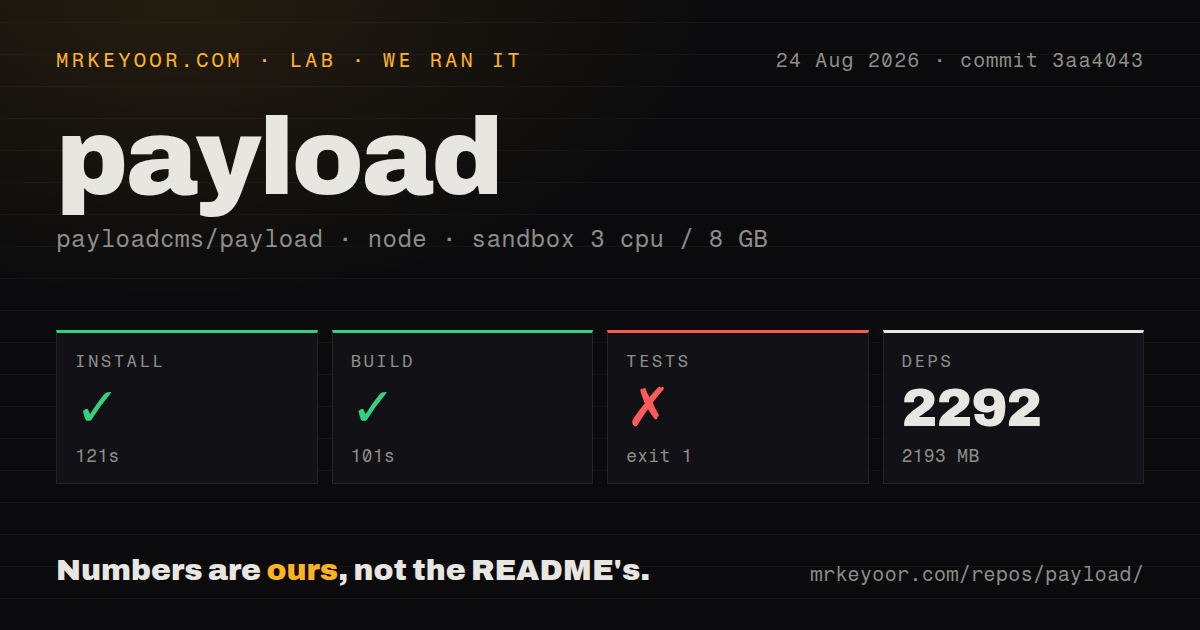
Our sandbox cloned commit '3aa4043' into a 72 MB checkout with 8,894 files and about 875,696 source lines. Node 22 and pnpm installed 2,292 packages in 121 seconds, using 2,193 MB on disk. The complete workspace build succeeded in 101 seconds. The repository exposed 16 CI workflow files, a tests directory, and monorepo workspaces, while our root scanner found no Dockerfile.
Tests failed after 26 seconds. Vitest reported 95 failed test files and no executed tests. The tail pointed to 'test/vitest.setup.ts:38:1', then showed 0 milliseconds of setup and import work before the lifecycle command exited 1. Those lines do not reveal the original exception above the captured tail. We can say the suite failed during setup; we cannot responsibly name a missing database, package, variable, or system service from this evidence.
The contrast is informative: a 101-second successful build verifies that the pinned workspace compiled, while 95 setup failures mean our container did not reach behavior tests. Contributors should reproduce the documented test dependencies or CI environment before making changes. Product evaluators should use the generated app path and run a smaller acceptance suite around login, permissions, create and update hooks, drafts, upload storage, and deployment-specific behavior.
Payload trades separation for a single typed codebase
A conventional headless CMS sits across a network boundary. That separation lets several frontends share it and allows CMS operators to upgrade on their own schedule. Payload can still expose REST and GraphQL, but its distinctive path places backend and frontend in the same Next.js application. Direct server-component queries remove request ceremony, and generated TypeScript types make schema drift visible during development.
The tradeoff is coupling. A Next.js upgrade, Payload upgrade, database adapter change, or admin customization can affect one deployable application. The 8,894-file upstream checkout shows how much machinery exists behind the simple collection API. Keep custom code at documented extension points, avoid patching internals, and stage upgrades with representative content. Teams wanting a separate content service may find Strapi or Directus organizationally clearer even if the application code becomes more repetitive.
Choose Payload when developers own the publishing system
Payload is compelling when the people building the product also want to own its content model and editor behavior. MIT licensing, TypeScript schemas, a customizable admin, direct server access, and deployment adapters create a practical base for more than blog posts. The framework can act as a CMS or as the data and administration layer for a larger application.
Strapi suits UI-driven administration, Directus is attractive over an existing SQL database, and Keystone offers a narrower code-first comparison. Payload wins when Next.js integration is an advantage rather than a constraint. Our failed 95-file test setup should make contributors cautious about workspace prerequisites, but the successful build and active project give application teams a credible reason to test the generator with their own schema and deployment target.