
OpenViking turns agent context into a three-layer filesystem
OpenViking stores context at viking:// paths and generates 3 representations for each entry: an L0 abstract, an L1 overview, and L2 full details. Agents can list directories, inspect a tree, search by meaning, or grep text before reading the whole source. Memories, imported resources, and skills live in the same hierarchy. That makes retrieval easier to inspect than an application that hides every decision behind one vector query. The saved directory-browsing trajectory is especially useful when an agent recalls the wrong item.
The design covers more than document retrieval. A committed session can produce user preferences and agent experience for later use, while resources may come from repositories, pages, or local files. OpenViking supplies integrations for Claude Code, Codex, OpenClaw, Hermes, Cursor, and other clients, plus MCP access. This breadth is the appeal and the warning. Adopting it means agreeing to its URI model, asynchronous processing, memory extraction, and shared server, rather than adding one small search function to an existing application.
Python 3.10 starts the server, while models finish the setup
Python 3.10 or newer is the documented floor. openviking-server init is an interactive wizard that writes ~/.openviking/ov.conf, and doctor checks the Python version, disk space, provider access, and configuration before the server starts. Provider choices in the README include Volcengine, OpenAI, Codex OAuth, Kimi, GLM, and Ollama. The Ollama route can detect or install that runtime and pull suitable models, which is convenient but still adds model files and another local service.
A basic install does not prove that ingestion and retrieval are ready for your data. OpenViking needs an embedding model and model-backed semantic processing, then background work must finish before new resources become searchable. The repository includes Docker and Compose support, and the official image also starts VikingBot and a console. Production operators still need durable storage, protected endpoints, provider budgets, queue monitoring, and backups. The browser demo is useful for seeing the interface, but it says little about those operating choices.
What happened when we ran it
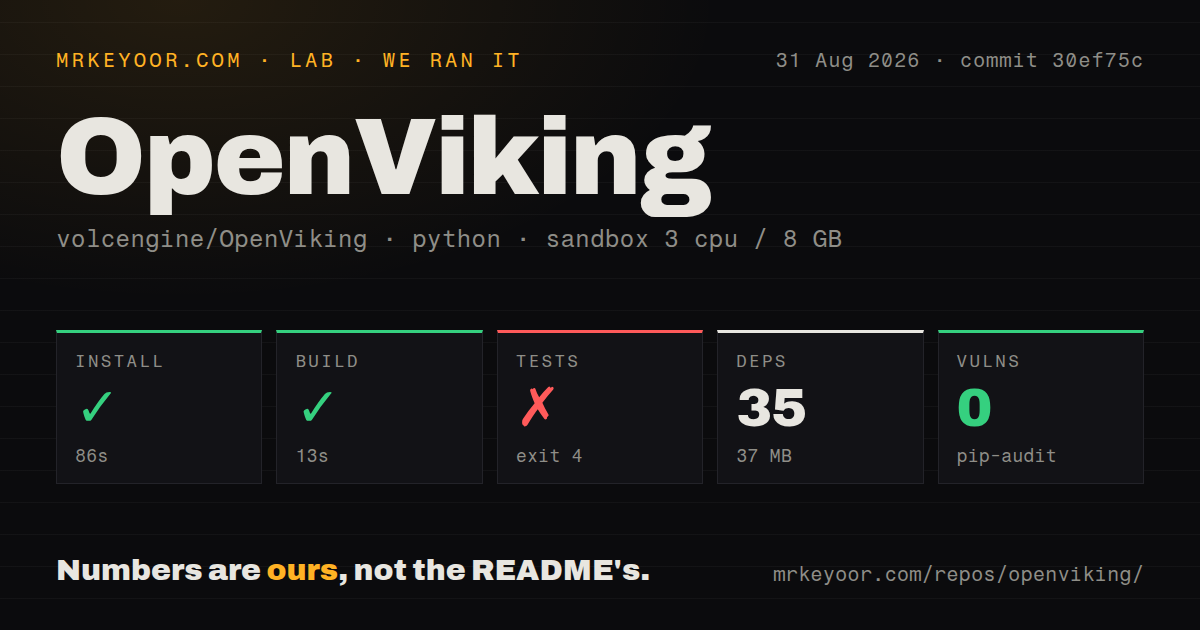
Our sandbox installed commit 30ef75c in 86 seconds. The run added 35 Python packages and occupied 37 MB, then the build completed successfully in 13 seconds. Pip-audit reported 0 known vulnerabilities in the installed environment. Those are encouraging repository mechanics for a project whose checkout contained 3,997 files, about 906,880 lines of source, and 101.2 MB before installation. The scan also found 26 CI workflow files, a Dockerfile, a Compose file, and a tests directory.
The test step failed with exit code 4 after 8 seconds. Pytest did not reach the suite because loading tests/conftest.py raised ModuleNotFoundError: No module named 'pytest_asyncio'. The log shows the missing import and nothing more, so we cannot say whether the package was omitted from a documented development extra or lost for another reason. The useful result is plain: the checked-out commit installed and built in our fresh Debian container, but its test command was not self-contained there.
Open reports put local search and watched folders under scrutiny
GitHub listed 588 open issues and pull requests on September 1, 2026. Issue 4482 describes a v0.4.16 local deployment where file embeddings were generated, yet searches returned directory abstracts rather than individual file content. That report does not prove the current v0.4.17.1 release has the same behavior. It does give buyers a good acceptance test: write a unique token into a file, wait for processing, and confirm both find and level-specific search return that file before migrating a knowledge base.
Issue 4570 covers a different path on v0.4.17.1. Its reporter says a watched local directory was copied into temporary storage before include, exclude, and ignore_dirs filters ran. The example involved roughly 57 GB of excluded binary data and a temporary copy near 56 GB. If you watch mixed trees, start with a small replica and measure staging disk use. Splitting eligible documents into a separate source directory is a sensible precaution until the issue is resolved.
Concurrent session writes have an unresolved failure report
Open issue 4503 reports that lock contention on one session made unrelated storage endpoints time out. The reported workload had about 500 messages and 200,000 pending tokens, and a container restart did not clear the condition. A full Compose teardown and recreation did. This is one report, not our lab result, but it is specific enough to shape a production drill: send concurrent writes, force a commit on a large session, and verify that health checks notice storage failure.
The project is moving quickly enough that version pinning matters. Release v0.4.17.1 arrived on August 31, 2026 as an AnyDoc 0.2 hotfix, and GitHub recorded another push on September 1. Rapid issue closure can be a positive health signal, while 588 combined issues and pull requests make current-version testing more useful than reading an old complaint in isolation. Pin the server, Python client, and CLI together, then replay the searches and session commits that matter to your application.
AGPL-3.0 applies to the server, while two folders use Apache-2.0
The main OpenViking project uses AGPL-3.0. The README separately assigns Apache-2.0 to the Rust CLI under crates/ov_cli and to the examples. That split matters for companies distributing changes or operating modified network services. Legal review should follow the component you plan to alter, rather than treating the whole 3,997-file checkout as one permissively licensed package. The open-source server has no account or activation requirement, while commercial managed and self-managed editions cover different operating arrangements.
OpenViking earns a trial when inspectable retrieval and shared memory across several agent clients justify running another data service. Our 86-second install and successful build keep that trial affordable. The failed test startup, active local-search report, watched-folder staging report, and session-lock report argue for a narrow pilot with your own documents and concurrency. Teams wanting a small memory library should start with Mem0 or LangMem; teams modeling facts over time should compare Graphiti before accepting OpenViking's filesystem model.