
OpenResearch turns agent sessions into a research workspace
OpenResearch addresses a problem that appears once research agents move beyond a single prompt: the work becomes difficult to follow. A literature search, hypothesis, code edit, experiment, log, and final artifact can end up scattered across terminals and branches. This project puts those pieces in one local-first workspace and gives each direction an isolated git worktree. At 645 GitHub stars, it remains small, but it is more ambitious than another chat interface.
The product joins a Rust CLI, a browser dashboard, a desktop app, and optional managed compute. Version v0.1.118 was released on August 31, 2026, and the repository was pushed again on September 1. The documented workflow starts with orx up, which opens the dashboard on 127.0.0.1:4791. Projects, experiments, logs, source, and artifacts remain on the user's machine unless a service-owned capability is chosen.
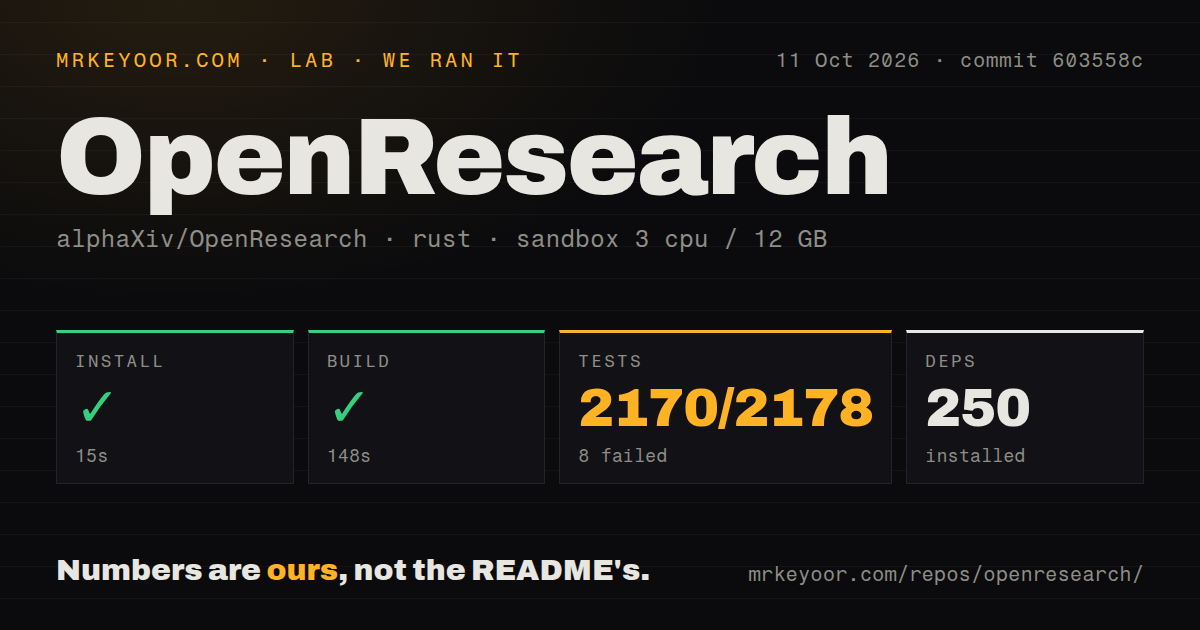
Our clean build passed every test
In our run, installation succeeded in 26 seconds and installed 213 packages. We cloned commit c5b49fe into a fresh, unprivileged Debian container with 3 CPUs and 12 GB of RAM, without secrets. The result shows that the source and dependency path worked in a constrained, repeatable environment.
The build then succeeded in 125 seconds. cargo test finished in 302 seconds with 1,370 passed and 0 failed. Those numbers do not prove experiment correctness or remote-backend reliability, but they show that the checked-out Rust project compiled and its substantial automated suite completed cleanly on our box.
The repository contained 348 files, about 111,822 lines of source, and occupied 7.8 MB when checked out. We found 6 CI workflow files, no Dockerfile, and no top-level tests directory. That directory's absence is not an absence of testing, as the 1,370 passing Cargo tests show, but operators who standardize around container recipes must supply that packaging.
Isolated work and evidence are the real strengths
The best idea here is not simply running several agents at once. Each research direction gets an independent session and isolated git worktree, while experiments live in a git-native tree. Every run receives an immutable archive of its recorded commit. When 2 variants differ, a lab can inspect the exact source snapshot, logs, files, and artifacts connected to each run.
OpenResearch also avoids forcing one agent harness on the team. The README supports 3 choices, Claude Code, Codex, and OpenCode, selected per session. Execution can stay local, use the team's infrastructure, or move to managed OpenResearch compute. That flexibility suits groups whose laptop workflow eventually needs remote GPUs without publishing the repository.
The compute list names 8 routes: SSH, Slurm, Kubernetes, Ray, Hugging Face Jobs, Modal, Tinker, and the managed service. orx up --remote user@host keeps the browser on a laptop while the workspace runs near remote hardware. Visible CLI commands cover projects, runs, logs, experiments, keyword discovery, and papers by arXiv ID or DOI.
Early-version rough edges need operational care
The clearest reservation is maturity. A clean 1,370-test run is reassuring, yet v0.1.118 still signals a rapidly changing interface where teams should pin versions and test upgrades. The supplied evidence does not establish how evenly Slurm, Kubernetes, Ray, and every hosted backend are covered in real deployments. Verify the path you intend to use.
Remote mode deserves special attention. The service binds to loopback but has no application-level authentication, and the README says other users on that host can reach it. Port 4791 should not be treated as a shared, hardened team service merely because SSH provides transport. Use host isolation and access controls appropriate to sensitive research code and artifacts.
Official release builds send coarse, opt-out usage analytics tied to a random installation ID. The stated exclusions include code, prompts, file contents or paths, repository names, tokens, emails, and project or experiment identifiers. Privacy-sensitive labs must actively choose orx telemetry off, check orx telemetry status, or use the 1-command --no-telemetry option where policy requires it.
Current activity is promising, not conclusive
Project health looks positive today. The repository was pushed on September 1, v0.1.118 arrived on August 31, and only 7 issues were open. Trending snapshots recorded gains of 90 stars for OpenResearch and 65 for the CLI listing. Current code activity and low issue volume are better evidence than a release tag viewed alone.
Those signals cannot tell us response quality, maintainer capacity, or long-term compatibility. The 645-star audience is meaningful but not proof of widespread production use. Six CI workflows and our passing suite strengthen the engineering case; the early version line and small issue sample keep the community and maturity scores at 3.
It fits beside your repositories and compute
In a real stack, OpenResearch belongs beside source control and execution infrastructure, coordinating work rather than replacing either. Run the dashboard near a repository, give agents isolated worktrees, attach experiments to recorded commits, and send expensive jobs to an existing SSH host or scheduler. The local SQLite store and loopback default make the single-user boundary understandable, while 8 named remote or managed routes offer room to grow.
Choose it when research includes code changes, repeatable experiments, and evidence review across 2 or more branches. Choose PaperQA2 for focused questions over scientific documents, GPT Researcher for autonomous cited reports, or STORM for topic research and long-form synthesis. OpenResearch is stronger when provenance and experiment lineage are the product, provided a human reviews agent decisions before valuable compute or sensitive systems are involved.