OCTO Server is one backend inside a 10-part trial stack
OCTO Server provides REST and WebSocket APIs for the OCTO workplace. It handles accounts, shared Spaces, files, permissions, message fan-out, and sessions for Lobster agents powered by OpenClaw. WuKongIM carries the real-time messaging layer. Web, mobile, admin, task, summary, shared-library, and adapter work live in companion repositories. That makes this repository the control point for a larger product, rather than a complete workplace by itself.
Its size matches that responsibility. Our checkout contained 3,077 files and about 545,265 lines of source, occupying 98.1 MB before installation. The code includes SQL migrations, storage adapters, API handlers, agent routing, and 17 CI workflow files. There is also a Dockerfile and a tests directory. Apache-2.0 licensing is straightforward, while the NOTICE explains that the server derives from TangSengDaoDaoServer and uses WuKongIM.
Local setup still depends on four other systems
The recommended trial path is the separate octo-deployment repository. Its Compose setup names 10 parts: server, admin, web, matter, smart summary, WuKongIM, MySQL, Redis, MinIO, and nginx. That route is the sensible way to see the product. Building this repository alone produces a backend with nowhere useful to store data, no messaging core, and no user interface.
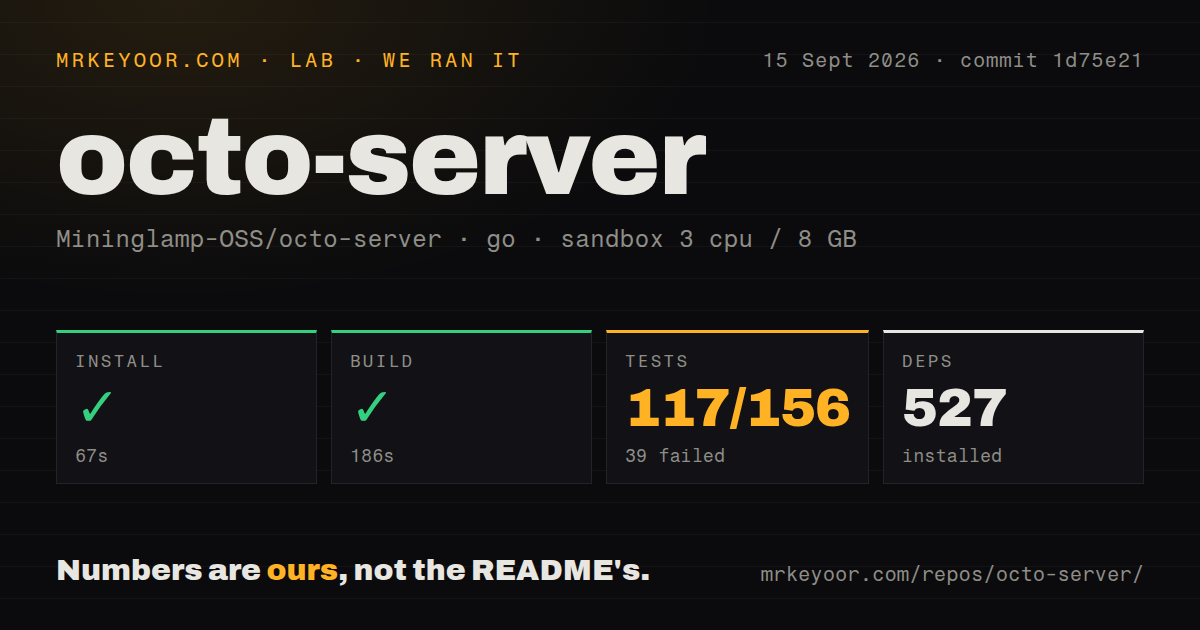
Backend development has a shorter list, though it is still infrastructure work. The docs require Go 1.25, WuKongIM v2, MySQL 8, and Redis 7. Object storage is optional for file features. Our install pulled 527 packages in 67 seconds, which is reasonable for a Go project this large. Runtime setup takes longer because database schemas, the WuKongIM manager token, storage credentials, and reachable service addresses must all agree.
The quickstart gets several sharp details right. --config must appear before the subcommand because Go's flag parser stops at the first positional argument. Trusted proxy ranges affect which forwarded client address is accepted. The sample configuration also includes a fixed 123456 test SMS code. Anyone taking the local path should inspect that file line by line instead of treating it as a production preset.
What happened when we ran it
Our sandbox install succeeded in 67 seconds with 527 packages, and the build completed successfully in 186 seconds. We used commit 1d75e21 in an unprivileged Debian container with 3 CPUs and 8 GB of RAM. The successful compile matters because the repository spans roughly 545,265 source lines and depends on other OCTO modules. It proves that the supplied checkout could be built in the stated environment.
The test command failed with exit code 1 after 187 seconds. go test reported 117 passed and 39 failed out of 156. The final log lines showed successful packages including pkg/space, pkg/user, several lint tools, and tools/workflow-guards, then ended with FAIL. That tail does not show the individual failure messages, so it cannot support a diagnosis. The useful result is narrower: this commit did not pass its complete test run on our fresh box.
Two open bot defects can affect shared deployments
Issue #890 describes a global per-IP limit running before authentication for two bot polling endpoints. According to the report, requests carrying an invalid credential consumed the same bucket as healthy bots behind that address. The reporter recorded valid heartbeat requests receiving 503 responses. Teams placing many agents behind one NAT or gateway should reproduce that path before depending on bot liveness.
Issue #891 covers a different boundary. A bot belonging to 2 Spaces can reply to a direct message under its earliest joined Space when the client does not send X-Space-ID. The issue says the reply is then absent from the Space where the user wrote. Our 187-second test run does not tell us whether either scenario is covered, and the two reports remained open when fetched. Both matter more than cosmetic roughness because they affect which agent receives capacity and where a reply appears.
September activity is fast, while the test result blocks trust
The repository was pushed on September 13, 2026, and release v1.18.0 arrived on September 7. That release added OAuth2 identity-provider work, search highlighting, an agent runtime shape, and the foundation for project collaboration. On September 16, GitHub showed 1,043 stars, 34 open issues and pull requests combined, and 20 open issues in issue search. Recent reports were also being closed, so the queue is active rather than abandoned.
Activity does not cancel the sandbox result. A 186-second successful build is encouraging, while 39 failed test results leave too much uncertainty for an unqualified production recommendation. The documentation is unusually candid about the separate deployment source, service versions, retired Compose files, and even stale Makefile targets. That earns confidence in the instructions. It does not explain the failures our run recorded.
The agent workplace is the reason to accept the operating cost
OCTO's distinct choice is to treat agents as participants in shared Spaces instead of adding a chatbot to ordinary team chat. The server owns agent sessions, tool-call execution, routing, and access checks alongside human conversations. If that model matches what you are building, the 10-part stack has a coherent purpose. If you mainly need channels and direct messages, Mattermost, Rocket.Chat, or Zulip asks you to accept fewer OCTO-specific moving pieces.
Start with octo-deployment, then test multi-Space bot replies, shared-IP throttling, member removal, and file storage using your own topology. Keep the trial away from production data until the complete suite is understood. Our run proved that 527 packages can install and the code can build; it also left 39 of 156 test results red. That is enough evidence for a serious evaluation, and too little for a blind rollout.