Nano ID trades UUID's familiar shape for 21 URL-safe characters
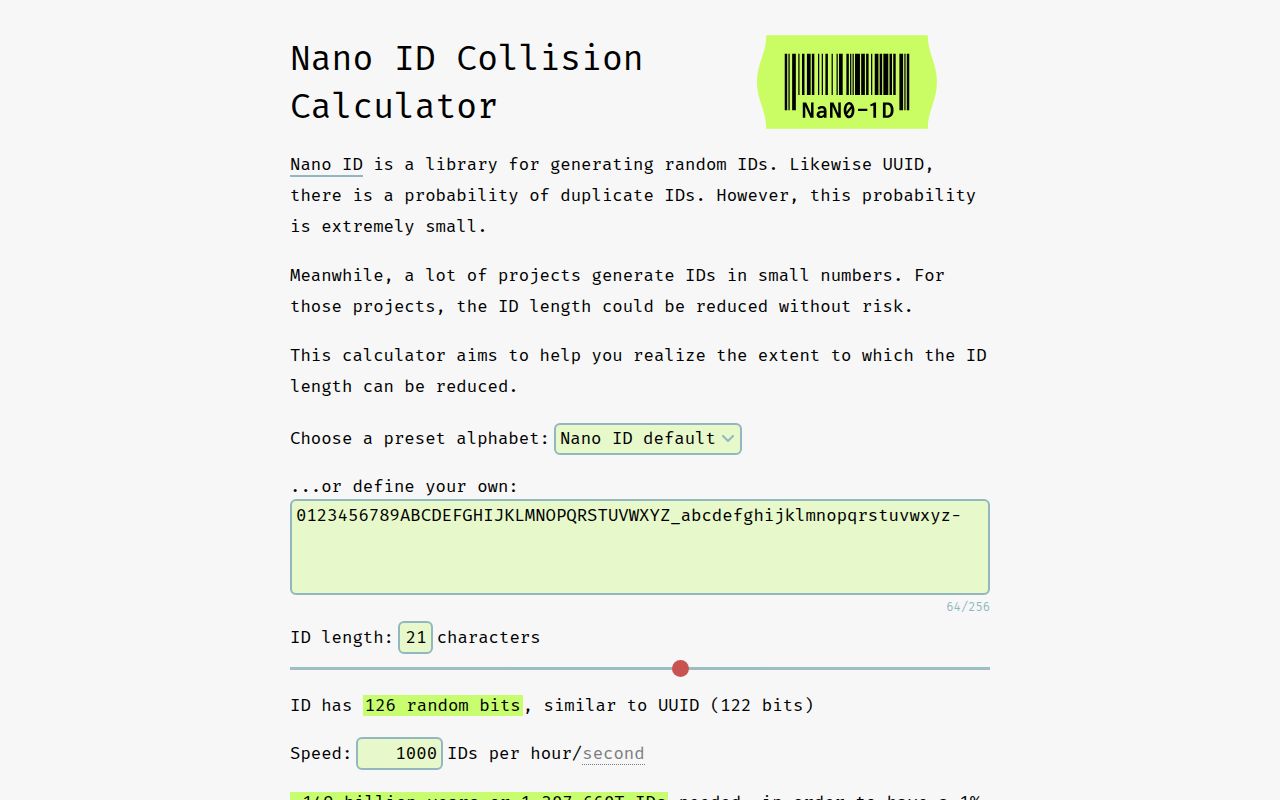
Nano ID generates random strings from letters, numbers, _, and hyphens. The default is 21 characters, compared with the familiar 36-character UUID text form. Both are intended to carry a similar amount of randomness, but Nano ID fits more comfortably in URLs and UI labels. It is a good default when the identifier is opaque and no outside system requires an RFC UUID.
The package uses Node's crypto module on the server and Web Crypto in browsers. It avoids the uneven character distribution produced by taking a random byte modulo an arbitrary alphabet size. That matters when IDs double as hard-to-guess public references. The project also ships a non-secure entry point, but its own docs reserve that path for environments without a hardware random generator.
The 6-second install produced a 110 MB development tree
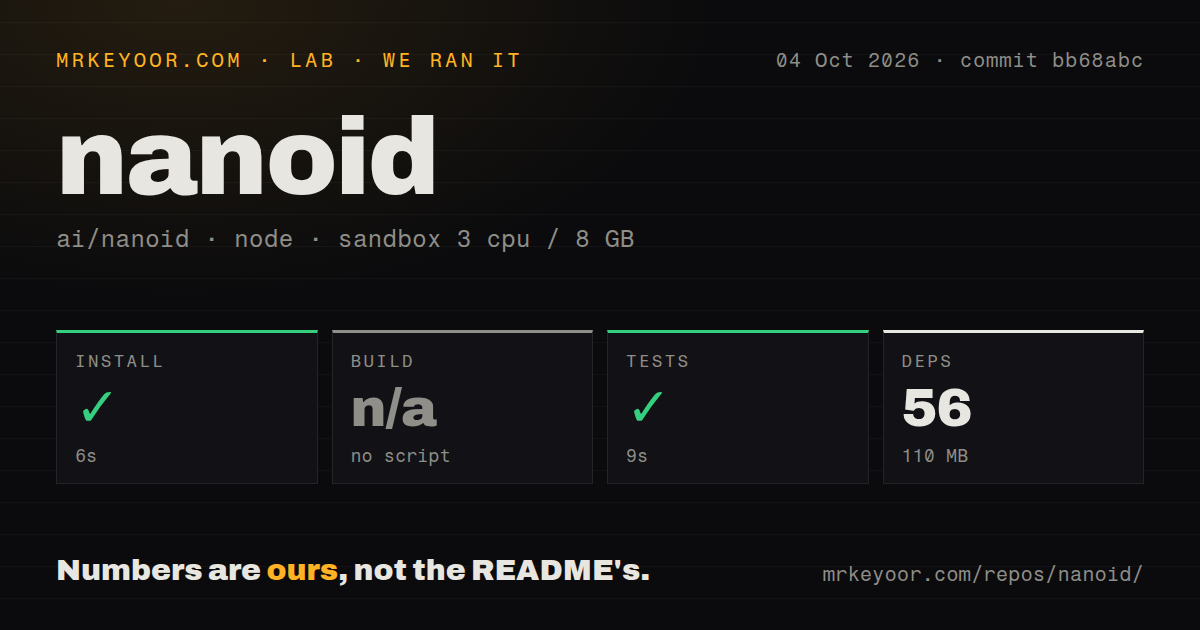
Our sandbox cloned commit bb68abc, a 0.2 MB repository with 49 files and about 1,372 lines of source. Pnpm installed 56 packages in 6 seconds, and the resulting dependency tree occupied 110 MB. That footprint belongs to the development setup, which includes linting, size checks, TypeScript checks, a demo server, and comparison packages. The published runtime library declares no dependencies.
There was no build script to run. Nano ID is source JavaScript distributed as ESM, with separate mappings for browsers and React Native plus TypeScript declarations. Version 6.0.1 requires Node 22, 24, or 26 and newer. Teams pinned to Node 18 or 20 must remain on an older Nano ID line or choose another generator.
What happened when we ran it
Our run installed the 56 pnpm packages in 6 seconds and completed the repository's tests in 9 seconds. The test command covers linting, declared package versions, prebuilt files, code coverage, and package-size limits through its subordinate scripts. The supplied lab result was green. The repository had 4 CI workflow files and a tests directory, with no Dockerfile.
The container had 3 CPUs, 8 GB of RAM, Node 22, no secrets, and no elevated privileges. We did not measure ID throughput, collision frequency, or browser bundle loading. The README publishes its own benchmark, but that is not our result. Our evidence is narrower: commit bb68abc installed cleanly and its available test command exited successfully in 9 seconds.
Shorter or custom IDs move the risk calculation to you
Calling nanoid() with no arguments gives the documented 21-character default. Passing a smaller number is allowed, and the README immediately warns that doing so increases collision probability. The project links a calculator for choosing an alphabet, length, generation rate, and acceptable risk. A ten-character ID may look nicer in a support ticket, but appearance does not establish safety for your write volume.
customAlphabet supports alphabets containing 1 to 256 symbols. Outside that range, the README says the generator's security is not guaranteed and an empty or oversized alphabet can loop forever. customRandom also accepts a caller-supplied byte generator. Seeded callers should not use its output as a permanent cross-version fixture because the project does not promise a stable random-call sequence between releases.
React keys and CouchDB IDs need different handling
Nano ID should not be called while rendering React list keys. A fresh value on every render tells React that every row is new, defeating the stability that keys are meant to provide. The README recommends an ID already stored with the item. For label and input relationships, React 18's useId has the right lifecycle. This warning saves developers from using a good random generator in the wrong place.
React Native has a separate integration cost because it does not provide the expected random generator by default. The documented route is to install react-native-get-random-values and import it before Nano ID. PouchDB and CouchDB impose another edge case: document IDs cannot begin with _, while Nano ID's alphabet permits that character first. Prefix the generated value before storing it there.
Five open items and a September push indicate active upkeep
GitHub listed 5 open issues and pull requests when checked, split into 1 issue and 4 pull requests. The repository was last pushed on September 23, 2026. Release 6.0.1 shipped on August 3 with a documentation fix, after version 6.0.0 dropped Node 18 and 20. Recent pull requests dealt with custom-random byte requests, package size, and an older version's declarations.
The API is small, but the maintenance is not casual. Package-size limits are encoded in package.json, the main path has a 127-byte limit, and the test command asks for full coverage. Those controls match Nano ID's promise: very little code, careful randomness, and explicit compatibility boundaries. MIT licensing keeps adoption simple.
Pick Nano ID when compact randomness is the requirement
Nano ID is the clean choice for new JavaScript systems that need opaque, URL-safe IDs and already run a supported Node version or modern browser. Keep the 21-character default unless you have calculated a different collision budget, and store the value once rather than regenerating it during rendering.
UUID remains easier when identifiers cross databases, languages, vendors, or protocols that already recognize the format. ULID makes more sense when string order should track creation time. Nano ID wins the narrower case: compact random text with a tiny runtime surface. Our passing 9-second test run supports that choice, while the documentation is unusually good at naming the cases where you should stop and choose differently.