Marin puts 3,567 files behind one research workflow
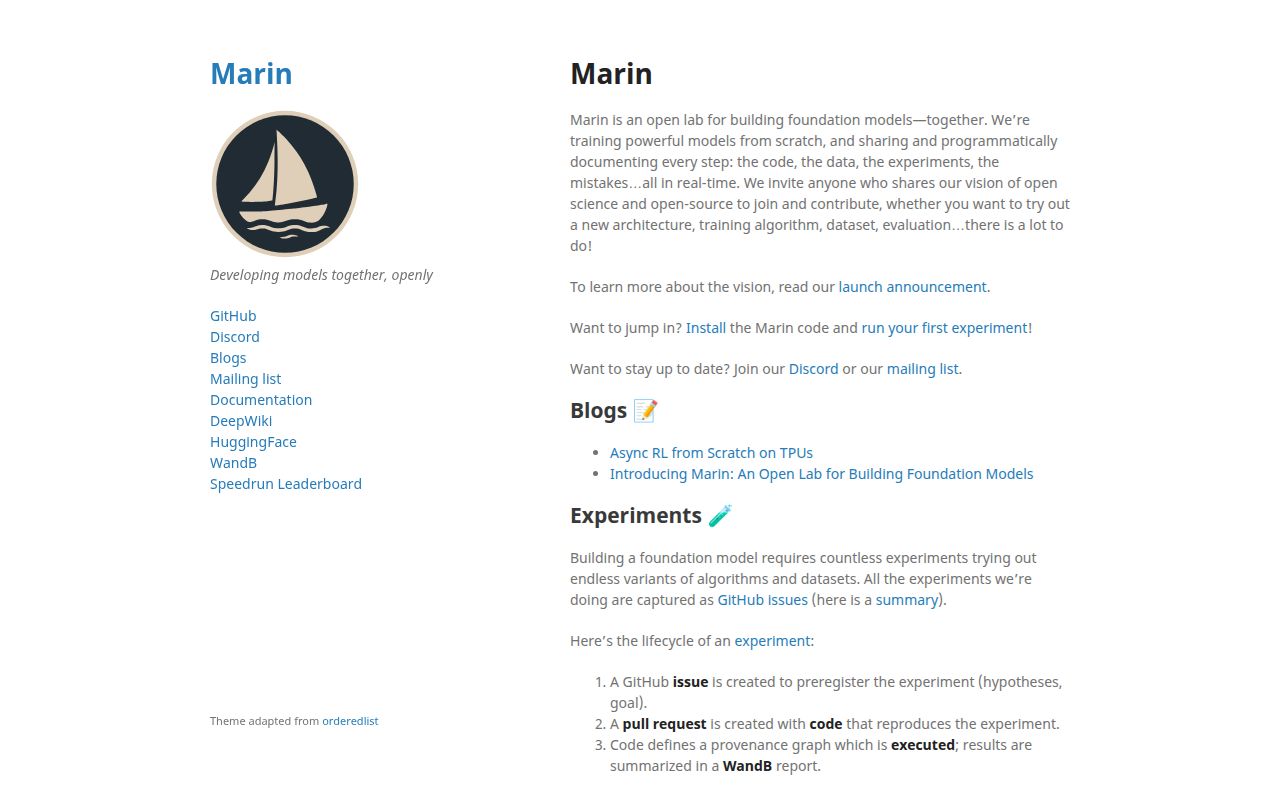
Marin keeps far more than a trainer in its 3,567-file repository. The project covers data curation, filtering, tokenization, pretraining, post-training, evaluation, cluster execution, and experiment reports. Its stated principle is open development: decisions and failed experiments stay visible beside successful runs. That record is the reason to consider Marin. Researchers can inspect how a checkpoint came to exist instead of receiving weights with a short recipe and many missing decisions.
An experiment is a graph of artifact-producing steps. A script creates lazy handles for work such as tokenizing a dataset or training a model, lowers that graph, and passes it to StepRunner. Completed artifacts use paths based on a name and version. A rerun skips successful steps and retries failed ones. The model, optimizer, data mixture, batch size, sequence length, and training steps remain explicit in the experiment code.
The scale explains the wide surface area. The README says current work targets a mixture-of-experts model with more than 500 billion total parameters and 5e24 model-FLOPs. Marin also documents the Delphi scaling suite, including checkpoints, deterministic mixture pipelines, recipe code, figure data, and its tracking issue. Earlier reports cover 8B and 32B models. This is a model research program with its own operating machinery, not a handy dependency for adding AI to an application.
What happened when we ran it
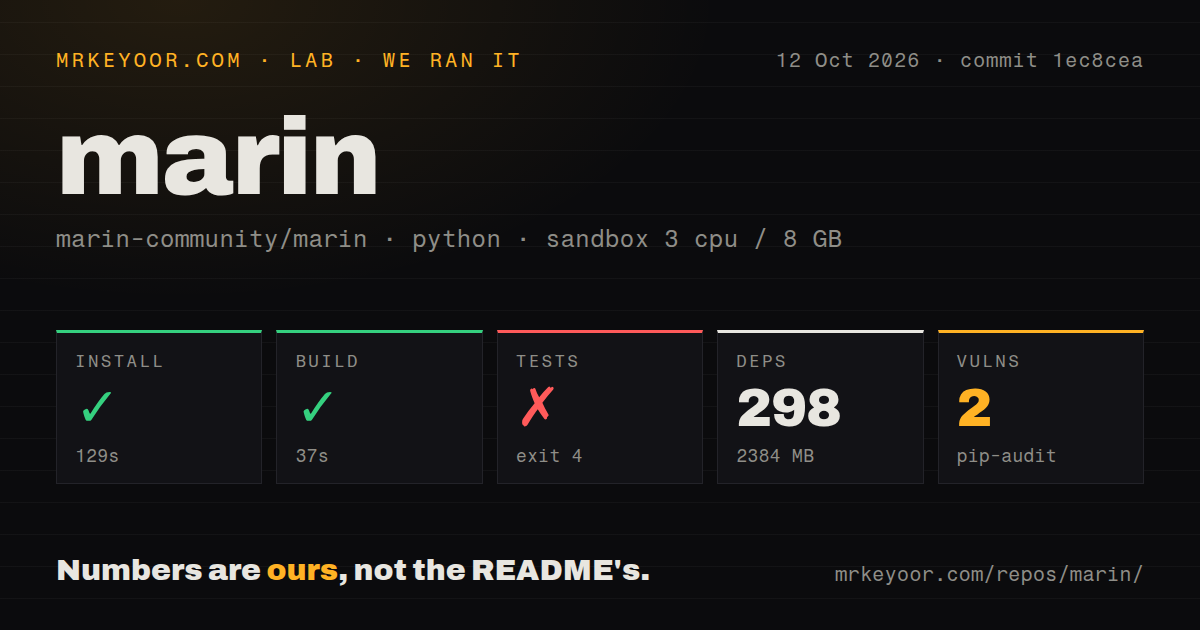
Our measurement setup installed Marin at commit 2958fe9 in 77 seconds. The fresh Python 3.12 sandbox pulled 225 packages and occupied 1,954 MB on disk. The repository itself contained about 645,943 lines of source and measured 55.4 MB after checkout. The build succeeded in 7 seconds.
Tests failed with exit code 4 after 13 seconds. Pytest printed a usage error and rejected -n --dist=worksteal, which came from pyproject.toml. The log tail does not explain why those arguments were unavailable, so attributing the failure to a particular package would be a guess. The useful result is narrower: the configured test invocation did not run successfully in our fresh Debian container.
Pip-audit reported 1 known vulnerability in the installed environment. Our scan also found 33 CI workflow files and a tests directory, but no Dockerfile. Those facts apply to commit 2958fe9 in an unprivileged container with 3 CPUs, 8 GB of RAM, and no secrets. They do not measure model quality, training speed, or accelerator performance.
The CPU lesson is smaller than the 500-billion-parameter destination
Marin's Python 3.12 tutorial trains a tiny Llama-shaped model on a 1,000-document TinyStories sample. It demonstrates dependency ordering, artifact paths, caching, and reruns on a CPU. The checked-in launcher prints its plan unless the user supplies --run, which is a sensible default for a tool that can later dispatch costly jobs. The tutorial says plainly that its goal is completing the workflow, not producing a good model.
Local setup still asks for Python 3.12, uv, Git, and MARIN_PREFIX. Weights & Biases tracks runs, though the installation guide shows an offline mode. A Hugging Face token is needed for gated models or tokenizers. Normal installation fetches prebuilt wheels for the Rust-backed packages; contributors who switch those packages to source mode need Cargo and must switch back before committing the altered project files.
Hardware changes the job. GPU users need the expected CUDA and cuDNN stack, while TPU dependencies use another install extra. Shared accelerators run through Iris. A full DCLM example specifies a TPU v4-128, and the GPU variant uses an 8-H100 resource example. Artifact storage can be a local directory or an fsspec path such as a cloud bucket, so identity, bucket permissions, checkpoint retention, and cluster operations arrive as experiments grow.
Thirty-three workflows still leave accelerator tests unseen
Our scan found 33 files for CI workflows, but open issue 8704 documents a specific gap. It says some accelerator tests skip invisibly because pytest has no standard marker for GPU type or device count, and the root options omit skipped-test reasons. Two checks that need real device topology were written outside pytest. A green general-purpose runner therefore does not prove that a specialized collective or accelerator kernel ran.
That distinction matters in this codebase. Issue 8621 questions whether a 4D MuonH optimizer path includes the expert dimension in its Frobenius norm, which could let individual matrices grow or shrink inside a combined constraint. The report calls the behavior possibly unintentional, so it should be treated as an open technical question rather than a confirmed project-wide defect. Teams using that path should pin a commit and reproduce it on the same hardware topology.
The August 27 push matters more than the prerelease labels
GitHub recorded Marin's last push on August 27, 2026. The repository had 2,519 stars, 485 open issues, and 86 open pull requests when fetched. That is a busy research queue, not 571 confirmed bugs. Recent items cover evaluations, infrastructure, TPU inference, data processing, and mixture-of-experts experiments, with both new work and closures visible on August 26 and 27.
GitHub's stable latest-release endpoint returned no result. The releases list does contain project and native-wheel artifacts, but the current entries are marked as prereleases, including dev-wheels. Daily main-branch work argues against calling Marin abandoned. It does mean adopters should record an exact commit, keep the lockfile, and validate the chosen accelerator path instead of assuming a stable release tag defines a supported environment.
Marin earns a place on the shortlist for a research group that wants data recipes, experiment graphs, model reports, and cluster work kept together. The 1,954 MB install and failed pytest invocation make the ownership cost visible before any model weights or datasets arrive. For teams prepared to manage that cost, the public process is unusually useful. For ordinary fine-tuning or serving, OLMo, TorchTitan, LLM Foundry, or a dedicated inference server will be easier to bound.