One local gateway changes several agents' model settings
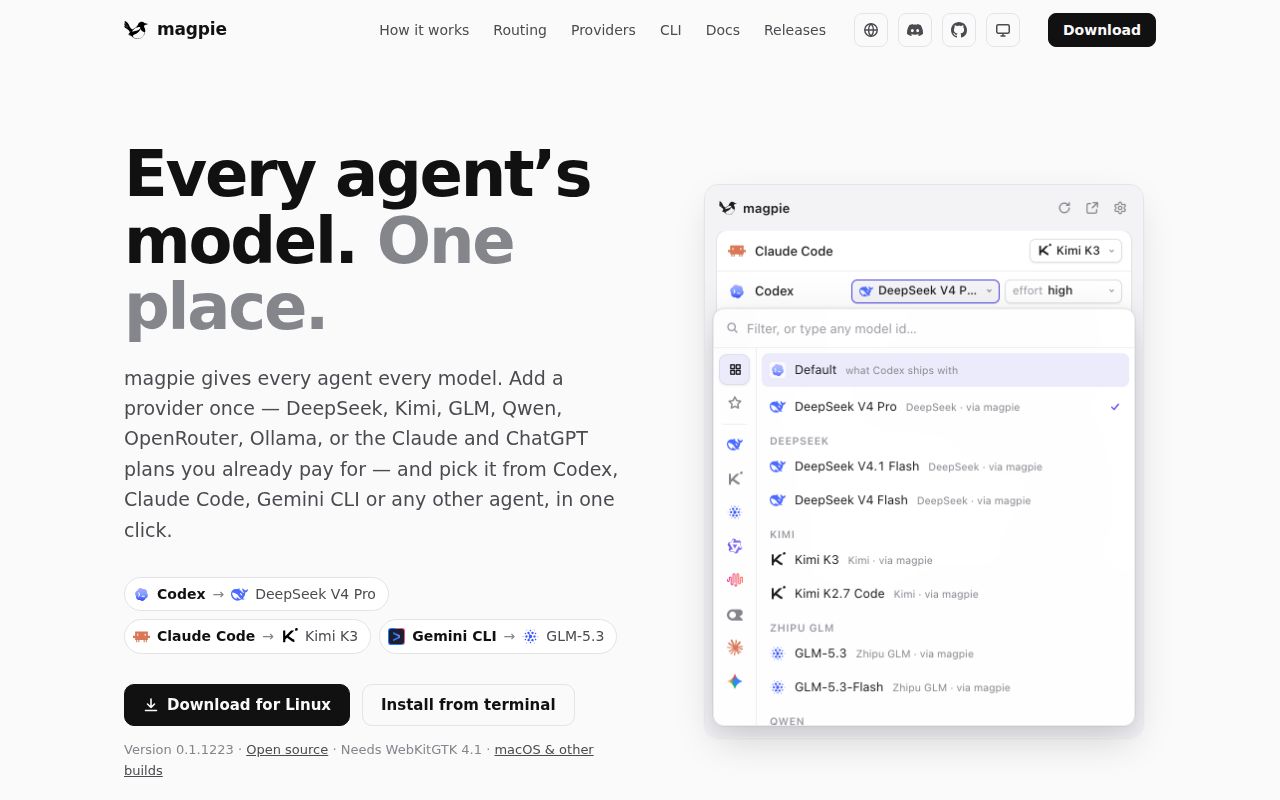
Choosing a different model in Magpie changes an assistant's own configuration, so the choice affects the next session you start. The gateway speaks OpenAI Chat and Responses, Anthropic Messages, and Gemini, with translation for streaming and tool calls. That is useful when Claude Code and another assistant need the same provider without separate configuration work. Our checkout occupied 94.9 MB, a reminder that this convenience comes from a substantial application.
The model picker uses provider/model identifiers, and saved profiles restore agent setups under a name you choose. A developer moving between a work provider and a personal account has a concrete reason to use that. Someone who uses one assistant on its vendor's subscription has less to gain. The README makes that distinction itself. Adding a local gateway should solve configuration work you already have, rather than create another service to remember.
What happened when we ran it
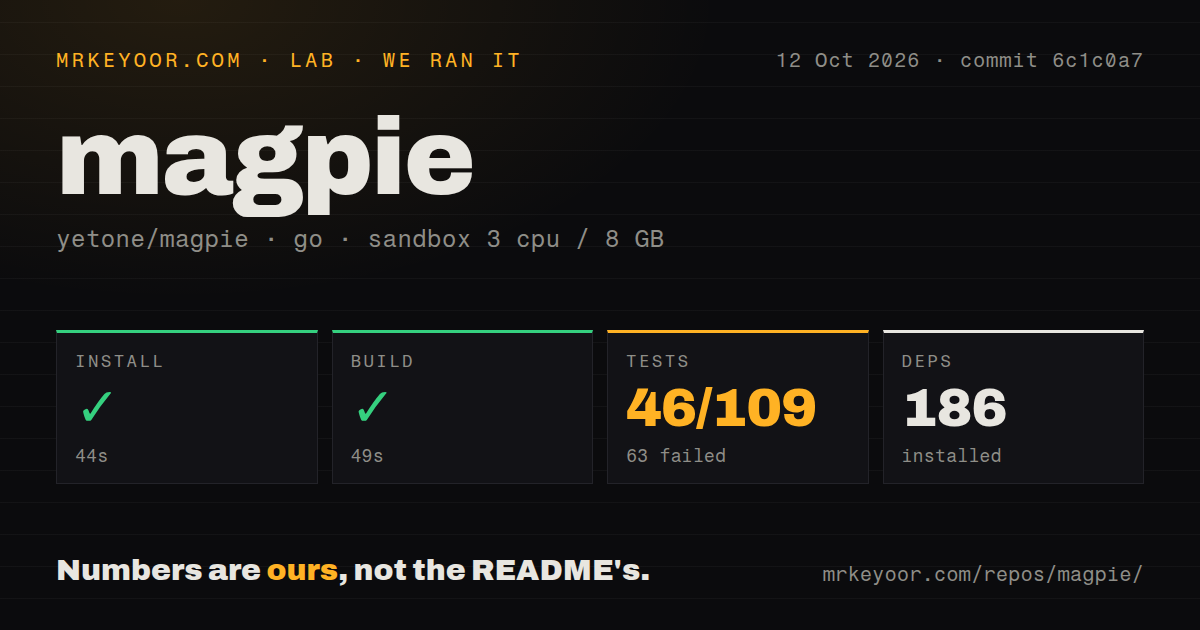
Our run installed Magpie commit 6c1c0a7 in 44 seconds, adding 186 packages, and completed its build in 49 seconds. We cloned and ran it on October 12, 2026, in an unprivileged golang:1.24-bookworm container with 3 CPUs, 8 GB of RAM, and no secrets. Those results establish that the measured install and build paths completed in a fresh Debian environment. They do not establish working provider sessions or desktop integration.
The test step exited with code 1 after 48 seconds. The supplied Go summary reports 46 passed and 63 failed out of 109 results. Its last lines label internal/stats, internal/tui, internal/tune, internal/update, internal/usage, internal/usageapi, and internal/wslrun as build failures. Other packages in the same tail passed. The excerpt contains no underlying compiler message, so attributing those failures to missing Linux libraries or a code defect would exceed the evidence.
Subscription discovery reads existing agent sign-ins
Magpie reads Claude Code and Codex sign-in files and the Keychain to discover subscription accounts. That removes a repeat login step, but it also determines which credentials the application can handle. The account discovery controls include a persistent setting and a per-run environment switch. API-key providers remain usable with discovery disabled. Claude subscription access also depends on the real local Claude binary and bridges agent tools over MCP.
Our 186-package install says nothing about successful authenticated requests because the sandbox had no secrets. Before connecting a work account, decide whether you want discovery enabled, which provider receives prompts, and which agent configuration will change. Magpie's library can distribute instructions, skills, and MCP server settings across supported agents. That saves repeated edits, while also giving one application influence over several assistants' behavior. Back up the configuration you intend to let it manage.
Failover can change the provider behind a conversation
Routing groups let an agent select several models under one name. The README documents ordered fallback, rotation, and modes based on usage or quota renewal. It also describes keeping a conversation on the account that answered while its prompt cache remains useful. Intent routing sends a turn to a small model you select before choosing the destination. A group therefore represents an operating policy, including where the next request may go.
The failed 48-second test step leaves that policy unverified by our run. Separately, issue 1925 reports that a Claude safety refusal can emerge as an API error instead of the response shape that triggers Claude Code's native model downgrade. The report concerns this gateway's current Claude bridge. It is a reason to check failure behavior for your own agent, and it does not explain the package build failures in our lab log.
Linux desktop support requires named system libraries
Release v0.1.1223 lists GTK 3 and WebKitGTK 4.1 for Linux desktop binaries, while separate terminal binaries cover users who do not need a window. The README also documents Docker and Termux routes. Plugins run on Bun, which Magpie retrieves when a plugin first needs it. A plugin can supply models or act as middleware that sees and rewrites requests, so the plugin choice extends the trust decision beyond Magpie itself.
The measured checkout contained 4,457 files and roughly 692,562 source lines. Our scan found 4 CI workflow files and a Dockerfile, with no dedicated tests directory. The failed Go test command shows why the directory signal alone is a poor proxy for test coverage. For a contributor, this is a large source tree to navigate. For a user, the more immediate question is which desktop or terminal path fits the machine that will run it.
Daily reporting is configurable, and outside pull requests are closed
The privacy section describes daily reporting from released builds, including a random identifier and agent, provider, and model identifiers. Settings and DO_NOT_TRACK can disable reporting, although the README describes some website fetch and click counts separately. An organization with strict outbound-traffic rules should read those distinctions before rollout. The local gateway label alone does not answer whether the released application makes other network requests.
The repository was pushed on October 13, 2026, and GitHub returned 557 open issues and PRs alongside 10,667 stars. Recent issue updates and that day's release show active maintenance. They do not cancel our 63 failed results. The README limits pull requests to maintainers and routes feedback to Discord, which makes outside contribution less direct. I'd try Magpie on a spare profile first, then connect the work setup only after checking config changes and provider fallback myself.