
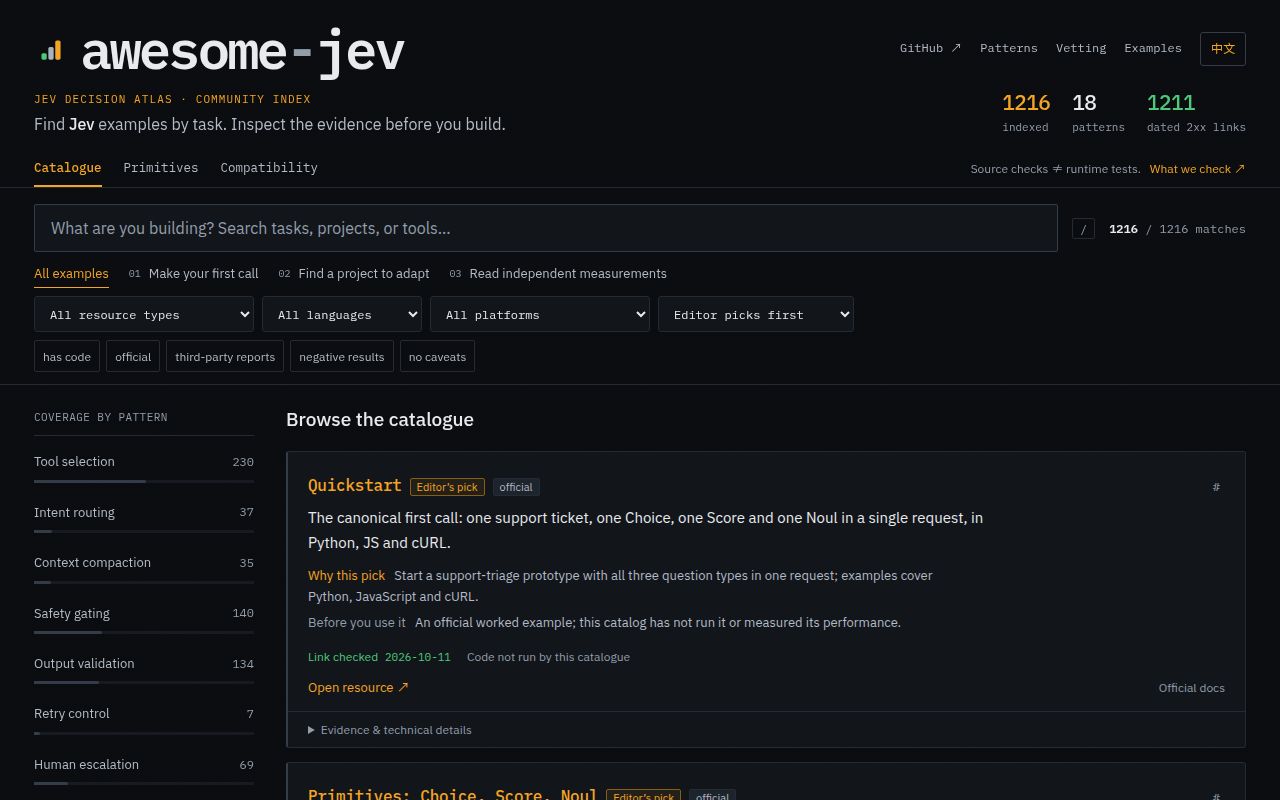
The catalog helps you choose what to investigate
Awesome-jev keeps the evidence next to the example. A row can point to a call site while warning that its code hasn't been run, that the integration stays in shadow mode, or that its author measured the approach and declined to adopt it. That makes this a useful starting point for a developer deciding where a typed decision model belongs in an agent.
Our checkout contained 259 files and roughly 40,236 source lines, much more machinery than a static bookmark list. There is a searchable bilingual site, machine-readable metadata, generated documentation, and an MCP server. The English README is the main entry point, with Chinese documentation alongside it. I would use the catalog's evidence definitions to shortlist examples, then read the linked implementation before borrowing it.
What happened when we ran it
Our sandbox installed commit d181418 in 13 seconds, adding 62 Python packages and using 72 MB on disk. The build succeeded in 1 second. The October 9, 2026 run used a fresh Debian container with Python 3.12, 3 CPUs, and 8 GB of RAM, without secrets or elevated privileges. The checkout occupied 7.7 MB before installation. That is a manageable local footprint for exploring the tooling.
Pytest succeeded in 126 seconds. The supplied summary reports 1,338 passed, 0 failed, and 2 skipped, with a stated total of 1,338. We retain those reported counts rather than infer a different total. Pip-audit reported 0 known vulnerabilities. The scan found 8 CI workflow files, a tests directory, and no Dockerfile. These results concern this repository. They don't validate every linked project, a hosted Jev response, or the accuracy of any decision model.
Catalog search needs no model credential
The MCP server searches recorded examples and returns their caveats. Tools include search_examples, get_example, and a compatibility lookup for provider-specific request shapes. A coding assistant can narrow its search by decision pattern, language, or platform instead of consuming the whole README. Browsing these records doesn't call Jev. Running the separate model examples does require access to whichever provider their code targets.
Our 62-package installation covers a larger environment than the catalog scripts alone, which the documentation describes as standard-library code. The MCP server guide documents a stdio command for general clients and a Claude Code plugin that bundles the server with an agent skill. The plugin requires uv on PATH. Python 3.12 satisfied the package's interpreter requirement in our run, but client registration remains a separate task.
MCP SDK 2.x is a real compatibility boundary
The server imports MCPServer from the MCP SDK's 2.x API. Its documentation warns that an environment pinned to the older SDK can fail at import. This matters if you already maintain a shared environment for MCP tools. Check the package constraint before adding the command to a client, and give it an environment whose dependencies can resolve independently if your existing server stack uses the earlier API.
The 72 MB footprint we measured makes a separate environment a reasonable trade for avoiding that conflict. Data freshness is another choice: the installed package can fetch the catalog from GitHub's main branch, then fall back to cached data or a bundled snapshot. Results identify their source and mark stale fallbacks. For an offline or pinned-data workflow, AWESOME_JEV_CATALOG points to a local directory containing the required JSON files.
A cited call site still needs your own trial
The catalog distinguishes a human reading of code from a script spotting a request-shaped string. Its evidence links generally target a file on the default branch, rather than a frozen commit. That keeps the destination convenient, but the file can change or disappear after the recorded reading date. A successful link check says the address answered then. It doesn't establish that the example works now or makes sound decisions.
All 1,338 reported passing tests belong to our run of awesome-jev, not to the projects it indexes. The repository is unusually direct about that limit. Independent measurement rows describe their authors' work, including unfavorable outcomes, without claiming reproduction. Use them to find a relevant comparison and inspect its dataset. If you're choosing a compaction policy, a source about classification correctness won't answer whether important tool output survives compaction.
Provider differences make copied examples easy to misuse
The compatibility matrix records differences in model identifiers, request envelopes, and answer fields across gateways. Its human verification date is September 22, 2026, and the prose tells readers to reopen the provider documentation before shipping. That dated boundary is useful. An agent copying code from a different surface can produce a valid-looking request that reads the wrong answer field.
Our 126-second pytest step doesn't settle those live provider contracts. The bundled wire_pattern prompt can supply a matching example and its caveats, while the skill supplements TypeSafe's official guidance. Choose the official TypeSafe skills for the API contract, Dave Ebbelaar's AI Cookbook for a tutorial sequence, or JevBench for a decision-model evaluation project. Those are narrower answers to different jobs, rather than substitute catalogs with identical scope.
October corrections show the catalog is being tended
The last push was October 11, 2026. GitHub listed 598 stars and 10 open issues and PRs. Recent merged work updated JevBench's entry and refreshed catalog metadata, while open discussions cover discovery and corrections to existing descriptions. The latest-release endpoint returned no published release. This is an actively edited reference whose data can change independently of its Python package.
The 1-second build and passing local suite make awesome-jev easy to consider as research infrastructure. The license needs a closer look when republishing: code uses MIT, catalog metadata uses CC0, and copied upstream descriptions retain their authors' rights. Pick a relevant row, keep its caveats with the snippet, and pin the implementation you actually test. The record is most useful when it sends you to a better experiment.