Four models answer typed questions without writing prose
Kev takes one state, which can be text or structured data, and a set of questions. A question can ask for yes or no, one choice from named options, or a score across ordered levels. The model returns a probability distribution and a selected result. It does not compose a paragraph. That makes the family relevant to ticket routing, policy checks, document triage, and other jobs where an application already knows the permitted answers.
The family has 0.8B, 4B, 9B, and 27B sizes under the Kev 1.0 release. The first three use adapters and pointer heads over Qwen3.5 base models. Kev-27B starts from Qwen3.8, fine-tunes the full backbone, and ships 51 GB of weights. All expose the same System One-compatible endpoint, which lets an existing TypeSafe Python client point at a local Kev server.
Kev-4B is the practical starting point, with an 8,192-token proof limit
The README recommends Kev-4B first. It targets a machine with one suitable GPU or a 32 GB Apple Silicon Mac, while the 27B model calls for an 80 GB data-center GPU. Smaller hardware can use Kev-0.8B, but the release notes warn against its tool-routing use. The server can also load a local checkpoint or a pinned Hugging Face revision instead of the moving latest name.
Serving limits need careful reading. Kev-0.8B, 4B, and 9B accept states up to 65,536 tokens, yet their validated context length is 8,192 tokens. The 4B model card says training states topped out at 7,552 tokens and reports a measurable accuracy drop at longer contract lengths. Kev-27B alone carries validation through the server limit. A successful HTTP 200 from a smaller model does not establish answer quality on a 50,000-token file.
What happened when we ran it
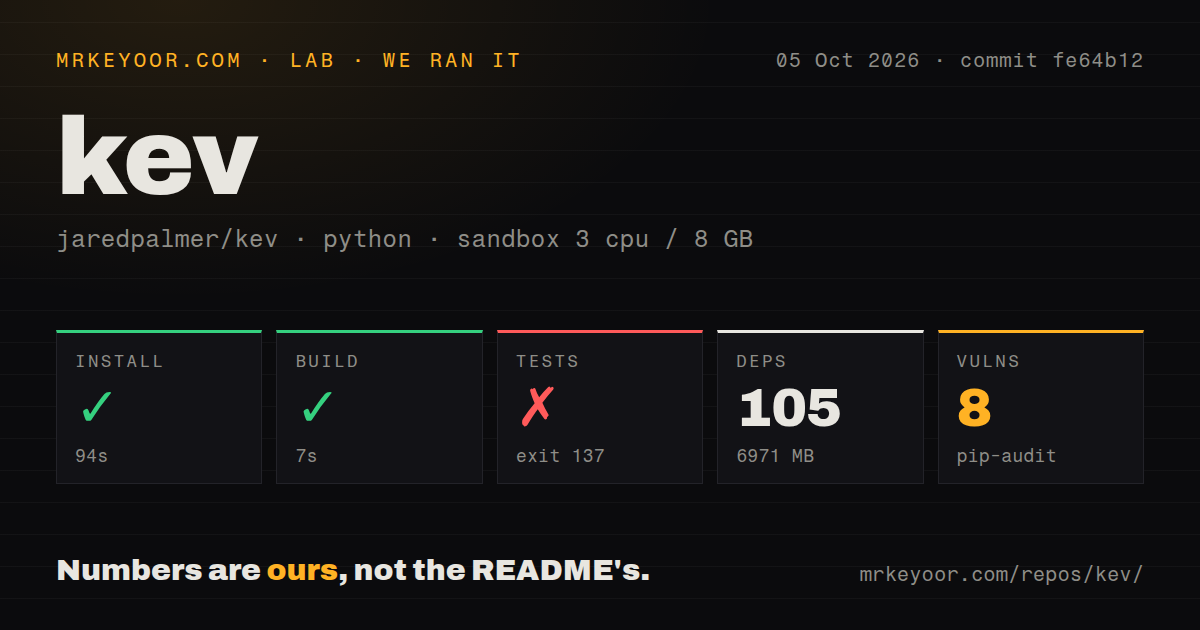
Our run at commit fe64b12 installed 105 packages in 94 seconds and used 6,971 MB on disk. The build completed successfully in 7 seconds. The fresh checkout was already large: 3,049 files, about 34,069 lines of source, and 852.5 MB before the environment was installed. Pip-audit reported 8 known vulnerabilities.
The test command did not complete cleanly. It ran for 239 seconds and exited with code 137. The final log showed pytest's timeout banner, one failure marker, and a tqdm monitor thread waiting inside Python's threading code. That tail does not identify the test name or prove why the process received exit 137, so we cannot narrow the failure to a particular module or missing system package.
The repository has one CI workflow and a tests directory, while our scan found no Dockerfile. CI deliberately runs a selected unit set without model weights or a live server, though it does download a tokenizer. Our result covers the supplied sandbox command and complete installed environment. It does not measure model accuracy, inference latency, GPU memory, or whether the narrower CI selection passes at this commit.
Installation occupies 6,971 MB before model weights arrive
The supported local path uses Python 3.12 or 3.13 and uv. Running uv sync --extra serve installs the API server and TypeSafe SDK, then the first inference downloads the selected adapter and base model. Python 3.14 is excluded because the required Torch wheels are unavailable according to the README. Open issue 159 adds another trap: pip install kev fetches an unrelated ORM, so install this project from its repository.
Hardware selection is automatic across CUDA, ROCm, Apple Silicon, and CPU, but issue 170 documents an AMD APU where Torch reports CUDA availability even though its ROCm wheel lacks the device's kernels. The result is a hard process crash after weight loading. An open pull request proposes an explicit device escape hatch. If your hardware is outside the documented paths, make a one-request smoke test part of provisioning before downloading the largest checkpoint.
One API key separates a local server from an open port
Kev binds to 127.0.0.1 by default. Binding to 0.0.0.0 exposes it to other machines, and the server accepts requests without authentication unless KEV_API_KEY is set. Self-hosting keeps document contents on your hardware only if the surrounding proxy, logs, model cache, and access controls do the same. The API returns request IDs and rejects over-limit states with HTTP 422 instead of silently cutting them.
Fine-tuning is a substantial part of the project. The repository includes direct training commands and agent skills that run a data, evaluation, training, calibration, and deployment flow on Modal. That convenience does not remove the need for held-out labels. A probability threshold should be chosen against your categories and error cost, because one fitted temperature cannot guarantee calibration after a domain change.
Kev 1.0 is active, but the package still says alpha
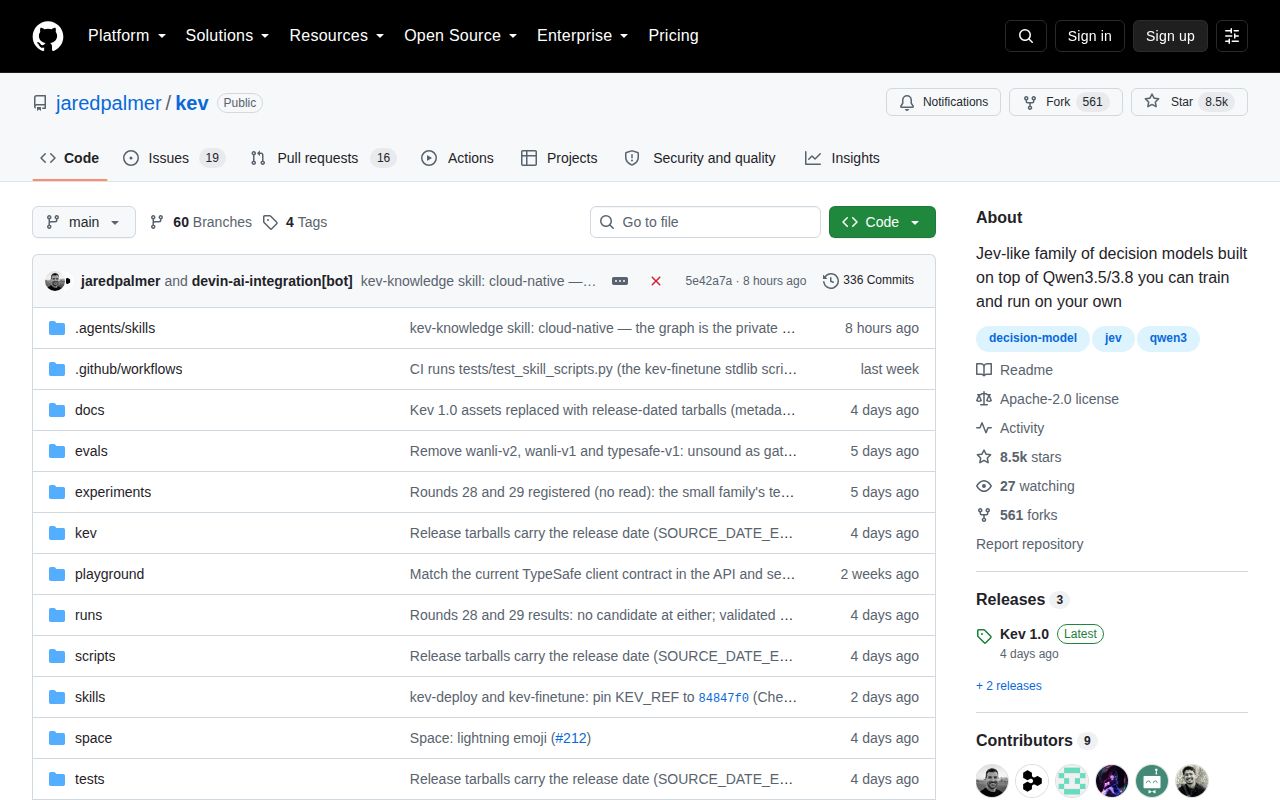
GitHub showed 8,524 stars and 35 open issues and pull requests on October 6, 2026, the same date as the latest push. Kev 1.0 shipped on October 1 with pinned checkpoints, checksums, model cards, and evaluation suites. The Python package metadata still marks version 0.1.0 as alpha. That split makes sense: the model family has a named release, while the serving and training code is moving quickly.
Kev is unusually candid about where its numbers stop applying. The model cards separate trained task families from unseen sources, publish context limits, and warn about English-only input, option-order sensitivity, date arithmetic, and consequential decisions. Pair that documentation with our failed 239-second test run and 8 audit findings. The right trial is one pinned model, one isolated endpoint, and a labelled slice of the exact decisions you intend to automate.