
Awesome Jev helps you find a decision pattern to inspect
Start with the decision your application needs to make: choose a tool, judge a retrieved passage, or sort a support request. Awesome Jev organizes projects around those jobs and links to the implementations. That's a useful way to browse an unfamiliar ecosystem. You can follow a named decision to its code instead of collecting repositories whose descriptions all promise better agents.
The README describes a dated catalog of 981 public repositories, spread across SDKs, agent tooling, applications, and other categories. That is upstream catalog coverage, not 981 projects independently executed by our lab. Our measured checkout contained 161 files and about 4,277 source lines. It includes an Astro website as well as the reading list, which explains why a directory repository has a substantial npm environment.
What happened when we ran it
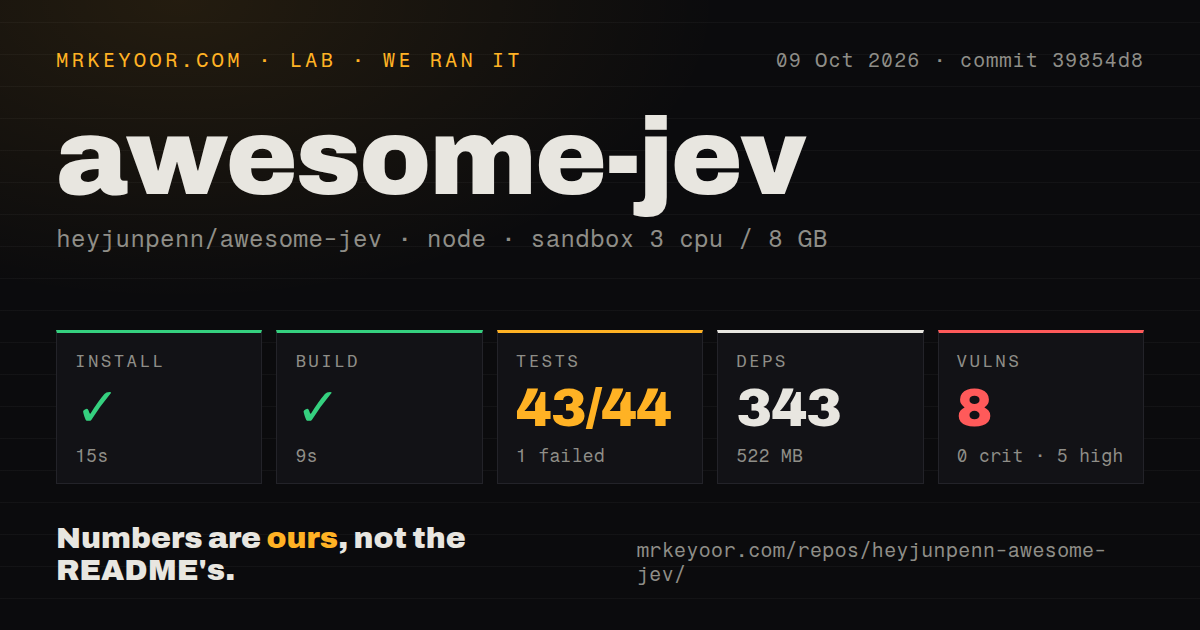
Our run of commit 39854d8 installed 343 npm packages in 15 seconds, used 522 MB on disk, and built successfully in 9 seconds. The October 9, 2026 sandbox used lab-node:22 with 3 CPUs and 8 GB of RAM, without secrets or elevated privileges. The checked-out repository occupied 13.8 MB before installation. These results cover the directory's codebase, not the projects it lists.
The tests failed with exit code 1 after 3 seconds: node:test reported 43 passed and 1 failed out of 44. The supplied tail contains passing sponsor-validation, placement, ranking, and masonry-position checks. It doesn't identify the failing case or show its exception. We can report an incomplete passing suite, but cannot responsibly label it a payment defect, a layout defect, or a missing system dependency.
npm audit reported 8 known vulnerabilities: 5 high and 3 moderate, with none critical or low. The lab found 1 CI workflow file, no Dockerfile, and a tests directory. The supplied evidence doesn't name the affected packages or show whether an advisory reaches a public route. A successful build doesn't resolve that question. I'd inspect the actual advisories and the failed case before adopting this snapshot as a hosted service.
Reading the catalog needs no running service
The catalog README is readable directly on GitHub, and the project links to its public site at jevbest.com. You don't need to clone the Astro application to discover an SDK or compare approaches to typed decisions. English is the main README, with linked translations. Its independence from TypeSafe AI is explicit, so inclusion should not be read as an official vendor endorsement.
Our 522 MB installed footprint matters if you want to maintain a fork of the website, rather than read the list. Local development uses npm and Astro; the package declares Node.js 22 or newer. The site guide says locale-specific README files supply project data. Changing catalog text therefore has consequences for the rendered website and translations. Treat the data and interface as connected publishing work, rather than editing a stray Markdown list.
Verification labels separate code inspection from reproduction
The evidence-label definitions distinguish a located call site, an upstream runbook, independent reproduction, and author-reported metrics. That separation is the catalog's best editorial rule. Finding a function that calls Jev establishes a concrete integration point. It doesn't establish decision accuracy, sensible thresholds, or acceptable behavior when the model's answer is uncertain. A reproduced workflow needs its own dated evidence.
The 43 passing tests from our run belong to Awesome Jev's application, not to the catalog's linked tools. The README also states that star figures are a dated snapshot for discovery rather than ranking. For a candidate you may deploy, follow the strongest linked evidence, check what the code does with the answer, and read the project's current limitations. A repository count can help you find options, but can't make that choice for you.
Hosting sponsorship payments adds Cloudflare and Stripe work
The site runbook deploys static pages and sponsor routes together as a Cloudflare Worker. Sponsor records use D1, and checkout uses Stripe with a signed webhook. Production setup needs Cloudflare credentials, database migrations, and Stripe secrets. The Wrangler configuration also declares sponsor-asset storage in R2. A fork must replace the supplied domain and storage configuration with its own resources.
Our 9-second build gives no evidence that checkout or a live webhook worked in the secret-free sandbox. The provided test tail contains useful payment-matching and sponsor-placement cases, but one test still failed somewhere in the suite. I wouldn't use those passing lines to approve a money-handling deployment. Read the failing case, configure the actual bindings, and verify the complete checkout-to-record path before taking sponsorship payments on a fork.
October submissions show ongoing catalog interest
The last push was October 4, 2026, and GitHub reported 959 stars with 6 open issues and PRs. The latest-release endpoint returned no release. Several submission issues were closed on October 4, while new project submissions appeared on October 9 and 10. Those dates show continuing catalog interest and recent editorial activity. They don't establish a response deadline or a production maintenance commitment for the website.
The README's last catalog review is October 4. That date is more useful than treating all entries as perpetually current. A typed answer can still be wrong, and the catalog's disclaimer tells readers to keep authorization, arithmetic, thresholds, and consequential actions in ordinary code. Its MIT license covers this project; the listed repositories retain their own licenses. Check the candidate you intend to use rather than inheriting the directory's license assumption.
Use a narrower resource once you've chosen the task
Awesome Jev Prompts focuses on question patterns and calibration guidance. TypeSafe's agent skills provide official instructions for building with the System One API. Choose the former when your problem is wording a decision, or the latter when you want vendor-maintained agent guidance. Keep Awesome Jev open when you still need to locate a concrete implementation. Hosting its sponsor site is a separate decision that our failed suite leaves unresolved.