Markdown compiles into an ordinary GitHub Actions workflow
An agentic workflow is a Markdown file with YAML frontmatter. The frontmatter declares triggers, permissions, tools, network access, and the AI engine; the body explains the job in natural language. Running gh aw compile validates that source and writes a .lock.yml file that GitHub Actions can execute. Teams can review the generated workflow with the same branch rules used for other CI changes.
The supported engines include GitHub Copilot, Claude Code, OpenAI Codex, Google Gemini, and Pi. Useful jobs include interpreting incoming issues, reviewing pull requests, investigating failed CI, maintaining documentation, analyzing dependencies, and producing repository reports. GitHub draws a sensible boundary: deterministic builds, tests, linters, deployments, and repeatable scripts belong in conventional Actions. gh-aw is for tasks where a model must interpret incomplete or changing information.
Read-only agent jobs and separate safe outputs limit write access
Agent jobs start with read-only GitHub access and sandboxed execution. Requested writes are buffered as safe outputs, checked against the configured output type, and applied by separate jobs with scoped permissions. That separation limits the damage an agent can do directly and makes intended effects such as creating an issue or proposing a patch visible in the workflow definition. It is a stronger design than handing a model a broad repository token.
The controls remain configurable, which moves responsibility to the author. A workflow can gain tools, network destinations, secrets, and write paths that enlarge its attack surface. The README tells users to review permissions, generated files, tools, and network access before deployment, and warns that human supervision is still necessary. Prompt injection from issue text, dependency content, or fetched web pages remains a problem even when the final write travels through validation.
What happened when we ran it
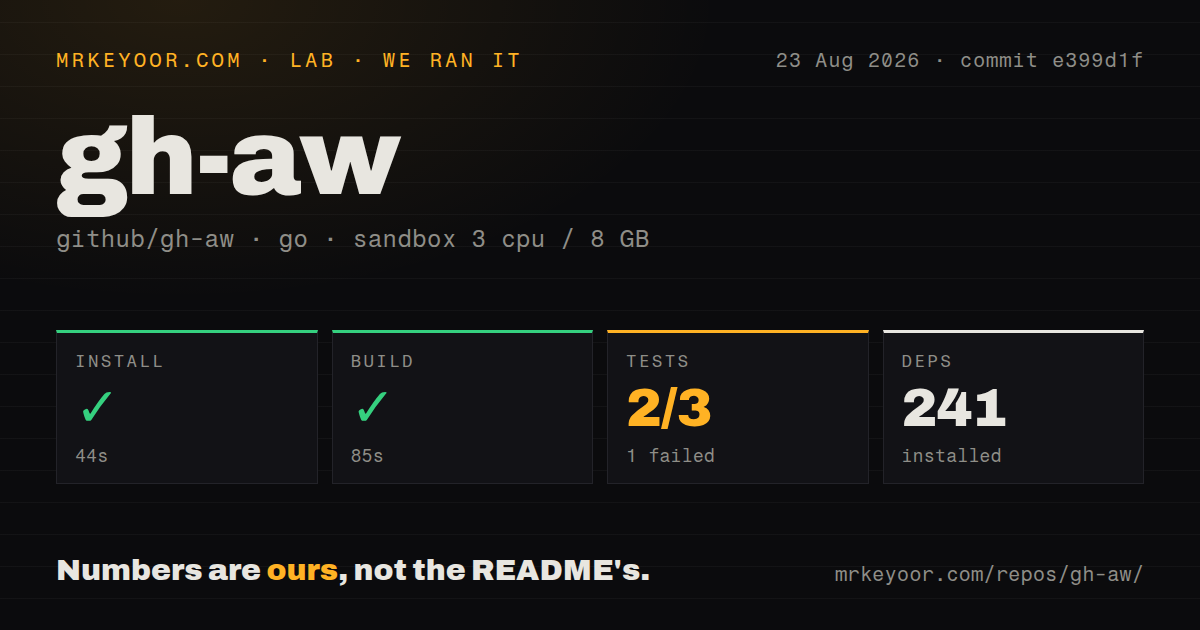
Our sandbox cloned commit e399d1f, installed 241 Go packages in 44 seconds, and completed the build in 85 seconds. The checkout was substantial: 7,473 files, roughly 1,241,035 source lines, and 370.1 MB. It included 329 CI workflow files and a Dockerfile, with no top-level tests directory. Those numbers fit a project that develops both a compiler and a large catalogue of its own agentic workflows.
The test command failed after 82 seconds. Go reported 2 packages passed and 1 failed out of 3. Fuzz cases 43, 44, and another saved input in FuzzSanitizeLabelContent returned the same error: node was not found in $PATH. The workflow package failed after those errors, while the compiler-environment and scripts packages passed. The log establishes a missing executable in our Go 1.24 Debian image; it does not establish why the dependency was absent from the tested setup.
Engine choice brings its own identity and billing model
Installing the GitHub CLI extension is only the first step. Each workflow needs an engine and a valid authentication path for that engine. Copilot, Claude, Codex, Gemini, and Pi differ in credentials, model selection, limits, and billing. GitHub Actions minutes and runner policy apply alongside model charges. An organization should identify which account pays, which secrets are available to which events, and whether fork-originated content can reach them.
A README notice says releases 0.68.4 through 0.71.3 are being retired because of a billing bug. That is a direct reason to pin and audit the compiler version rather than allowing old generated workflows to linger. The latest GitHub release returned by the API was v0.86.2, published August 11, 2026. Its notes cover continued Docker sandbox rollout, MCP gateway restrictions, runtime tracking, threat detection, and several security fixes.
Sandboxes, a firewall, and an MCP gateway cover different risks
The project has companion components for network egress and Model Context Protocol access. Agent Workflow Firewall controls allowed domains and records activity. The MCP Gateway centralizes calls to MCP servers. Shared actions support compiled workflow behavior. These pieces address different boundaries: filesystem and process isolation, outbound network access, tool routing, and final GitHub writes should not be treated as one security switch.
Release v0.86.2 added explicit mount-policy allowlisting for the safe-output backend and updated the MCP gateway and GitHub MCP server. It also expanded the docker-sbx rollout and fixed false positives and secret handling. The pace is reassuring for active security work, though it means generated files and runtime components can change quickly. Teams need an upgrade process that recompiles workflows, examines diffs, and runs a low-risk job before broad deployment.
Current edge cases affect fork updates and organization setup
Issue 56115 describes a maintainer-triggered workflow that checks out a fork pull request successfully but cannot generate the patch required by push_to_pull_request_branch. That matters for open-source repositories where external contributions are routine. Issue 56088 reports that gh aw env update --scope org can update existing organization variables but cannot create missing ones because the API request lacks visibility, forcing an out-of-band bootstrap step.
GitHub showed 311 combined issues and pull requests, 5,015 stars, and a last push on August 26, 2026. That count is not 311 confirmed bugs; this repository also creates automated work-in-progress, smoke-test, and report issues through its own workflows. The dense activity and current release work show maintenance. They also make careful issue filtering necessary when judging whether a particular engine, safe output, or runner combination is dependable enough for your repository.