The demo makes 20-plus business surfaces feel like one product
Founder OS puts a solo company's inboxes, client funnel, content calendar, finances, tasks, agent roster, workflows, usage, and business memory behind one sidebar. The repository has more than 20 connector groups and routes for everything from sponsorship deals to a brokerage monitor.
It is also the first boundary to understand. Every name, client, financial figure, and social number in the demo is placeholder data. SQLite seeds the interface on first use, so full charts do not prove that Stripe, Slack, email, or a brokerage is connected. Connector states can report connected, not_configured, or error, which is the right model, but real data still depends on credentials and connector behavior.
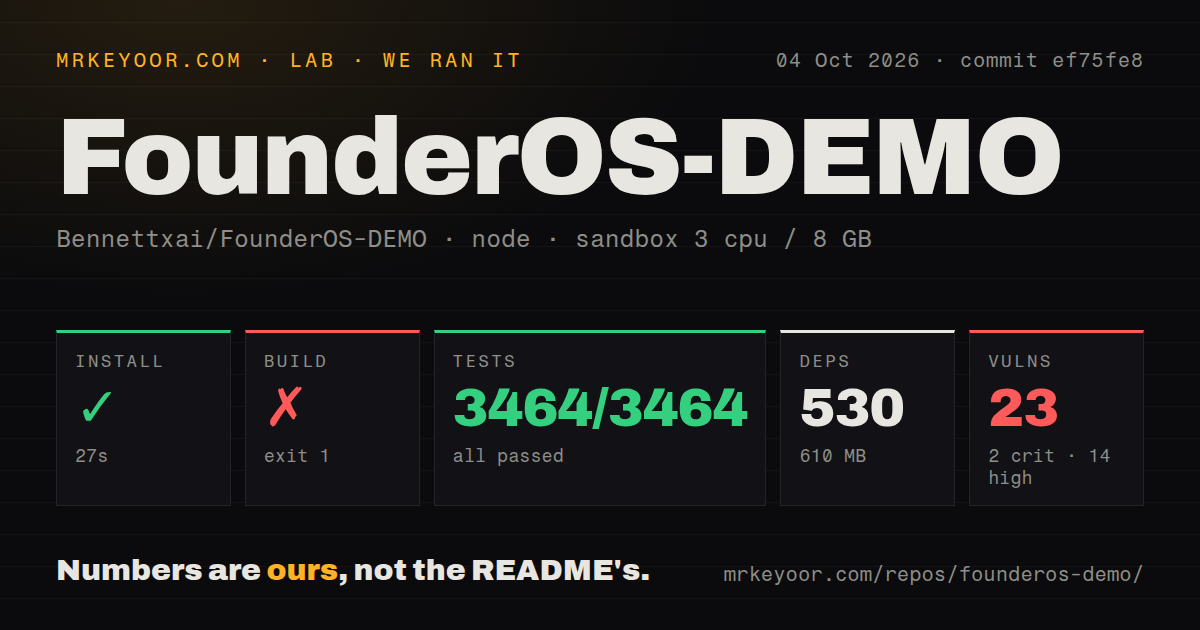
A 27-second install led to a failed production build
Our sandbox cloned commit ef75fe8, which contained 834 files and about 112,354 lines of source in a 5.1 MB checkout. Npm installed 530 packages in 27 seconds, leaving 610 MB on disk. Node 22 is required. The basic demo needs no secret because the app creates and seeds a local SQLite database when it first touches the data layer.
The production build ran for 30 seconds before failing in app/layout.tsx. The log says an error occurred in next/font; the Google font loader tried to read property 1 from null, and webpack stopped. That file configures JetBrains Mono through next/font/google. The log does not identify why the loader received null, so blaming the container network, font service, or application code would go beyond the evidence.
What happened when we ran it
Our run installed 530 npm packages in 27 seconds, then the build failed with exit code 1 after 30 seconds. The exact tail was TypeError: Cannot read properties of null (reading '1') inside Next's compiled Google font loader, followed by Build failed because of webpack errors. This is a production-path failure even though the development server may behave differently.
Vitest told a much better story. In our sandbox, all 3,464 tests passed in 60 seconds, with 0 failures. The repository had a tests directory and 1 CI workflow file, but no Dockerfile. Tests use in-memory SQLite rather than the seeded development database, according to the README. A green suite does not cancel the build failure; together they say the internal modules are well exercised while the artifact we tried to produce did not compile.
Npm audit found 23 known vulnerabilities: 2 critical, 14 high, 4 moderate, and 3 low. Those counts are dependency findings, not proof that an attacker can reach each flaw through Founder OS. They still require triage before any public deployment that holds inbox, payment, Slack, or LLM credentials. The combination of a 610 MB dependency tree and action-capable connectors makes ignoring the audit a poor bet.
The repository layer is the most reusable part
Pages and API routes read through typed repositories rather than issuing raw database queries. Zod checks rows as they leave the database, and seeded agents map to runtime agents whose runs persist. That structure gives a fork a sensible replacement point: add a repository method, schema, seed entry, and test when introducing data instead of scattering SQL across components.
The knowledge screen has a similar seam. In the demo, it uses a stub provider. The documented production design pairs Markdown source files and hybrid retrieval with a governed memory model where agents can create sources, signals, and pending claims, while reviewed promotion controls what becomes a fact. That is a design description, not evidence that the two companion services are bundled and ready in this repository.
Public Railway deployments need an undocumented access token
commit ef75fe8 does contain middleware for a whole-app gate. It activates only when FOUNDER_OS_ACCESS_TOKEN is set; when the variable is empty, the gate returns an open decision. The README's Railway instructions do not tell the operator to set that variable, and .env.example omits it. Following the visible deployment steps can therefore leave the app open while other environment variables hold live credentials.
Open issue 2 records that exposure, and open pull request 16 proposes restoring the missing deployment guidance and sample variable. The gate itself uses a shared token stored in an HTTP-only cookie after entry. That is better than no gate, but it remains single-secret access rather than accounts, roles, or tenant isolation. Test it on the deployed URL before adding IMAP passwords, payment keys, or an AI gateway key.
Live operation is a service-integration project
The sample environment file spans four IMAP inboxes, Slack, several payment processors, Notion, a webinar system, an LLM gateway, Beehiiv, ManyChat, SMTP, call recorders, a memory API, and other optional sources. Some connectors are described as wired, while others remain honest placeholders until configured. Each secret expands what the public app may read or do.
The README describes Railway hosting, a managed database, and companion knowledge services as the full production plan. Treat that as a target architecture. The demo currently centers on Next.js and seeded SQLite, has no Dockerfile, and published no GitHub release. A serious fork needs database migration work, backups, connector-specific permission review, job scheduling, and an access model suited to the people using it.
Use Founder OS as a reference before using it as an operating system
The product thinking is sharper than the deployment story. Honest connector states, repository boundaries, seeded screens, and 3,464 passing tests make the codebase useful for studying how a founder dashboard could fit together. The failed font build is fixable in principle, but our log does not prove which fix is correct.
Start by getting npm run build green in the target environment, resolve or accept each of the 23 audit findings, and confirm that an unauthenticated request receives the gate rather than business data. Then connect one low-risk service and verify its read and write paths. Until those steps pass, Founder OS is an unusually detailed demo, not the place to entrust a company's keys.