mrkeyoor.com_
Sun 06 Sept 07:54 UTC
Dev Toolsevaluationupdated 06 Sept 2026

emscripten review

Emscripten is a compiler toolchain that turns C and C++ programs into WebAssembly, with JavaScript or HTML needed to load them in browsers and other runtimes. It solves the hard parts of moving an existing native codebase to the web, including support for familiar libraries such as SDL2 and OpenGL-style graphics APIs.

Verdict

Our Emscripten checkout installed 258 npm packages in 14 seconds, but it exposed no npm build or test target, so a source clone is not a self-contained compiler setup. Use Emscripten when preserving a substantial C or C++ codebase is worth adapting its operating-system assumptions to browser rules. Choose WASI SDK for a WASI-native target, or wasm-pack when the code is Rust and JavaScript packaging is the main job.

We ran it

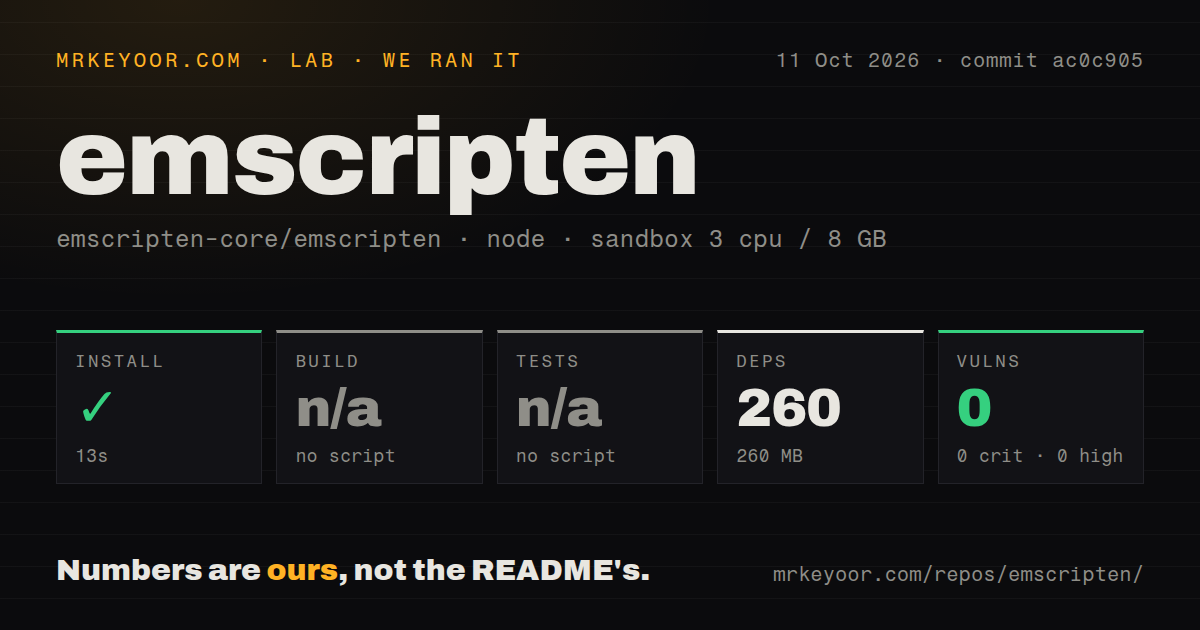
Lab card: what happened when we ran emscriptenScreenshot of emscripten (github.com/emscripten-core/emscripten)
Install✓ · 14s258 packages · 235 MB
Buildn/ano build script
Testsn/ano test script
Known vulns00 critical · 0 high · 0 moderate · 0 low (npm audit)
Repo15225 files~2,186,413 lines of source · 140.6 MB · 6 CI workflows · tests dir

Answers from our run

Does emscripten build from source?

Dependencies installed in 14 seconds (258 packages), and the project has no separate build step. We cloned commit 6fad56c into a clean Debian container with 3 CPUs and no project-specific setup.

Does emscripten have tests you can run?

Not through a standard command: the project exposes no test script or target that our harness could run.

Does emscripten have known vulnerabilities in its dependencies?

npm audit found none in the dependency tree at the time of our run.

Who should not use emscripten?

Developers expecting an npm package to produce a working compiler checkout: our install found no npm build or test target, while the README directs normal users to the separate Emscripten SDK.

What are the alternatives to emscripten?

WASI SDK, wasm-pack, Cheerp. Our Emscripten checkout installed 258 npm packages in 14 seconds, but it exposed no npm build or test target, so a source clone is not a self-contained compiler setup.

Setup3/5SDK path is clear; the source checkout needs a different workflow
Docs5/5Porting, compiler flags, runtime limits, and SDK use are documented
Community5/527,596 stars with active September 2026 issues and releases
Maturity5/5Long-lived toolchain with release 6.0.9 and broad platform use

Who it’s for

C and C++ teams porting an existing engine, editor, game, or scientific application to a browser.
Developers who need the same compiled program to run on the web, Node.js, or a WebAssembly runtime.
Maintainers prepared to adapt native assumptions about files, networking, main loops, and threads.
Rust teams that specifically need the wasm32-unknown-emscripten target and its C or C++ interoperability.

Who it’s NOT for

Developers expecting an npm package to produce a working compiler checkout: our install found no npm build or test target, while the README directs normal users to the separate Emscripten SDK.
Browser deployments that cannot set COOP and COEP response headers: the pthread documentation says threaded builds will not work without them.
Teams that require one binary to use threads where available and fall back elsewhere: Emscripten documents that threaded and single-threaded targets need 2 separate builds.
WASI-native projects seeking a direct C or C++ target: open issue 12073 still tracks a PURE_WASI mode, so WASI SDK is the clearer fit.
Production users depending on Emscripten's wasm-bindgen integration today: release 6.0.9 labels the setting experimental because it is still changing.

Setup reality

Our sandbox installed 258 npm packages in 14 seconds and used 235 MB on disk. The checkout had 15,225 files and about 2,186,413 source lines. It exposed no build script or target and no test script or target, so both steps were skipped. Npm audit reported 0 known vulnerabilities.

That npm result is repository housekeeping, not the setup path the README recommends to compiler users. The documented route is the separate emsdk: install an SDK version, activate it, then load its paths and environment variables. A manual source setup uses ./bootstrap.py and the contributor guide. No account credential is required, but the SDK downloads its toolchain.

Browser ports inherit browser rules. Pthreads require SharedArrayBuffer plus correctly served COOP and COEP headers, and threaded fallback needs a second build. Native networking, synchronous main loops, POSIX signals, and process creation do not map directly to the web environment.

Emscripten compiles C and C++ for 3 kinds of runtime

Emscripten takes C or C++ through Clang and LLVM, then uses Binaryen in a toolchain that produces WebAssembly. Its normal output includes JavaScript that loads the module, while an HTML target can generate a sample page. The same result can run in a browser, Node.js, or another WebAssembly runtime. Rust can use the wasm32-unknown-emscripten target, although C and C++ remain the project's main focus.

That breadth matters most when a large native codebase already exists. Emscripten supplies web-facing support for portable APIs, including SDL2 and OpenGL-style graphics, instead of asking a team to rewrite an engine around browser APIs. The repository itself shows the scale of that promise: our commit 6fad56c checkout contained 15,225 files, about 2,186,413 source lines, and 140.6 MB before installation. This is infrastructure for a porting program, rather than a small build dependency you add casually.

The Emscripten SDK is the practical install path

The README gives 2 routes. Regular users are sent to the separate Emscripten SDK, where emsdk install, emsdk activate, and an environment script put the compiler and its companion tools on the shell path. Developers working from this repository run ./bootstrap.py and follow a contributor guide. That split is important because a successful npm operation inside the source tree does not mean emcc is ready to compile an application.

Our Node 22 install finished in 14 seconds, pulled 258 packages, and occupied 235 MB, but the checkout had no npm build or test target. A team evaluating Emscripten should use the SDK route for a first hello-world program, then pin the chosen SDK version in CI. Source contributors have a different task: they need the bootstrap and test-runner workflow, plus the LLVM and Binaryen pieces that the project is built around.

What happened when we ran it

Our sandbox cloned commit 6fad56c with 3 CPUs and 8 GB of RAM. Npm installation succeeded in 14 seconds, adding 258 packages and bringing installed disk use to 235 MB. Npm audit reported 0 known vulnerabilities across that dependency set. Those are useful facts about the repository's Node side, but they do not prove that a complete Emscripten SDK was installed or that a C++ program compiled.

The build and test steps were both skipped because neither npm target existed. That is narrower than a failure: no compiler error or failing assertion appeared because no build or test command ran. Our scan did find 6 CI workflow files and a tests directory, while finding no Dockerfile. The source tree plainly has tests; it simply does not expose them through the generic npm convention used by this sandbox.

Pthreads need headers and 2 separate browser builds

Emscripten's pthread support uses SharedArrayBuffer and web workers. Deployed pages must return the required Cross-Origin-Opener-Policy and Cross-Origin-Embedder-Policy headers or the threaded code will not work. The documentation also says one output cannot enable threads when available and fall back to a single thread elsewhere. Shipping both cases means compiling 2 variants and selecting one at runtime.

Native thread behavior still needs review even after those headers are set. Browser main-thread blocking can waste power, freeze the tab, or deadlock when a worker needs proxied main-thread work. POSIX signals and fork() are unsupported, and creating a worker may require returning to the browser event loop before it starts. A port that assumes immediate thread creation or long synchronous waits will need code changes, worker pooling, or a different main-loop design.

WASI and wasm-bindgen remain distinct boundary cases

Release 6.0.9, published September 1, 2026, marked the WASM_BINDGEN setting experimental and added a compiler warning because the integration is changing. Open issue 27665 also tracks how wasm-bindgen snippet folders must be copied with output files. Depending on that bridge in production means accepting an interface and packaging path that the maintainers themselves have not called stable.

Emscripten can run output in WebAssembly runtimes, but its established model is broader than a pure WASI toolchain. Open issue 12073 still discusses a PURE_WASI option and the different filesystem model involved. A project whose only destination is a WASI host should start its comparison with WASI SDK. Rust browser packages should also compare wasm-pack, which centers the Rust and JavaScript packaging workflow instead of C and C++ compatibility.

September 2026 activity supports a mature choice

GitHub recorded the last push on September 5, 2026, and release 6.0.9 arrived 4 days earlier. The repository had 27,596 stars and 2,477 combined open issues and pull requests when fetched; a separate issue search counted 2,037 open issues. Recent updates included a test-suite design discussion, wasm-bindgen tracking, and a long-running WASI request, which shows both active maintenance and a large support surface.

The dual MIT and University of Illinois/NCSA licensing is permissive, and the README tells commercial users to treat the practical terms much like MIT. Emscripten earns its place when a real C or C++ asset justifies the porting work. The 14-second npm install should not be mistaken for that work: success depends on the SDK, browser deployment headers, runtime-specific testing, and deliberate handling of native APIs that browsers cannot reproduce.

Alternatives

ProjectWhat it isPick it when
WASI SDKA Clang-based C and C++ toolchain aimed directly at WASI runtimes.pick this instead when the target is a WASI host rather than a browser application with Emscripten's JavaScript support layer.
wasm-packA Rust-focused workflow for building and packaging WebAssembly for JavaScript consumers.pick this instead when the source is Rust and the deliverable is an npm-ready web package.
CheerpAnother C and C++ compiler for web applications, producing WebAssembly and JavaScript.pick this instead when you want to compare a different C or C++ web compiler and its browser integration model before committing.

What people are saying

  1. [velocity-scout] emscripten-core/emscripten

Sources

  1. Emscripten README at commit 6fad56c
  2. Emscripten SDK download and installation guide
  3. Emscripten pthreads documentation
  4. Emscripten 6.0.9 release notes
  5. WASM_BINDGEN snippets tracking issue 27665
  6. PURE_WASI issue 12073

More dev tools reviews

core · difftastic · phpunit · chisel · openssl · nono · the whole board →