The repository contains 21 Chinese-language chapters
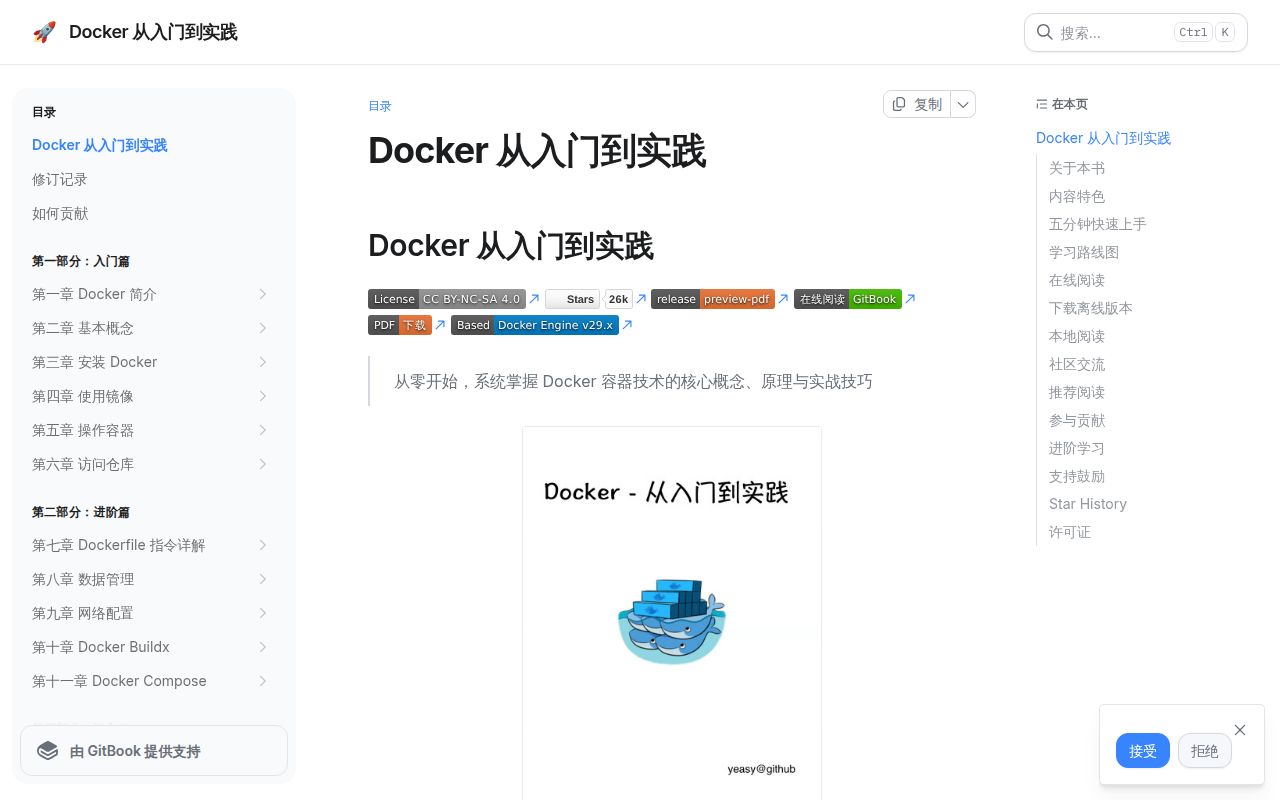
Docker Practice is a book first, and its 21 chapters form a much longer course than the repository name suggests. The opening chapters explain images, containers, registries, installation, and everyday commands. Later sections cover Dockerfile instructions, storage, networking, Buildx, and Compose. The route then widens into Kubernetes, Etcd, cloud deployments, Podman, security, observability, and DevOps cases. A learner can follow it in order, while an experienced operator can jump to a command or deployment chapter.
The primary text is Chinese. There is no parallel English directory in commit 40629be, and issue 510 asked for an English translation because its author had to use a translator. That request was closed in February 2026 without an English edition in the tree. GitHub labels the repository's main code language as Go, but that classification comes from examples and tooling. It does not describe the language of the book. English-only readers should treat that as a firm selection boundary.
What happened when we ran it
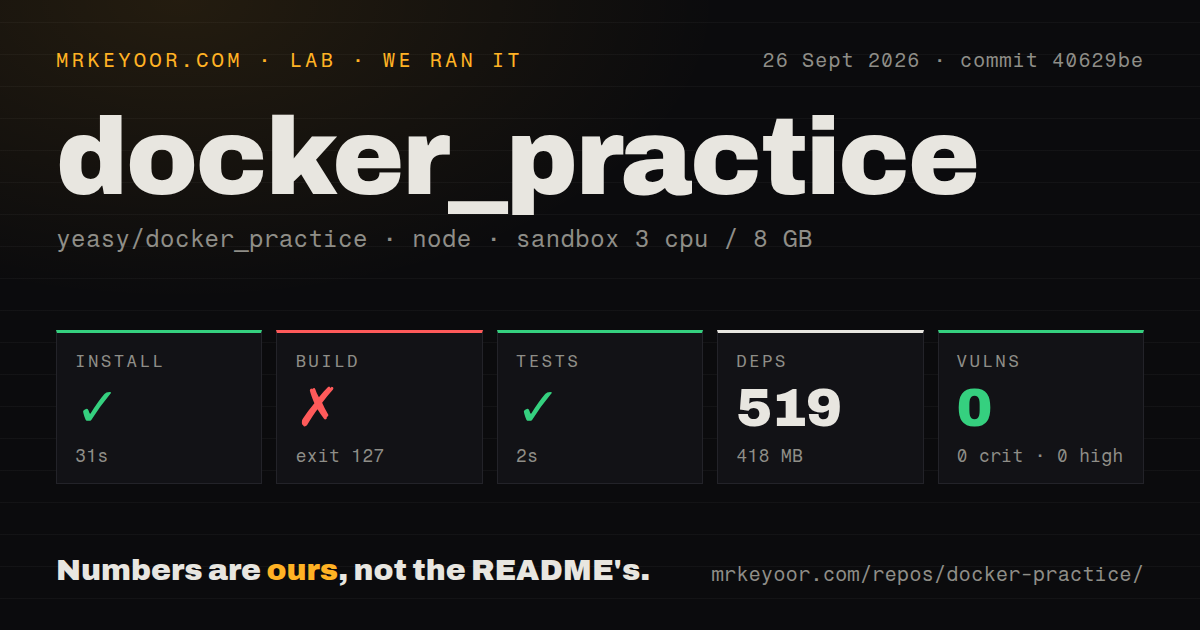
Our sandbox installed 519 npm packages in 31 seconds and used 418 MB on disk. The install itself completed without an error. The 5.6 MB checkout contained 347 files and about 2,417 lines of source at commit 40629be. Npm audit reported 0 known vulnerabilities, with 0 critical, high, moderate, or low findings. Those results cover the dependency tree we installed in a fresh Node 22 container.
The build failed with exit code 127 after 1 second. Its script removed _site and then called mdpress build --format site --output _site; the shell answered mdpress: not found. The log establishes only that the command was unavailable in our environment. It does not show a rendering error or a broken chapter, and we will not assign a cause beyond the missing executable.
Tests succeeded in 2 seconds in the same unprivileged container. The repository has a tests directory and 7 CI workflow files, plus compose examples but no root Dockerfile. Passing tests and a failed site build can coexist here because the test command checks metadata, PDF preparation, Python tests, and examples, while the build invokes mdPress. For a contributor, the green test result is useful, but it does not prove that the local reading site can be generated.
Local reading requires a separately installed mdPress
The README gives one local-reading route: install mdPress with brew tap yeasy/tap && brew install mdpress, then run mdpress serve. Package version 1.9.2 declares Mermaid CLI as its only development dependency, so an npm install does not supply the site generator called by the build script. That split is easy to miss if you begin with the usual Node workflow instead of following the local-reading paragraph exactly.
You can avoid that toolchain for ordinary reading. The project links to a hosted GitBook, and release v1.11.0 provides the formal release path and PDF download. A continuously replaced preview PDF is also available from the default branch, with the README warning that it is not a formal release. No API token, database, or hosted service credential is part of the reading path. Docker itself becomes necessary when you perform the exercises rather than merely browse the text.
Docker Engine v29.x is the book's stated baseline
The README identifies Docker Engine v29.x as the current base, and the table of contents reaches well beyond introductory commands. Chapters 1 through 6 cover foundations. Chapters 7 through 11 handle Dockerfile, data, networking, Buildx, and Compose. Chapters 12 through 17 move into container internals and orchestration, followed by security, monitoring, logging, operating-system cases, and a DevOps workflow in chapters 18 through 21. This is useful breadth for a planned course, though it can be too much for someone who only needs today's CLI syntax.
Examples are part of the repository rather than decorative snippets. The tree includes multi-stage build material, Compose projects for Django and WordPress, registry configuration, Kubernetes deployment routes, and appendices for commands and common errors. The CC BY-NC-SA 4.0 terms matter if you teach from it: sharing and adaptation are allowed with attribution, noncommercial use, and the same license. A company assembling paid courseware should review that restriction before copying chapters.
September 2026 activity and an empty open queue show active upkeep
GitHub recorded 26,271 stars and 5,778 forks when we fetched the repository. The last push was September 26, 2026, when commit 40629be merged a Mermaid CLI dependency update. Release v1.11.0 had shipped on July 4, 2026. GitHub showed 0 open issues and pull requests, while the recent history included closed reports about PDF images, an incorrect command example, static assets, and dependency updates. The zero is a combined queue count, not a claim that the book has never had errors.
That maintenance record makes Docker Practice easier to recommend than an old tutorial whose commands froze several engines ago. The local build gap still matters: our 31-second install and 2-second successful test run did not produce a site because mdPress was absent. Chinese-reading learners can use the hosted book immediately and get a broad sequence that continues past Docker basics. Contributors should install the documented generator first, while English readers will get more direct value from Docker Docs, Docker Getting Started, or DockerLabs.