Devenv 2.3 puts more than 50 language setups behind Nix
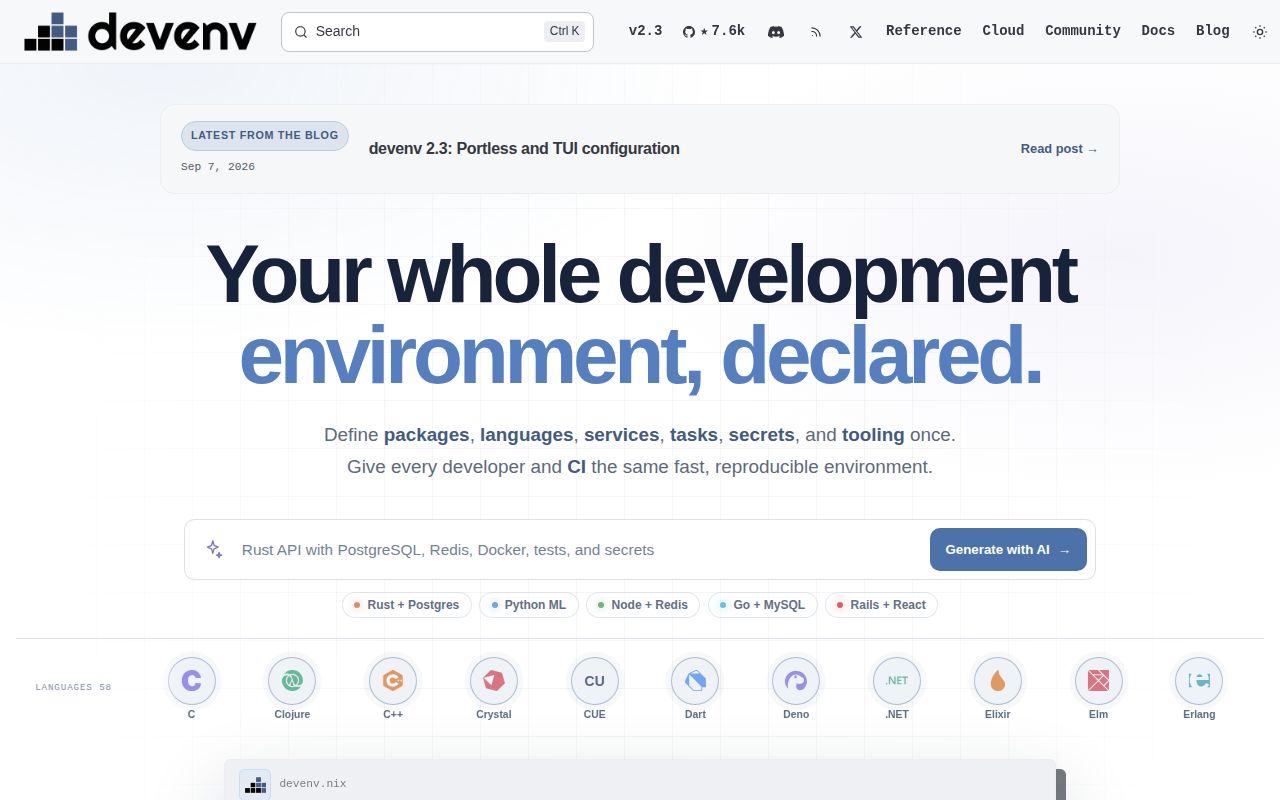
devenv 2.3 turns a repository's development environment into checked-in configuration. A devenv.nix file can select compilers, packages, environment variables, scripts, and entry hooks, while devenv.yaml identifies inputs and a lockfile pins them. The README says the language modules cover more than 50 languages and pull tools from Nixpkgs. That is a useful answer to setup guides that drift as each developer installs a slightly different compiler or database.
The scope goes well beyond a shell. More than 40 documented service modules cover software such as PostgreSQL, Redis, MySQL, MongoDB, Elasticsearch, and Caddy. Tasks can have dependencies, caching, namespaces, and parallel execution. A native process manager adds readiness probes, restarts, port allocation, and file watching. Profiles support environment variants, imports share configuration across repositories, and outputs can package applications or produce OCI containers without requiring Docker for the build.
A 3-file project setup still asks developers to learn Nix
devenv init creates devenv.nix, devenv.yaml, and .gitignore, then devenv shell activates the result. The generated Nix file is heavily commented, so enabling a language or service usually begins by changing one option. Ad hoc flags can also create a shell without a configuration file. Once a project needs custom packages, module composition, or overrides, someone on the team still has to understand Nix values, inputs, and evaluation errors.
The command surface is unusually broad for a development shell. It includes environment updates, package search, processes, task runs, tests, container output, garbage collection, a REPL, an LSP, and an MCP server. That range can replace several project scripts, but it also makes devenv an operating convention rather than a small helper. A team should decide who owns shared modules and input updates before many repositories start importing the same configuration.
What happened when we ran it
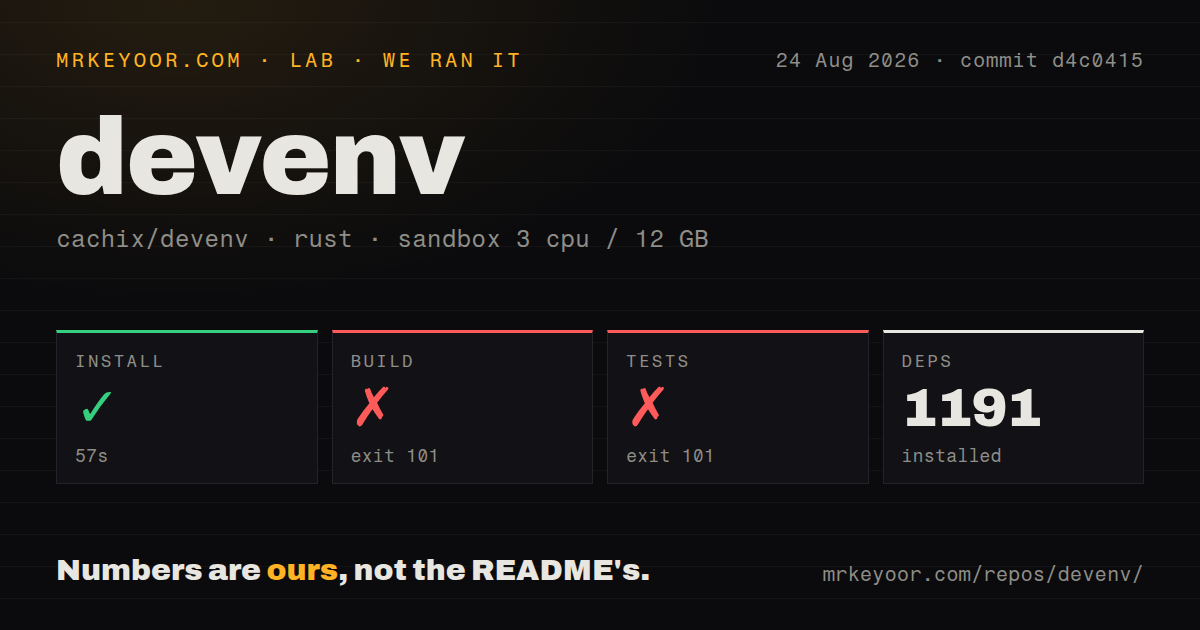
Our run cloned commit d4c0415 into an unprivileged Debian container with 3 CPUs and 12 GB of RAM. The 14 MB checkout contained 1,537 files and about 107,320 lines of source. Installation succeeded in 57 seconds and added 1,191 packages. Our measurement setup had no secrets, and the repository contained 17 CI workflow files plus a tests directory, but no Dockerfile.
The build failed with exit 101 after 219 seconds. pkg-config could not find the system library nix-flake-c required by the nix-bindings-bindgen-raw crate. The log specifically said nix-flake-c.pc was missing from the search path and PKG_CONFIG_PATH was unset. It does not show whether setting that variable alone would be sufficient, so the defensible result is that the checkout did not build in the stated fresh image.
Tests failed separately with exit 101 after 46 seconds. Their log reached a detached checkout of a Ghostty dependency, then a Rust build script panicked while trying to execute zig: the executable did not exist. The build log and test log name different missing components. Neither result says that normal devenv shell use fails after installing the supported package, but both matter if you plan to modify and compile the Rust source.
Nix is required, while a GitHub token is optional
The official installation sequence puts Nix first and devenv second. Linux uses the Nix daemon installer, macOS uses the newer Nix installer, and Windows is covered through WSL2. macOS users are advised to install a newer Bash to avoid evaluation errors. The Docker tab starts a NixOS container, which can be useful for a trial, though the repository itself has no Dockerfile according to our scan.
A GitHub access token is the only credential in the basic setup guide, and it is optional. Nix makes enough GitHub API requests that unauthenticated users can hit rate limits, so the guide recommends a token with no extra permissions in nix.conf. Project services may add database passwords or other secrets. SecretSpec integration can obtain those values from a keyring, 1Password, or dotenv instead of placing them directly in the Nix file.
Release v2.3 is active, but one test exit bug deserves a CI check
GitHub recorded 7,630 stars, 363 open issues and pull requests, and a last push on September 9, 2026. Release v2.3 arrived on September 7 with many fixes around shell reloads, task output, process cleanup, concurrent initialization, and detached process managers. Recent issues and pull requests were still being updated on September 10, so the large combined open count sits beside visible current work rather than a dormant queue.
Open issue #3168 reports a specific CI risk in devenv 2.2.2: devenv test returned exit 0 when a declared PostgreSQL process failed to start, and one observed run skipped enterTest. The reporter supplied a reproduction and a marker-file workaround. Version 2.3 release notes do not name that report as fixed. CI users should therefore include a deliberately failing process case before treating the command's status as their only gate.
Devbox or direnv costs less attention for narrower jobs
The 1,191-package install in our sandbox shows the cost of working on devenv itself, while daily users normally install the packaged tool through Nix. Devbox is the closer alternative for teams that want Nix packages behind JSON. devshell keeps the configuration in Nix but focuses on per-project shells. direnv is smaller still and only automates directory-specific environment changes.
devenv earns its complexity when one definition replaces language setup, local databases, task ordering, and process supervision across several machines. Its documentation is detailed, the September 2026 release and issue activity show regular maintenance, and the product surface has reached version 2.3. The failed source build and test run make a different point: contributors need the project's expected native toolchain, not just Rust and a successful package install.