
Eleven model wrappers hide a five-stage pipeline
DeepFace wraps 11 documented recognition-model choices behind functions for verification, search, representation, and attribute analysis. Its pipeline detects a face, aligns and normalizes it, creates an embedding, then compares that representation. The default choices are VGG-Face for recognition, OpenCV for detection, cosine similarity, and alignment enabled. That common interface makes model comparison easier than wiring each upstream implementation yourself.
The wrapper still leaves consequential choices with the developer. The README lists 20 detector backend strings and 4 distance metrics, with different models available for recognition. A verified boolean looks simple, but its usefulness depends on the model, detector, image conditions, and threshold used for the application. DeepFace publishes benchmark material for its configurations; our lab did not measure recognition accuracy, false accepts, false rejects, detector recall, or webcam speed.
Eight database backends extend search beyond folders
The basic find flow points DeepFace at a directory of known faces and stores embeddings on disk. A newer register-and-search interface supports exact and approximate-neighbor queries against 8 named backends, including PostgreSQL, MongoDB, Neo4j, pgvector, Pinecone, Milvus, Qdrant, and Weaviate. This gives teams a route beyond repeated comparisons against a folder when their collection grows.
Each route creates biometric records that need an owner and retention policy. Embeddings, source images, identities, match results, and deletion requests do not become ordinary cache data because a vector database stores them. The README demonstrates registration and search mechanics, while application teams must decide consent, authorization, tenancy, backups, audit logs, and removal behavior. DeepFace supplies face operations; it does not supply the surrounding identity-governance system.
What happened when we ran it
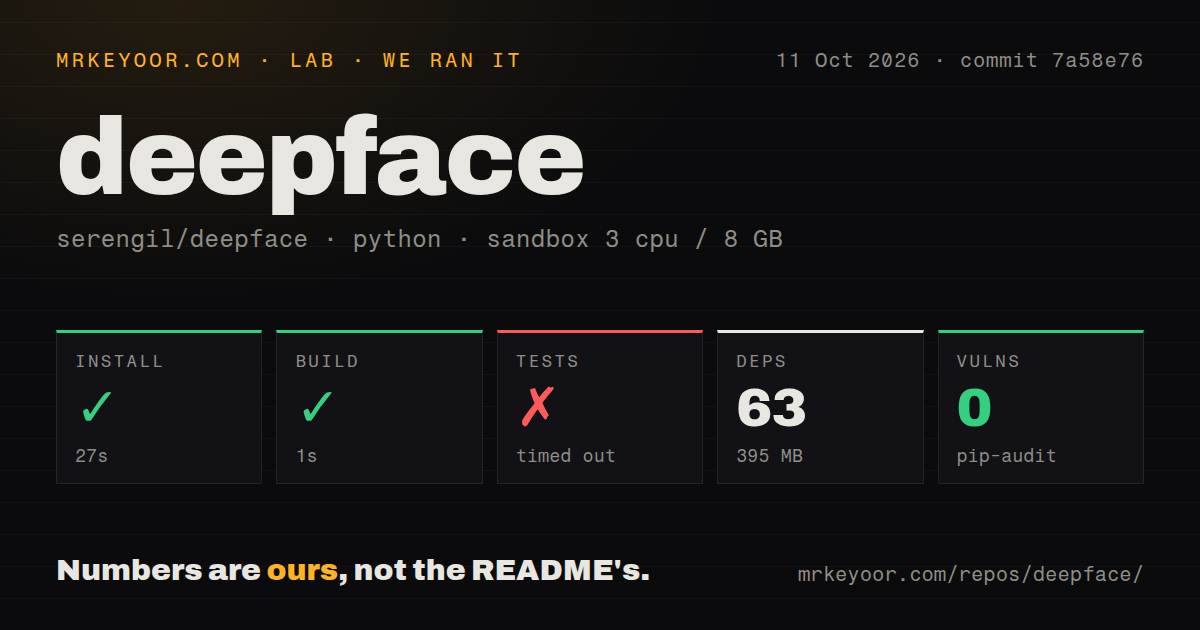
Our sandbox installed 87 Python packages in 55 seconds at commit ae08a3a, consuming 2,349 MB on disk. The package build succeeded in 8 seconds. Pip-audit found 0 known vulnerabilities in the installed environment. The checkout itself held 240 files, about 20,082 source lines, and 32.2 MB. Our scan found 1 CI workflow, a Dockerfile, and a tests directory.
Pytest exited with code 1 after 20 seconds. It reported 8 passed, 0 failed, and 15 collection or setup errors out of 23. The visible tail named errors in test_extract_faces.py, test_find.py, test_find_batched.py, test_landmark_sanitization.py, test_output_normalization.py, test_represent.py, test_signature.py, test_verify.py, and test_version.py. The supplied tail did not include the underlying exception, so it supports no claim about the cause.
A 2,349 MB install makes the simple API operationally heavy
The pip install command is short, but our environment occupied 2,349 MB after 87 packages were installed. That cost matters for CI caches, container pulls, autoscaling, cold starts, and developer machines. The repository offers a Dockerfile and scripts for a Gunicorn service. Open issue 1598 reports that Docker Hub's latest image was still version 0.0.96 when the requester wanted a 0.0.99 image, so image users should verify tag parity with the Python package they evaluated.
Open issue 1512 also describes DeepFace as tied to TensorFlow and Keras and proposes a PyTorch backend. The issue is a proposal, not a promised feature. A team standardized on PyTorch should count the existing framework stack in memory, image, and dependency budgets rather than assuming an interchangeable backend will arrive. Our 55-second install shows the dependency graph resolves in the stated sandbox; it does not show inference memory or throughput.
Five HTTP examples accept files, paths, URLs, and base64
The README demonstrates 5 API jobs: represent, verify, analyze, register, and search. A service script starts Gunicorn, while a Docker script packages the same interface. Requests may submit uploaded files, exact image paths, URLs, or base64-encoded images. Those input modes are convenient for internal integration and deserve strict boundaries on any reachable deployment, especially because local paths and server-side URL fetching have different trust implications from an uploaded file.
DeepFace's README does not document an authentication step for the self-hosted HTTP examples. Put the service behind an authenticated gateway, restrict outbound network access and readable paths, cap upload and request sizes, isolate stored images and embeddings, and avoid exposing raw model errors. Those are deployment recommendations, not findings that the API contains a named vulnerability. Our run did not start the service or test its access controls.
Anti-spoofing is optional, and 4 attributes need restraint
DeepFace v0.0.100 can estimate 4 groups of attributes: age, gender, emotion, and race or ethnicity labels. These are statistical model outputs, and the README's examples do not establish fitness for employment, policing, medical, credit, or access decisions. Teams considering those uses need independent evaluation across their population and image conditions, plus a policy for uncertain or disputed results. A convenient function call does not settle whether the inference should be made.
Liveness is a separate setting. The README says anti-spoofing activates only when anti_spoofing=True, so a default face match should not be treated as proof that a live person is in front of the camera. Version v0.0.100's release notes also say heavy unit tests were disabled. That change and our 15 setup errors are separate facts, but together they support running an application-owned suite for every model, detector, threshold, and spoof case used in production.
Seven open issues and one pull request make a small queue
GitHub showed 23,384 stars, 7 open issues, 1 open pull request, and a last push on September 1, 2026. Release v0.0.100 was published May 9, after three earlier 2026 releases. The current push date and compact open queue indicate ongoing work; the May tag alone is not evidence of inactivity. Several open items are feature requests, including S3 search, gRPC, a registered-face identify endpoint, and a PyTorch backend.
DeepFace is appealing as an experimenter's switchboard, especially when comparing model and detector combinations through one Python interface. The 2,349 MB environment, failed suite collection, inherited licenses, optional liveness check, and sensitive API inputs make production adoption a separate project. face_recognition is narrower, InsightFace offers a more direct model ecosystem, and OpenCV gives lower-level vision control. Pick after testing the exact images, thresholds, error costs, and deployment boundary your application will carry.