What this project is trying to fix
Claude Code can produce technically correct answers that are harder to read than the task demands. claudish-to-english adds a presentation layer after each assistant response: a second model rewrites the text in plainer English, and the plugin shows that version on screen. The original response remains in Claude's reasoning flow and saved transcript. That boundary is the project's most important idea because it reduces the chance that a readability tool changes the actual working record.
The plugin uses Ollama and a local model by default. It can instead call the Anthropic API or an OpenAI-compatible API. It also includes a separate, optional hook that rewrites Markdown files when Claude writes or edits them. That feature is off by default, appropriately, because changing files carries much more risk than changing display text.
This is a focused utility, not a general Claude Code replacement or a new coding agent. It belongs beside Claude Code as a user-interface filter, with Ollama or an API provider supplying the rewrite.
What it gets right
The fail-open behavior is excellent. If Ollama is stopped, the model is missing, a request times out, a key is absent, or another dependency fails, Claude's original response still appears. The hook cannot swallow an answer. A one-time notice explains why rewriting was skipped, and users who prefer silence can disable that notice. For a tool inserted into every assistant response, graceful failure is more valuable than clever recovery.
The separation between display and source material is equally sensible. Claude continues working from its original answer, and the transcript retains that answer, so the rewrite should not create a compounding loop in later turns. Users can consult the stored original if a rewrite removes nuance. The README does not promise perfect preservation, but the architecture gives you a useful escape hatch.
Configuration is more flexible than the narrow premise suggests. Environment variables select the provider, model, mode, prompts, notices, debugging, and Markdown behavior. Custom prompt files let teams define what plain English means for their work while preserving code and structure. There is also a mid-session kill switch, which matters when a rewrite becomes distracting or a local model consumes resources needed for development.
The documentation is a particular strength. macOS and Windows get separate prerequisite tables, concrete install commands, model warming instructions, and warnings about the platform-specific default. The README explains where marketplace configuration belongs, why editing the cached plugin is a mistake, how settings precedence works, and why Claude Code must be restarted after environment changes. Those details address the failures users are most likely to encounter.
The costs and rough edges
Every visible rewrite adds a second inference step. The supplied evidence includes no latency or quality measurements, so there is no basis for claiming the delay is small or that the rewrite always preserves meaning. A local model avoids sending text to another hosted service, but it consumes memory and compute. The suggested macOS model download is roughly 17 GB, a substantial prerequisite for a readability filter. Choosing an API provider trades local resource use for credentials, network dependency, possible usage charges, and another copy of the response leaving the machine.
Setup is also platform-sensitive. The default model tag is an Apple-silicon MLX build and will not run on Windows. Windows users must install Git Bash and set a non-MLX model explicitly. All users need jq and curl, and Ollama users must keep its service running, pull the exact configured model, and warm it to avoid a slow first request. Environment blocks do not merge across Claude Code settings scopes, so an unrelated higher-precedence block can quietly replace the intended values.
Rewriting creates a fundamental accuracy concern. Plain language often helps, but a second model can flatten qualifications, change emphasis, or mishandle code-adjacent prose. The untouched transcript limits the damage, yet readers may act on the displayed wording without checking it. The optional Markdown hook deserves even more caution because it edits artifacts rather than presentation. Use narrow directory controls, version control, and review diffs.
Finally, the repository calls itself a working prototype. That description should carry real weight. There is not enough history to judge compatibility across Claude Code updates, provider edge cases, or sustained maintenance.
Community and project health
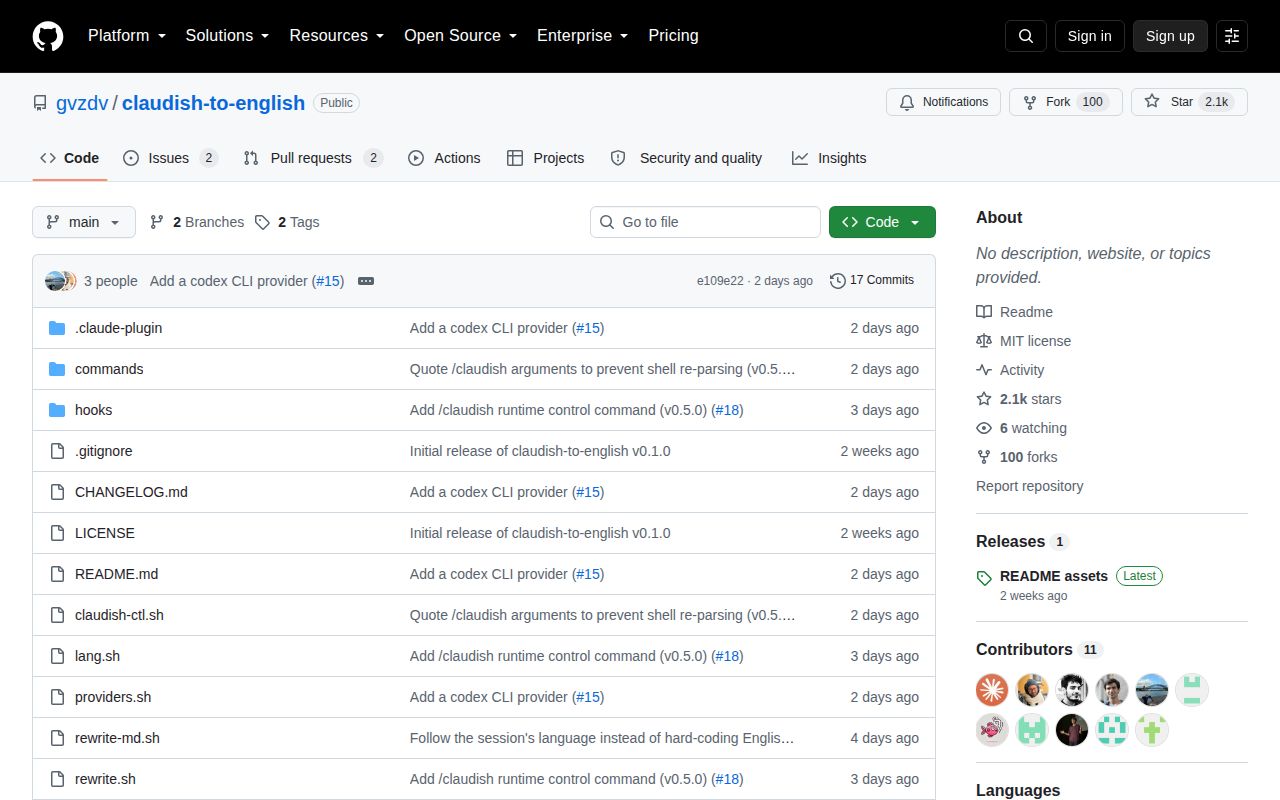
The early attention is striking: the supplied repository snapshot reports 1,325 stars, while the community item records 1,231 stars shortly beforehand. That suggests rapid initial interest, not a settled user base. Five open issues is a manageable visible queue, but issue count alone says little about response quality or resolution time.
The timing is encouraging but extremely compressed. The project was created on August 10, 2026, published release assets on August 11, and was last pushed on August 13. Relative to August 19, that is recent activity, yet only about a week of public history. It is fair to call the project active and young, but not mature or proven. The MIT license is friendly for inspection, adaptation, and internal use.
Where it fits in a real stack
Treat claudish-to-english as an optional accessibility and readability layer. Claude Code remains the agent, the repository and transcript remain the source of truth, and Ollama or the selected API is a downstream text transformer. Start with display rewriting only, keep the fail-open default, and compare rewritten replies with originals until you trust the behavior of your chosen model and prompt.
Teams that need consistent documentation standards may be better served by Vale, textlint, or write-good. Those tools flag defined problems and fit CI, though they do not automatically make conversational output friendlier. This plugin is most compelling for an individual whose daily Claude Code sessions genuinely become easier to scan. It is less convincing as mandatory team infrastructure, and the file-rewriting hook should remain opt-in until the project has a longer record.