ByteRover stores coding context across agent sessions
ByteRover CLI addresses the amnesia built into most coding chats. It keeps project facts in a context tree that agents can query later, adds a review queue for proposed changes, and offers branch, commit, merge, push, and pull operations for that memory. The same store can serve a terminal REPL, a local web interface, and an MCP connection. That makes it useful when a developer moves between Claude Code, Cursor, and other compatible tools but wants one maintained account of the codebase.
The breadth comes with weight. Our checkout contained 2,038 files and roughly 315,399 source lines before installation. The CLI includes a daemon, React-based terminal interface, web dashboard, 24 built-in agent tools, connections for 20 model providers, cloud sync, connectors, and a package hub. A team should approach it as another development service with state and credentials, not as a small prompt file that can be copied into a repository and forgotten.
Reviewed curation is safer than automatic memory writing
The strongest product decision is the pending-review workflow. A developer can curate a fact, inspect the proposed operation, and approve or reject it before the context tree changes. That matters because stored guidance outlives the chat that created it. A wrong authentication convention or stale deployment command can be repeated by every connected agent. Version-control commands also give the context tree branches and history, which helps teams discuss a memory change instead of editing an opaque database record.
Those controls only help when people use them. The installed tree reached 1,006 MB in our sandbox, and the runtime can execute code, read and write files, and call model providers. Credentials may include an OpenAI, Anthropic, Google, or another provider key, plus a ByteRover Cloud key for team sync. Local providers avoid sending prompts to a hosted model, but they still require a reachable service and enough time for agent loops. ByteRover's documented defaults allow 10 minutes per task and 2 minutes per model request.
What happened when we ran it
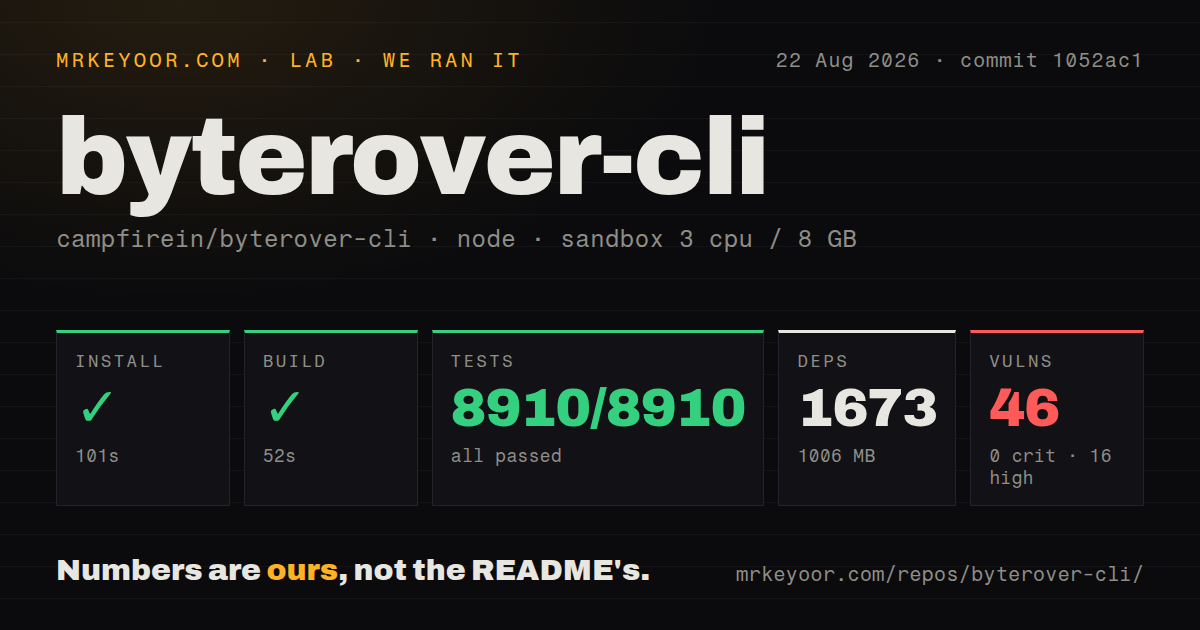
Our clean Debian sandbox installed commit 1052ac1 in 101 seconds. Npm added 1,673 packages and occupied 1,006 MB on disk. The build succeeded in 52 seconds. This is a straightforward result in the sense that no manual repair was needed, but the dependency count and disk use are high for a command-line memory tool. Budget both in CI images and developer machines before adopting it across a team.
The test command ran for 222 seconds and Mocha reported 8,910 passed with 0 failures out of 8,910. That is unusually substantial executable coverage for this category. Npm audit gave the less comfortable result: 46 known vulnerabilities, split into 16 high, 11 moderate, and 19 low, with none critical. The audit does not prove an exploitable path in ByteRover, but it gives maintainers a concrete dependency queue that security-conscious adopters should review before exposing the daemon or processing sensitive repositories.
Curation can report success without preserving the requested fact
Open issue 767 documents a sharp automation hazard in version 3.16.1. A bracketed label led the curator to produce a category outside its accepted enum. The individual write failed validation, yet the task was marked completed and the CLI printed a success message with zero facts added. A script that checks only process status can silently lose memory. Until fixed, integrations should inspect operation results and confirm that the intended fact appears in a follow-up query.
Issue 757 is more serious for human-reviewed use. Its reporter submitted several targeted curation entries and found that 5 of 6 initial cases produced unrelated internal workflow content; one contrast case worked. The report says review tasks looked plausible while representing the wrong source material. It does not establish that every provider or project suffers. It does establish a reason to compare each proposal with the submitted text before approval, especially when the tree is treated as source-of-truth documentation.
Local operation still depends on provider and daemon behavior
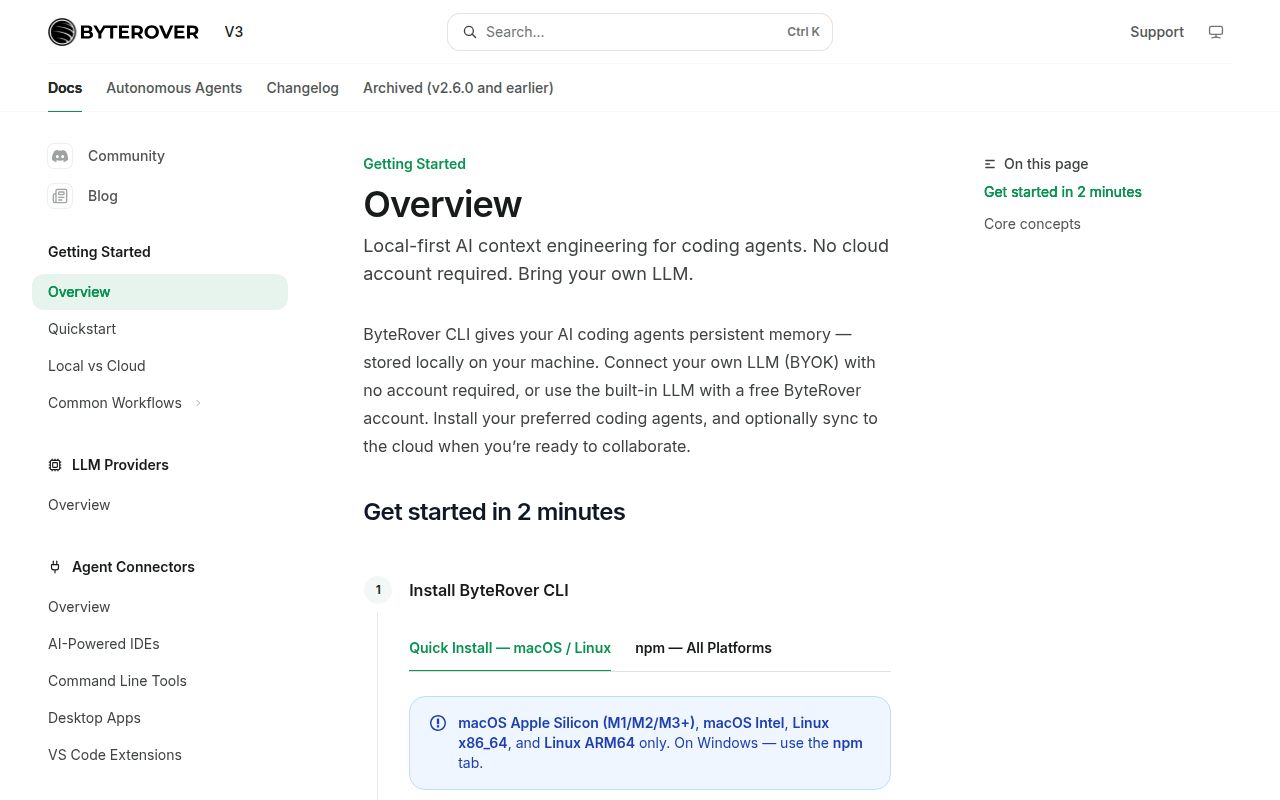
The packaged shell installer supports macOS and Linux on x64 and ARM64 without a separate Node installation. The npm path needs Node 20 or newer and covers other platforms. First run selects a model provider, while cloud collaboration requires login. The daemon reads settings at startup, so changing concurrency or timeouts takes a restart. Project data and global state also need a backup policy if the memory is valuable.
Slow local models expose another edge. Issue 765 reports a curate operation hanging during its second model step and says restarting the daemon temporarily clears the condition. The report names a local LM Studio setup and offers a suspected connection-pool cause, which remains the reporter's diagnosis rather than a confirmed project finding. Issue 715 separately says the web UI binds to localhost, preventing ordinary access through a published Docker port. Headless users should verify both behaviors before designing a shared internal service.
Elastic License 2.0 limits hosted resale
GitHub's license field did not identify an SPDX license, while the repository's LICENSE file is Elastic License 2.0. It permits use, copying, distribution, and modification under stated conditions. It also prohibits offering third parties a hosted or managed service that exposes a substantial set of the software's features. Internal use and commercial resale are different questions here, so product teams should read the license before building ByteRover into a customer-facing platform.
The repository had 4,948 stars and 23 combined open issues and pull requests when fetched. Its last push was June 25, 2026, while issue discussion continued in August. Release 3.16.1 arrived May 27 and fixed login state being lost across restarts. That activity does not settle the curation correctness reports. With 8,910 passing tests, the engineering base is credible; with 46 audit findings and open cases where memory can be wrong or absent, adoption should stay supervised.