Bitcoin Core gives you your own validating node
Bitcoin Core downloads and fully validates Bitcoin blocks and transactions. That is the reason to operate it: you want software on your own machine checking network data. The wallet and graphical interface are optional. A developer can use its RPC interface to connect an application to that node, while someone who only wants a lightweight Bitcoin client should compare a narrower product before taking on node operation.
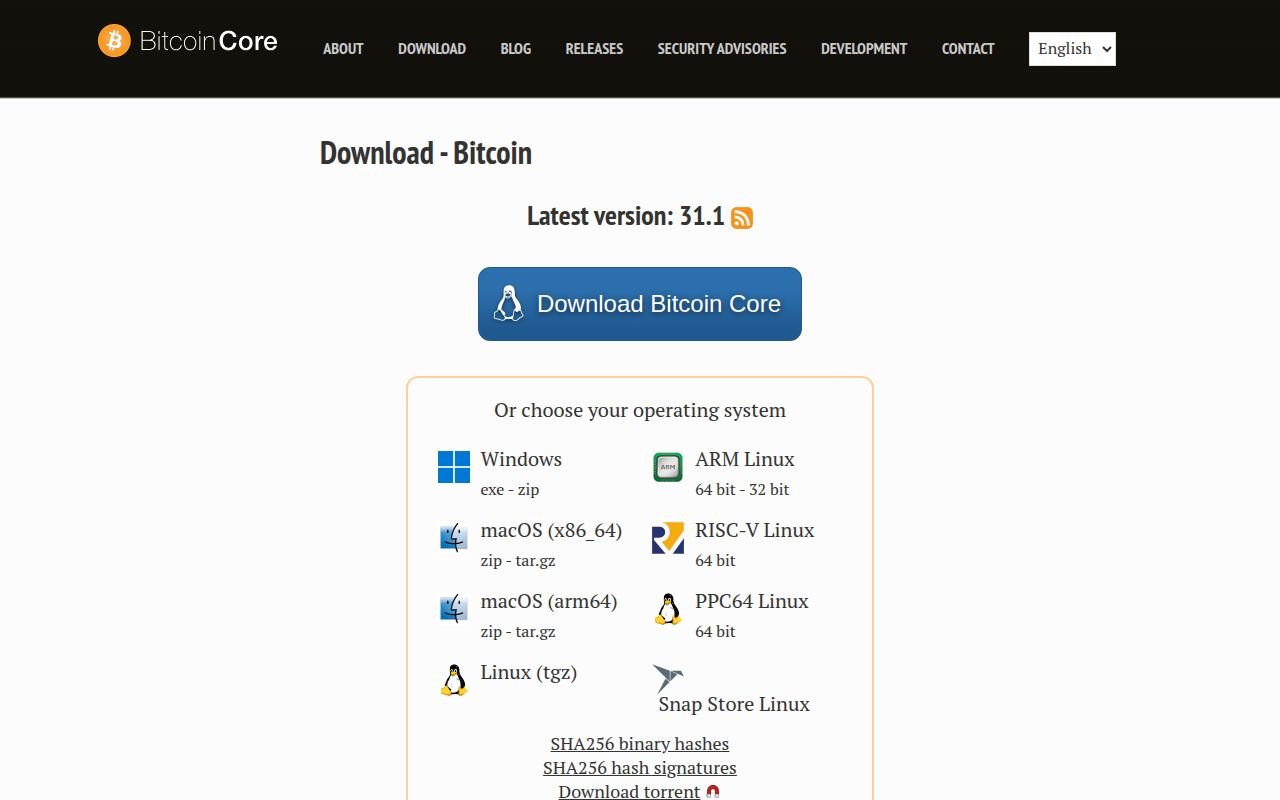
The repository README makes another useful distinction immediately. Its master branch is an integration and staging tree, and the project directs ordinary users toward binary downloads. I'd start an operator there, then read the stable release's instructions. Cloning the busiest development branch is a contributor decision, with different expectations about changes and stability.
What happened when we ran it
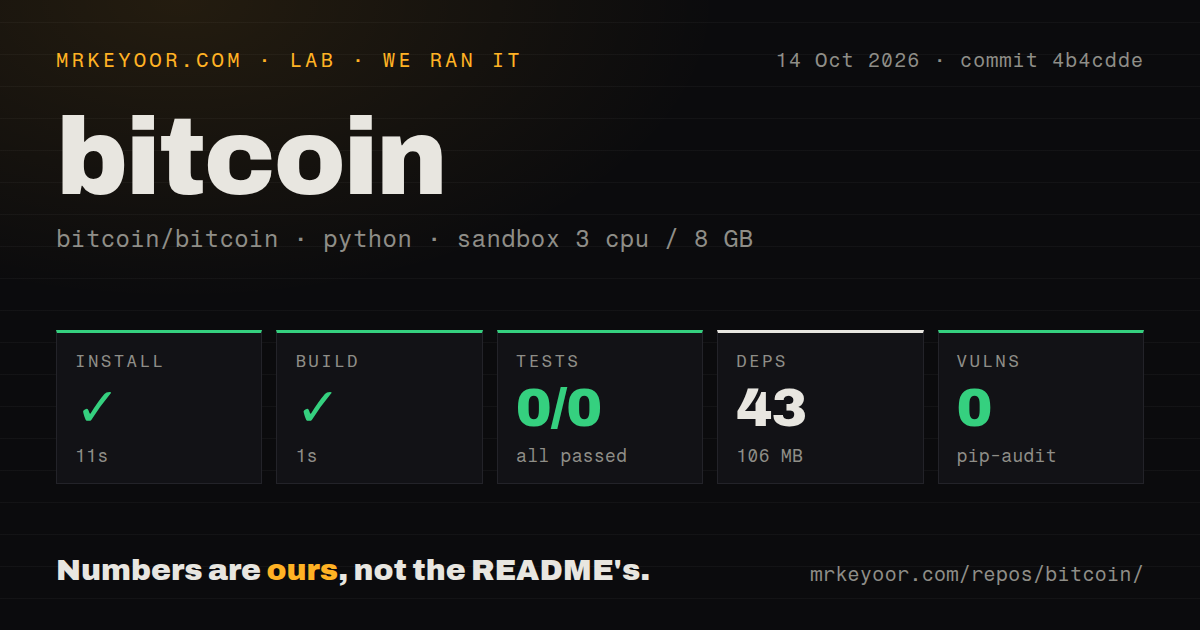
Our sandbox installed Bitcoin Core's ci/lint Python environment in 11 seconds at commit 4b4cdde on October 14, 2026, recording 43 dependencies and 106 MB on disk. The build step succeeded in 1 second. Those results belong to a helper under ./ci/lint/. They provide no Bitcoin Core compilation timing and no evidence that a Bitcoin node started.
Pytest exited with code 5 after 1 second. Its summary recorded 0 passed and 0 failed out of 0, with the message "no tests ran in 0.00s". Calling that a clean suite would be misleading. We reached a command that collected nothing, so there is no test coverage to credit to the node or the helper from that invocation.
Pip-audit reported 0 known vulnerabilities in the selected Python environment. That finding doesn't cover the C++ node or establish that a wallet is safe to use. Our checkout contained 3,058 files, about 804,600 source lines and occupied 50.4 MB. The scan found 1 CI workflow file, no Dockerfile and a tests directory. None of those inventory signals changes the scope of the command we ran.
The recorded sandbox configuration had 3 CPUs and 8 GB of RAM and used an image labelled ghcr.io/astral-sh/uv:python3.12-bookworm. We don't have raw toolchain logs establishing actual runtime or operating-system versions. We also have no initial synchronization, storage-growth or transaction-processing measurement. You cannot size a node deployment from this helper's small installed environment.
The README's checking paths differ from our pytest invocation
Bitcoin Core's README directs contributors to ctest for compiled unit checks and to build/test/functional/test_runner.py for Python regression and integration checks. Those are documented routes, not commands we completed. The empty pytest result therefore tells you about the selected lab path, without supporting a claim that Bitcoin Core lacks checks or has a failing node suite.
That boundary changes the adoption decision. A contributor needs a native source environment and the applicable project instructions. An operator needs an official release and an operating plan for the node. Our fast helper build establishes neither. Before treating a separate reproduction as release evidence, require its report to name the node artifacts it actually produced and the checks it actually executed.
RPC access can spend wallet funds and affect the host
The RPC guide says the headless daemon enables its API by default, while the graphical application leaves it disabled unless server mode is enabled. Local cookie authentication is the preferred method. This makes local application integration a documented use, but the credential grants substantial control rather than access to a harmless public data endpoint.
The guide explicitly includes spending wallet funds, reading private data and affecting consensus verification among RPC capabilities. It also warns that credential holders can influence filesystem resources available to the daemon. If your application needs access, treat both its credentials and its operating-system permissions as part of the node's security boundary. The project's command whitelists are not a substitute for system-level isolation.
Public Internet RPC exposure is a reason to reject a proposed deployment. Bitcoin Core's guide says the interface lacks transport encryption and hasn't been hardened for arbitrary Internet traffic. It describes secured private connections for remote control. A node may serve your application perfectly well while remaining unsuitable as a directly exposed Internet API. Decide that boundary before connecting a remote client.
Electrum and BTCPay Server answer narrower product questions
Electrum describes itself as a lightweight Bitcoin client. Choose it when that client is the product you want, rather than starting with Bitcoin Core because the repository name is familiar. This comparison doesn't establish equivalent validation or security properties, and our Bitcoin Core helper run measured neither Electrum nor its dependencies.
BTCPay Server is a self-hosted Bitcoin payment processor. It belongs on a merchant's shortlist when accepting payments is the immediate requirement. It isn't evidence that node operation disappears. Assess the payment system's deployment separately, instead of assuming Bitcoin Core's node and optional wallet provide the whole merchant product.
October activity supports maintenance, without validating our checkout
GitHub recorded Bitcoin Core's last push on October 19, 2026. The recently updated pull-request list that day included peer-relay work and a change to kernel logging. Those are concrete signs of current engineering activity. GitHub's 770 open items combine issues and PRs, so that number cannot be presented as a count of confirmed bugs.
Documentation earns 4/5 in our text-based assessment: it distinguishes development from stable use and supplies specific checking and RPC-security instructions. Setup and runtime maturity remain unassessed because our run never reached the node. If you need independent validation, begin with the official stable release and a private RPC boundary, then gather node-specific evidence before relying on it for an application.