This client queries Shodan's index rather than scanning a network
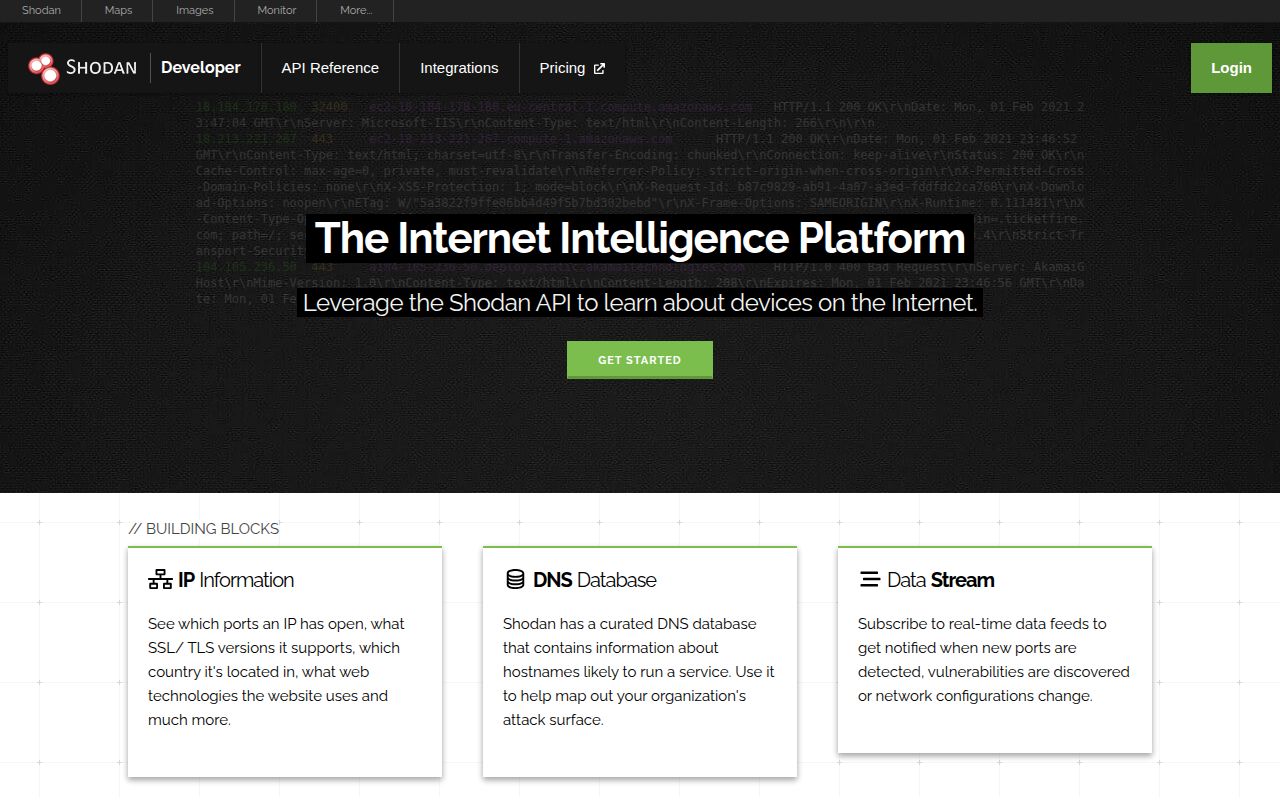
shodan-python wraps Shodan's REST and streaming APIs. You can look up an IP, search indexed service banners, count results, inspect DNS data, watch a stream, manage network alerts, download bulk datasets, and query the exploit archive. The included shodan command exposes much of the same service from a terminal. It is useful when Shodan already has the data and you want to automate the questions.
That distinction matters. The README describes access to information stored by Shodan. It does not describe a local scanner that probes your address range on demand. A result can therefore be convenient and broad without being a fresh measurement of a device you own. For current internal exposure checks, pair the client with an authorized scanner or another source whose collection time you understand.
A Shodan key is required before the examples become useful
The quick start constructs Shodan('MY API KEY'), then calls host lookup, a cursor-based search, and a count query. You obtain that credential from a Shodan account. Endpoint access and available filters can depend on the account, which the test source makes explicit by expecting an advanced filtered query to fail on the free plan. Your application needs to handle those service-side permissions rather than treating every API error as a client defect.
Keep the token outside source control and pass it into your own program through a secret store or environment. The repository's tests use a different convention: each case opens a file named SHODAN-API-KEY from the working directory. That file was absent in our unprivileged sandbox. The resulting failure says more about the test harness's credential assumption than about search correctness.
What happened when we ran it
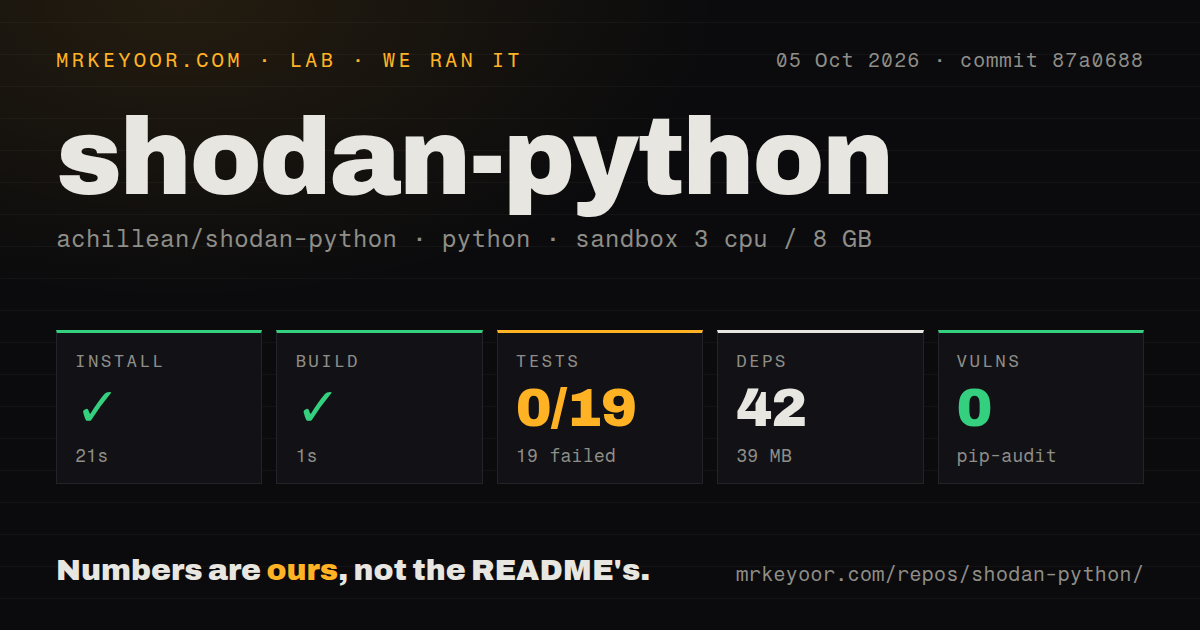
Our sandbox installed commit 87a0688 in 21 seconds. It pulled 42 packages and occupied 39 MB on disk, while the checkout itself held 44 files, about 4,763 lines of source, and used 0.2 MB. The package build succeeded in 1 second. Pip-audit reported 0 known vulnerabilities in the installed Python environment.
Pytest failed after 2 seconds with 0 passed and 19 failed out of 19. Every failure shown in the log tail ends with FileNotFoundError for SHODAN-API-KEY, including invalid-host, invalid-key, search, facet, and trends cases. The suite never reached the assertions in those cases because setup tried to open the credential file first. We did not add a key or make paid API calls, so this run does not judge live endpoint behavior.
The test suite is a live account check, not an offline safety net
The 19 supplied cases call real Shodan services. They check search results, facets, host details, exploit pages, trends, and error responses against data that can change outside the repository. That can catch contract drift with the service, but it also means a new contributor cannot run the suite with an isolated fake server. There are no GitHub Actions workflow files showing how maintainers provide a test account, and the repository has no Dockerfile.
A production team should add its own tests around the paths it depends on. Mock the HTTP boundary for deterministic parsing and error handling, then keep a small credentialed check for account permissions and endpoint compatibility. Our 2-second failure is a useful warning here: without a secret, the upstream suite provides no passing baseline at all.
Search, streams, alerts, and downloads share one small client
The project's appeal is its directness. The main client uses requests, builds paths for the API services, and raises APIError when Shodan returns a problem. Nested helpers cover DNS, notifications, organization membership, exploit search, trends, and other service groups. The README also lists bulk IP lookup, real-time firehose consumption, network alerts, email notifications, and bulk downloads.
This is a synchronous Python client. That is convenient for scripts and analyst tools, but a high-concurrency service may need its own scheduling, backoff, timeout policy, and usage accounting. The README does not promise an asynchronous interface. Before putting it behind an API, check the Shodan plan's limits and decide which responses you cache. Those service details were outside our 39 MB local installation measurement.
Packaging debt is visible in the open queue
commit 87a0688 declares package version 1.31.0 in setup.py, while GitHub's latest release entry is 1.28.0 from July 9, 2022. The repository was last pushed on August 5, 2024. GitHub listed 65 open issues and pull requests on October 5, 2026, split into 45 issues and 20 pull requests. Incoming reports continued after the last code push, so a stale release tag alone is not the whole health picture.
The open work still gives a buyer pause. Issue 246 reports that the CLI fails when pkg_resources is unavailable. Pull requests 248 and 253 both propose moving that lookup to importlib.metadata, and issue 252 requests the same change. The reports show a known packaging pressure point. They do not prove that every supported Python environment is broken, but they justify testing the exact interpreter and setuptools policy you deploy.
Choose it for Shodan data, not for a general asset platform
Censys Python is the closer substitute when your organization already searches Censys hosts and certificates. pygreynoise answers a narrower question about whether an IP belongs to ordinary Internet scanning activity. Masscan takes the opposite route and collects live TCP scan results from networks you are authorized to probe. Each changes the data source, not merely the Python syntax.
shodan-python remains the shortest official path from Python to a Shodan account. The local footprint was modest and the build passed, but our run could not produce one passing test without the expected secret file. Combined with the 2024 last push and open pkg_resources work, that makes it a dependency to pin and surround with your own contract tests. If you do not already need Shodan's index, choose the data source before choosing this client.