Shared job templates replace deployment from one terminal
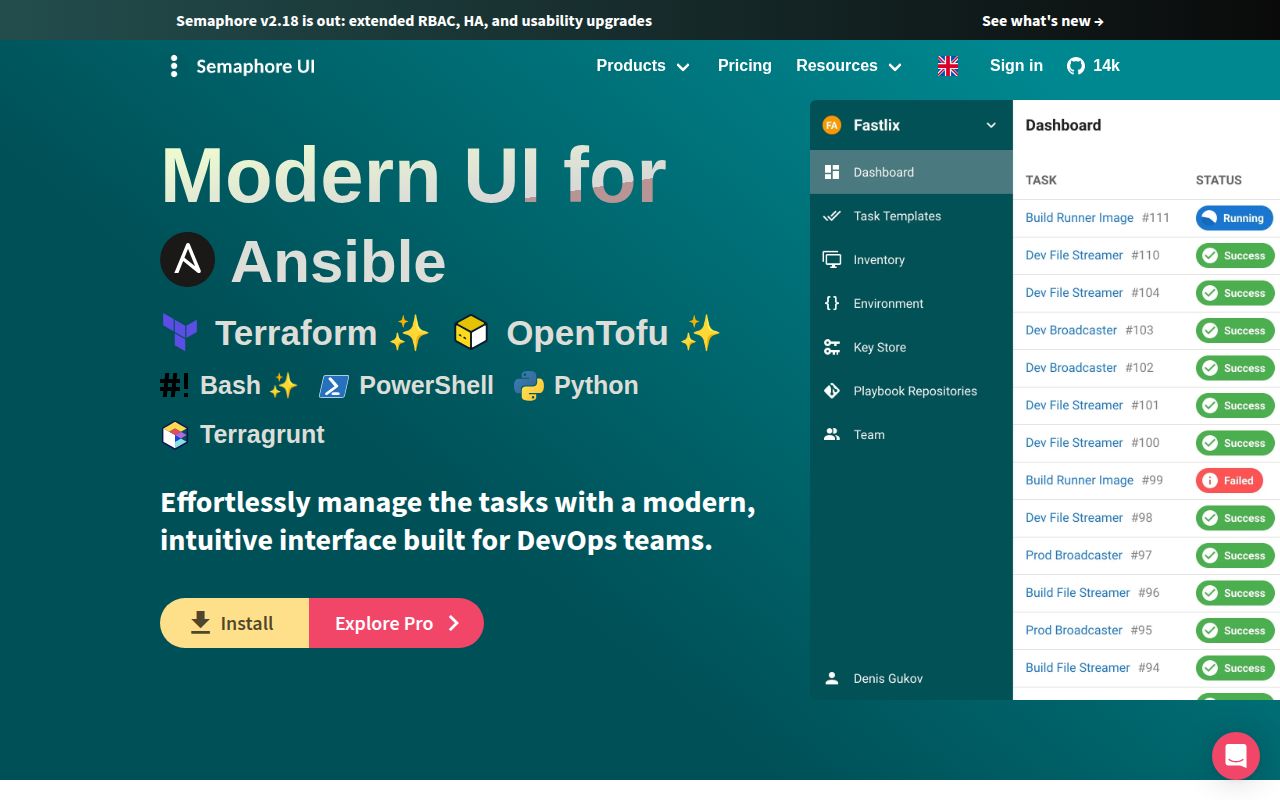
Semaphore UI organizes operations into projects, task templates, task runs, schedules, inventories, and variable groups. An Ansible playbook or Terraform directory can become a repeatable job that another authorized user launches from a browser. The service records execution, can notify on failure, and keeps credentials away from the command pasted into chat. That is enough structure for many small infrastructure teams.
Its scope goes beyond Ansible. The README names Terraform, OpenTofu, Terragrunt, PowerShell, Bash, and other command-line tools. That makes Semaphore a thin control layer over tools the team already understands. It does not write correct playbooks or plans for you. Operators still need to test the underlying automation, interpret failures, and know how to run it without the web interface when the controller is unavailable.
A 13-second build still ended with 3 failed test packages
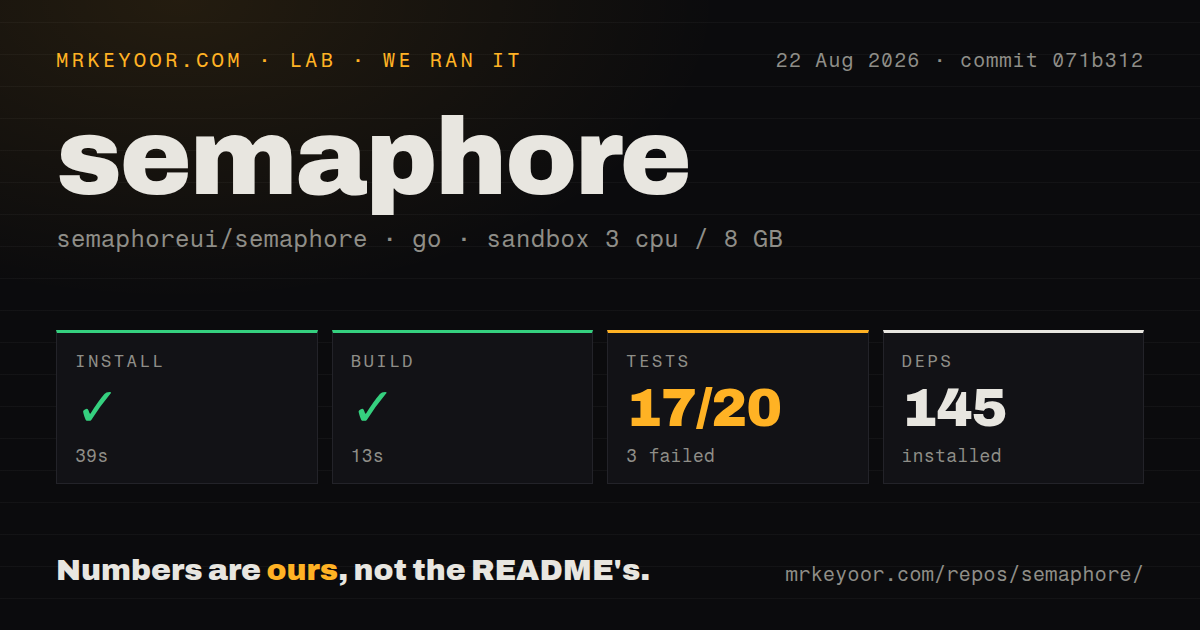
We cloned commit 071b312 into an unprivileged Debian container with 3 CPUs and 8 GB of RAM. The 17 MB checkout contained 955 files and about 94,397 source lines. Installing 145 Go packages took 39 seconds, and the build succeeded in 13 seconds. Those are modest contributor costs for a web controller with several execution backends.
Our scan found 5 CI workflow files and a tests directory, but no Dockerfile in the measured checkout. The project nevertheless publishes a container and documents it as the most popular installation method. That means users of the image should inspect the release pipeline and image tags rather than assuming a root Dockerfile describes the artifact. Pinning a numbered image is safer than copying the README's latest tag into production.
What happened when we ran it
Our sandbox tests failed after 55 seconds. Go reported 17 passing packages and 3 failures out of 20. The tail shows successful results for project, runners, schedules, server, tasks, and util packages, then ends with FAIL. It does not show which 3 packages failed or include their assertion messages.
That limited tail rules out a responsible cause claim. We can say commit 071b312 installed and compiled on the stated Go image, while its full test command did not pass in our fresh environment. Before contributing or upgrading, capture the complete test output in your own CI. For an operations controller, regression tests around task execution, credentials, schedules, and migrations deserve more weight than a fast compiler result.
SQLite gets a demo running; production adds state and secrets
The README's container command exposes port 3000, selects SQLite, and sets the initial administrator through environment variables. It is a quick evaluation path, provided the example password is changed. A durable installation also needs persistent database storage, backups, TLS termination, a hostname, and a recovery procedure for the encryption material protecting stored access keys.
Jobs add another layer of dependencies. Semaphore needs network access and credentials to clone repositories, reach inventory hosts, and obtain any roles, collections, providers, or modules used by the task. The execution environment must contain Ansible, Terraform, PowerShell, or whichever binary a template calls. MySQL and Postgres options suit installations that have outgrown one SQLite file, but release v2.19.8 exists solely to fix an SQLite migration, so upgrades should be tested against a database copy.
Repository authentication differs across install methods
Issue 4165 describes Azure DevOps HTTPS cloning that succeeds in the v2.19.8 Docker deployment but fails with authentication errors in the package installation, despite the reporter using the same database and configuration. The environment includes a corporate proxy and a no_proxy rule, so it is a specific report rather than proof of a universal package defect. It still gives enterprise users a useful acceptance test.
Issue 4129 covers the development image, where a duplicated ssh token in GIT_SSH_COMMAND makes OpenSSH try to resolve a host literally named ssh. The reporter says accept-new avoids the affected branch. Released tags and development images carry different risk, and the latter should never enter a deployment path just because it contains a desired fix. Test both HTTPS and SSH repositories with the exact installation format you will operate.
Variable groups require object-shaped input
Variable groups hold environment values and secrets for tasks. Issue 4163 reports that JSON mode accepts null, an array, or a scalar even though the later code expects an object. Switching a null value to table view can throw an exception; saving directly can return success while discarding the value. This is a narrow input-validation bug with an unpleasant operational outcome.
Until the behavior is fixed in the chosen version, keep variable groups in source-controlled setup code or validate their JSON before sending it through the interface or API. After any edit, read the value back and run a harmless template that proves the expected variable arrived. A successful save response is not enough when the reported failure mode is silent data loss.
August 2026 activity is high, and so is the queue
GitHub showed 14,058 stars, 1,077 combined issues and pull requests, and a last push on August 26, 2026. Release v2.19.8 landed on August 17 with one SQLite migration fix. A large combined queue is not a count of confirmed bugs, especially in a repository with automated dependency pull requests. It does mean adopters should search existing reports before assuming an installation problem is unique.
Semaphore UI is MIT-licensed and offers Docker, binary, Debian, RPM, Snap, and marketplace routes. Its user guide, API reference, and Postman collection cover more ground than the short README. For a small team, the controller is easier to understand than AWX and more infrastructure-focused than a general workflow platform. Keep playbooks portable, pin every component, and make controller loss a rehearsed inconvenience rather than a deployment outage.