Filament v5 turns PHP configuration into a Livewire interface
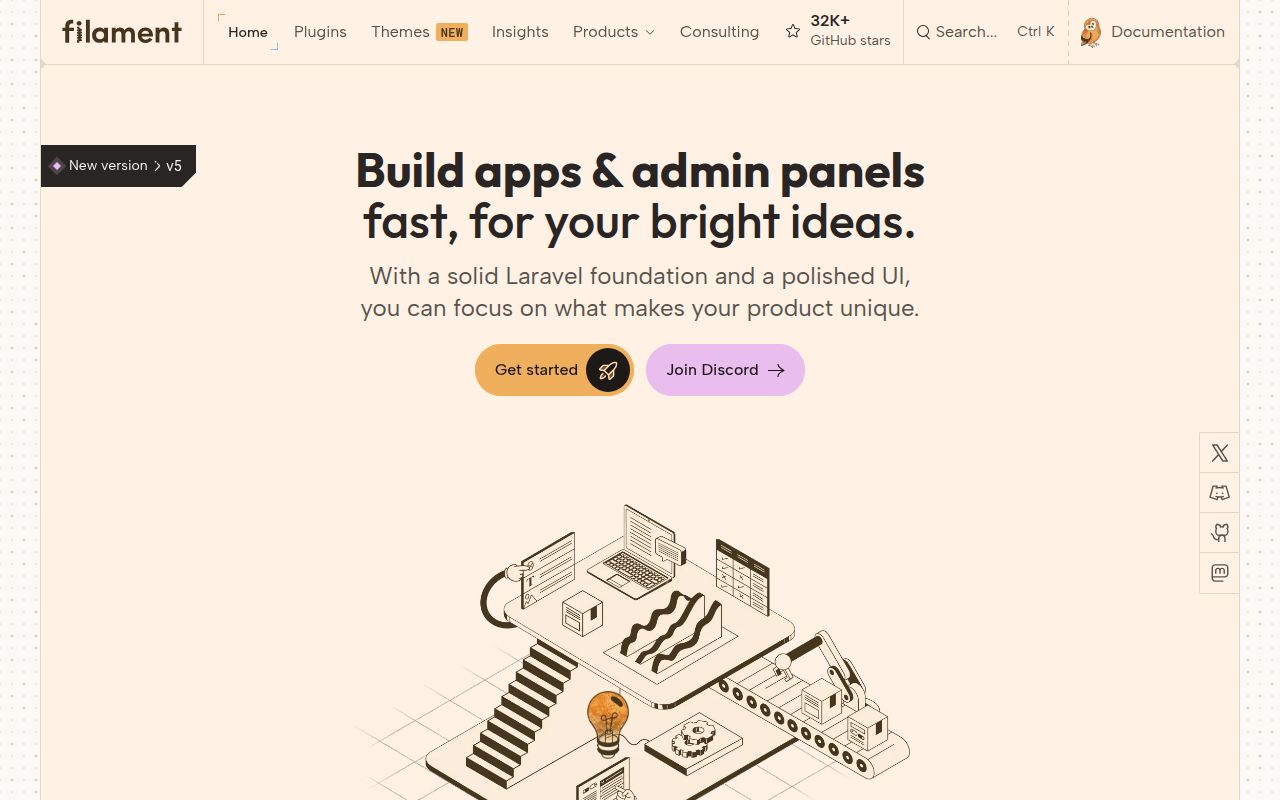
Filament v5 is a server-driven UI framework for Laravel, with panel pages and individual components defined through PHP configuration objects. The package set covers tables, schemas, forms, infolists, actions, notifications, widgets, and shared support code. A team can install the complete panel builder for an admin area or take only selected components into Blade views. That split makes Filament useful for a greenfield back office and for an existing Laravel application that only needs a better table or form.
The trade is architectural. Livewire owns the interactive component lifecycle, Alpine.js handles browser behavior, and Tailwind CSS supplies the styling system. Most routine screens need little custom JavaScript, which is appealing when the same PHP team owns models and UI. Deeply custom client behavior still means understanding Livewire. Filament's own comparison sends teams that want Vue and Inertia customization toward Laravel Nova, while teams seeking a ready CMS are pointed to Statamic.
What happened when we ran it
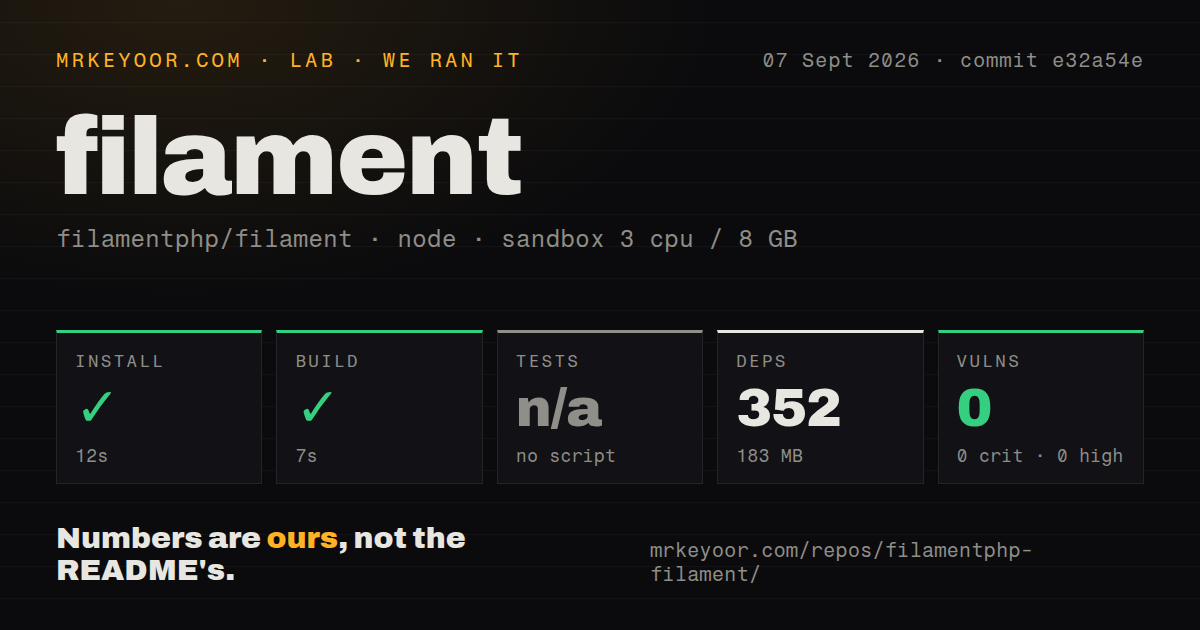
Our sandbox installed the Node workspace in 12 seconds, adding 352 packages and using 183 MB on disk. The frontend build succeeded in 7 seconds. The package had no npm test script or target, so that test step was skipped. npm audit reported 0 known vulnerabilities across the installed tree. These are useful facts about the repository's asset toolchain, not proof that a Laravel application built with Filament behaves correctly.
commit e32a54e was a 136.8 MB checkout with 8,166 files and roughly 538,581 lines of source. We found 10 CI workflow files and a tests directory, but no Dockerfile. The repository's root Composer configuration does define Pest, SQLite, MySQL, PostgreSQL, PHPStan, and serial test commands. Our supplied lab run used Node 22 and did not execute those PHP targets, so no PHP test result belongs in this review.
PHP 8.2 and Laravel 11.28 are the entry floor
Filament v5 requires PHP 8.2+, Laravel 11.28+, Livewire 4.0+, and Tailwind CSS 4.0+. Installing the panel builder takes a Composer requirement and an Artisan installer, which creates an AdminPanelProvider. A separate command creates a Filament user. The short path assumes a working Laravel application already has database configuration, sessions, application secrets, web serving, and deployment arranged. Filament adds the interface framework; it does not replace the Laravel operating environment.
Individual components involve more assembly. Existing apps may need the Tailwind Vite plugin, package-specific CSS imports, compiled assets, and @filamentStyles plus @filamentScripts in a Blade layout. The v5 installer offers scaffold mode for a new project, but its documentation says that mode overwrites modified application files. On an established codebase, use the manual route and review every layout and build change rather than treating scaffolding as an upgrade command.
Livewire 4 makes application tests part of adoption
Every Filament v5 panel page, relation manager, and widget sits on Livewire, so the testing guide uses Livewire helpers through Pest or PHPUnit. Resource classes, schema components, and actions are not Livewire components themselves, although they participate in those screens. The practical testing unit is usually the mounted page or widget a user touches. Teams without Livewire test experience should expect a learning step even when the generated resource code looks declarative.
The lab's missing npm test target should not be misread as an empty upstream test story. The repository contains PHP test commands, and the documentation has separate guides for resources, tables, schemas, actions, and notifications. Still, we did not run those commands in the measured Node container. A buyer should judge the framework through application-level tests for roles, filters, form state, uploads, and custom actions, because package tests cannot know the rules of one business.
Standard CRUD authorization does not cover custom actions
Filament automatically consults Laravel Model Policies for standard resource operations such as viewing, creating, updating, and deleting records. The v5 security guide draws a clear boundary around that help: custom actions, pages, Livewire components, API endpoints, and other business logic need application authorization. Inline editable columns only check whether the column is disabled before saving. Hiding a control is not a substitute for authorizing the server-side operation.
Multi-tenancy deserves the same caution. Filament can scope tenant-aware resource queries, yet custom queries and pages still need manual scoping. Its docs warn that a partial setup can expose one tenant's records to another. Production panel access also requires the User model to implement FilamentUser; without it, no user can sign in when the environment is not local. MFA is available, but it is disabled by default and does not cover authentication paths outside Filament.
Version 5.8.1 shipped while 16 issues and pull requests remained open
GitHub recorded release v5.8.1 and the latest push on September 8, 2026. The repository had 32,007 stars and 16 combined open issues and pull requests. That release fixed a missing CSS utility, guarded enum casts, and adjusted a FileUpload callback. An issue filed the same day reports that 2 TableSelect pickers can share session state and produce an HTTP 500 when their persisted query-builder filters conflict. It is specific, reproducible evidence, not a reason to dismiss the whole framework.
Filament is the sensible first trial for a Laravel team that wants a serious panel without maintaining a separate frontend application. The 7-second asset build makes repository work approachable, and the documentation is unusually candid about security ownership. Choose it with eyes open: Livewire shapes customization, v5 raises the dependency floor, and custom authorization must be designed and tested rather than assumed.