Four asset types give agent memory an owner and an audience
TencentDB Agent Memory stores more than conversation snippets. It turns chats into layered memories, finished work into reusable skills, documents into linked wiki pages, and repositories into code graphs. The Hub tracks ownership, versions, visibility, and agent bindings for these assets. That structure addresses a real team problem: useful context often exists, but the next agent cannot find it or should not see all of it.
Visibility has explicit modes for private, team, restricted, and agent-bound material. The README says private assets remain visible only to their owner, while restricted assets can use user, role, or agent rules. This is a stronger starting point than copying a shared prompt into every client. It still requires humans to review extracted facts and skills before trusting or sharing them.
Three services and two model configurations sit behind the quick start
The installation guide starts Memory Core, Memory Hub, and a proxy through the global-images deployment. Before launch, the operator copies an environment file and fills 2 sets of LLM settings: one for memory work and another for proxied agent traffic. The panel then runs on port 8125, and each supported agent receives a base URL and user key.
This arrangement avoids writing a plugin for every client, but it puts the proxy in the model request path. Outages, wrong public URLs, or identity mismatches can remove memory and may block the agent itself. Open issue 1144 documented host-side Codex failures caused by container-only addresses, a missing Codex session prefix, and incomplete knowledge injection. The report includes a later verification of its proposed fixes, yet the networking lesson remains relevant.
What happened when we ran it
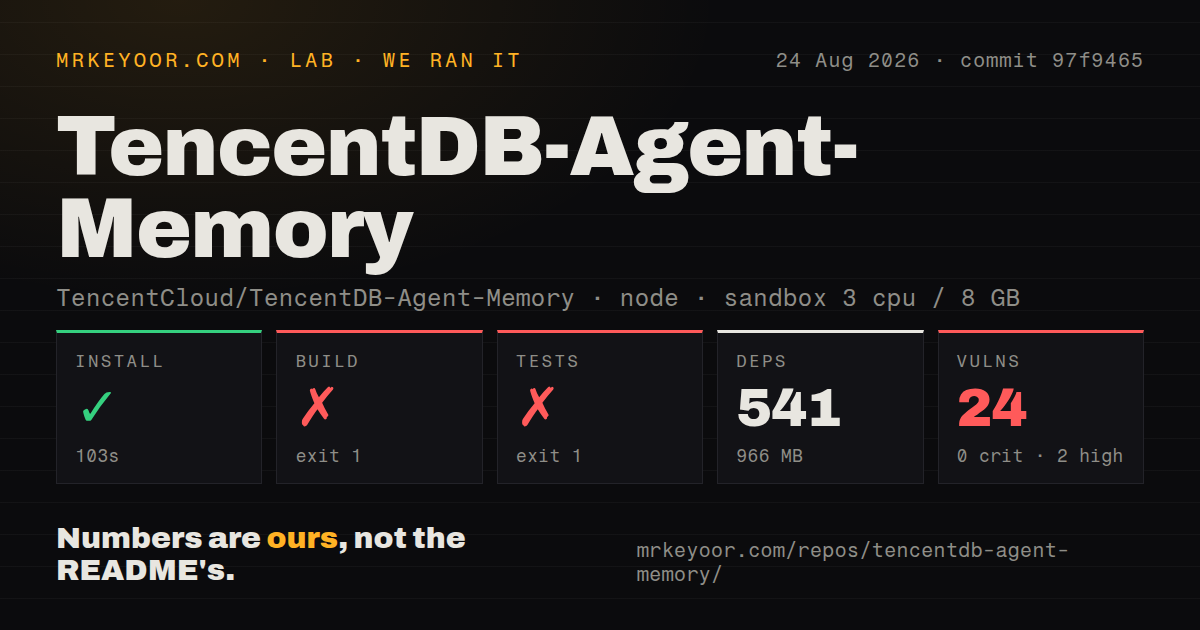
Our sandbox cloned commit 97f9465 and entered MemoryCore/. Npm installed 541 packages in 103 seconds and occupied 966 MB. The repository checkout itself held 930 files, roughly 197,413 source lines, and 42.9 MB. Npm audit reported 24 known vulnerabilities, divided into 2 high and 22 moderate findings.
The build exited 1 after 9 seconds. Several earlier TypeScript stages completed, then build:seed-v2 called the compiler with scripts/seed-v2/tsconfig.json. The final error was TS5058 because that path did not exist. The log identifies a missing project file; it does not show whether the intended fix is restoring the file or removing the stale build step.
Tests exited 1 after 5 seconds. Vitest searched src/**/*.test.ts and __tests__/**/*.test.ts, excluded distribution, dependency, and end-to-end paths, then reported that it found no test files. That means 0 tests ran. It is a configuration or repository-content failure, not a failed assertion, and it leaves our run without automated behavior evidence.
Agent support is broad, while several edges are still moving
The English README lists Claude Code, Codex, DeepSeek Harness, CodeBuddy, WorkBuddy, Hermes, OpenClaw, and a generic adapter path. Release v2.0.1, published August 25, 2026, added more client support and improved onboarding, session binding, skill editing, conversation search, and deployment checks. The release notes themselves are primarily Chinese, while the main README and linked installation material have English versions.
The project says no MCP server or client hook is required because agents use the proxy protocol. That simplicity depends on the proxy correctly identifying sessions and injecting reachable tools. Test each supported client separately, including reset, agent switching, task switching, and a service restart. A successful chat response does not prove that the right memory or wiki was attached.
The npm install side effect needs an explicit policy
Open issue 1095 says installing the published memory package can locate an existing OpenClaw and patch its built distribution files during postinstall. The report notes that current main added logging and a skip variable, while the behavior remained opt-out. An operator installing the package for Hermes could therefore modify a separate OpenClaw installation on the same machine.
That is too surprising for shared production hosts. Inspect the package scripts, use a disposable build environment, and decide whether install scripts are allowed before running npm. If OpenClaw support needs the patch, apply it as a documented deployment step and verify it again after OpenClaw upgrades. Lockfiles will not describe an in-place change to another installed product.
Twenty-four thousand stars arrived before source checks became dependable
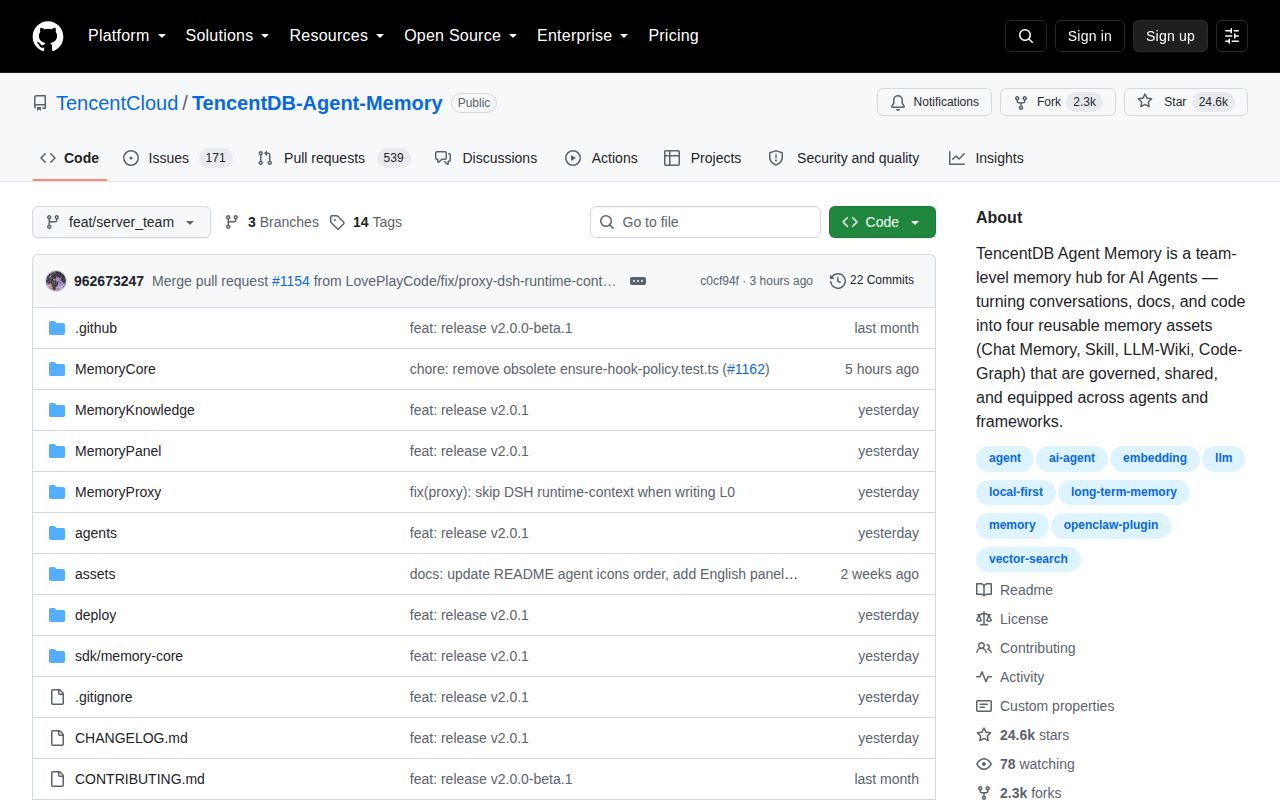
GitHub recorded 24,583 stars, 710 combined issues and pull requests, and a last push on August 26, 2026. The v2.0.1 release landed one day earlier. This is unusually fast interest and development for an agent-memory service. It also means configuration and client behavior can change quickly enough that release notes and migration tools are part of normal operation.
The idea is stronger than the current source verification. Shared assets, human-controlled access, and client portability solve problems that simple vector recall does not. The 9-second build failure, empty 5-second test run, 24 audit findings, and open integration reports justify a contained pilot with synthetic data. Keep the proxy away from critical agent work until restarts, permissions, deletion, upgrades, and wrong-memory cases pass your own checks.